

Home health care in 2026 will be defined by rising demand for home-based services, persistent workforce shortages, expanding higher-acuity care, and increasing regulatory complexity. Agencies that embrace value-based care, invest in their workforce, and leverage integrated, intelligent technology platforms will be best positioned to grow, stay compliant, and deliver better patient outcomes.
Overview
The home care and home health care industry will continue its rapid evolution in 2026, driven by demographic shifts, workforce constraints, expanding care models, regulatory complexity, and increasing pressure to reduce the total cost of care. As the aging population grows and healthcare delivery continues moving closer to the home, demand for home-based services will remain strong.
Despite the growing demand, Home Care and Home Health Care agencies will continue to face significant headwinds in 2026. Workforce shortages, rising labor costs, reimbursement pressures, and expanding compliance requirements will challenge agencies to deliver more care with fewer resources. Agencies that adapt by expanding services, improving care coordination, and leveraging technology will be better positioned to grow and remain profitable. According to the U.S. Bureau of Labor Statistics, employment growth in home and community-based care continues to outpace institutional care.
Home-based care will play an even more critical role across the post-acute and chronic care continuum in 2026. New care delivery models, value-based reimbursement arrangements, and payer expectations will require home care agencies to operate more efficiently while delivering higher-quality, personalized care.
In this blog, we explore the key trends shaping the Home Care industry in 2026 and what agencies can do to prepare for the year ahead.
Trend #1 Continued Growth of Home-Based Care
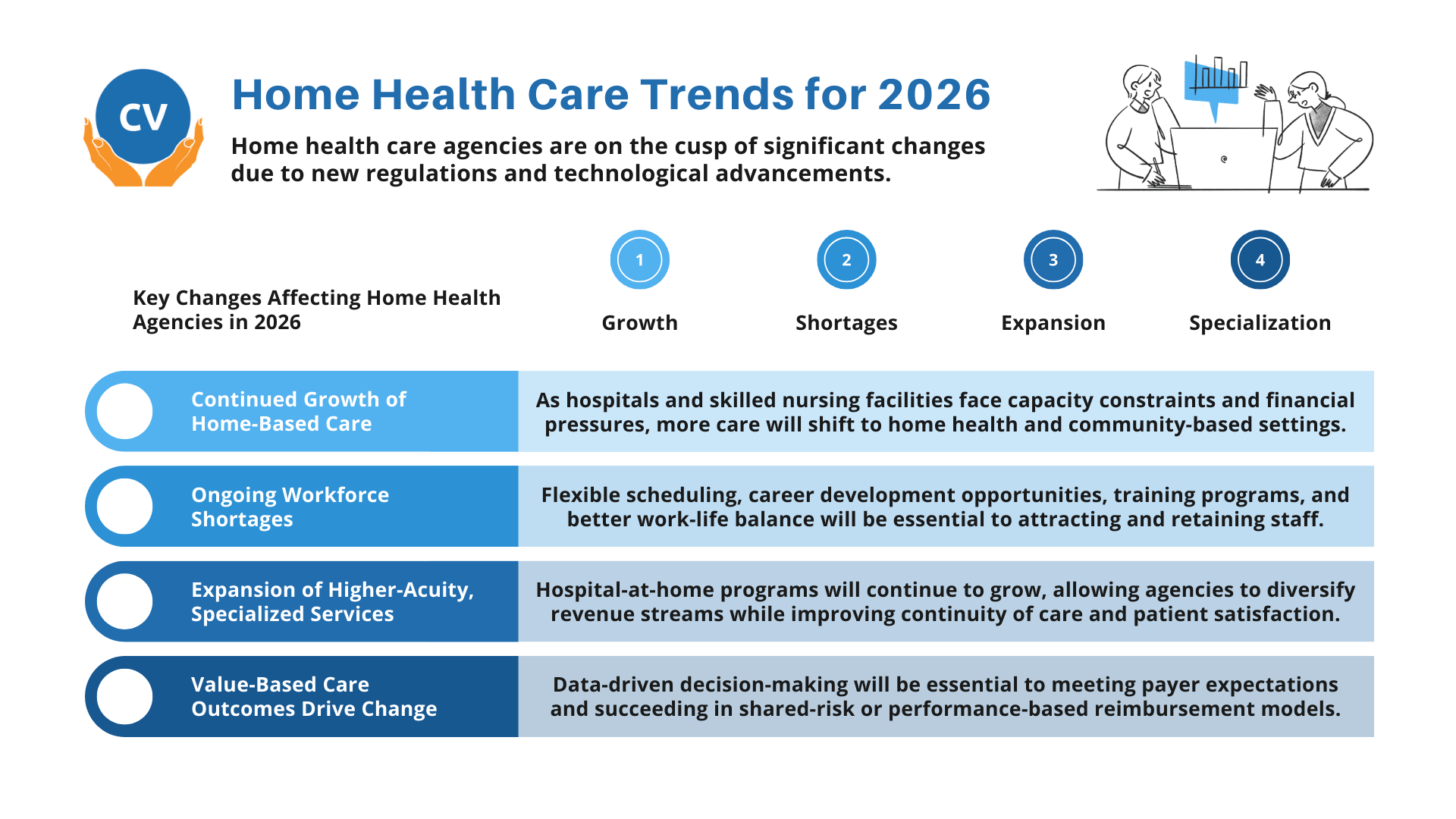
Demand for home-based care will continue to accelerate in 2026 as the baby boomer population ages and consumer preferences increasingly favor care delivered at home. Aging in place remains a top priority for older adults, families, and payers due to improved outcomes, higher satisfaction, and lower overall costs compared to institutional care.
Chronic disease management, mobility support, personal care, and skilled nursing services delivered in the home will see sustained growth. As hospitals and skilled nursing facilities face capacity constraints and financial pressures, more care will shift to home health and community-based settings. CMS reports show continued expansion of home health services as part of broader efforts to reduce institutional care utilization.
This continued growth will place additional strain on home care providers, requiring agencies to scale operations efficiently, invest in staff, and adopt technology that supports long-term growth.
Trend #2 Workforce Shortages Will Remain a Structural Challenge
Workforce shortages will continue to be one of the most significant challenges facing home care agencies in 2026. Demand for caregivers, aides, nurses, and therapists will continue to outpace supply, creating competition for talent and upward pressure on wages. The Bureau of Labor Statistics projects sustained demand for home health aides, nurses, and personal care workers over the next decade.
Recruitment and retention will require agencies to rethink traditional workforce models. Flexible scheduling, career development opportunities, training programs, and better work-life balance will be essential to attracting and retaining staff.

Technology will play an important role in helping agencies address workforce challenges. Intelligent scheduling, automation of administrative tasks, mobile documentation, and streamlined workflows can help reduce burnout, improve productivity, and allow caregivers to spend more time delivering care.
While technology can never replace human empathy, it can support caregivers by removing inefficiencies and administrative burden.
Trend #3 Expansion of Higher-Acuity and Specialized Services
Home Health Care will continue to expand its role in delivering higher-acuity and specialized services in 2026. As healthcare systems seek to reduce inpatient stays and post-acute facility utilization, home care agencies will increasingly deliver services once reserved for hospitals or skilled nursing facilities.
Services such as therapy at home, home-based mental health, chronic condition management, wound care, respiratory care, and hospital-at-home programs will continue to grow. These expanded offerings allow agencies to diversify revenue streams while improving continuity of care and patient satisfaction. The American Hospital Association highlights hospital-at-home and post-acute care partnerships as key strategies for reducing inpatient utilization.

Expanding services also positions home care agencies as essential partners for hospitals, health systems, and managed care organizations seeking reliable post-acute and longitudinal care solutions.
Trend #4 Value-Based Care and Outcomes Will Drive Change
The shift toward value-based care will continue to accelerate in 2026. Managed Care Organizations (MCOs), Medicare Advantage plans, and health systems will increasingly hold home care agencies accountable for outcomes, cost efficiency, and care coordination. Industry analysts note that value-based care models are becoming a priority for home health agencies working with Medicare Advantage and managed care organizations.
Agencies will need greater visibility into clinical outcomes, utilization patterns, and performance metrics. Data-driven decision-making will be essential to meeting payer expectations and succeeding in shared-risk or performance-based reimbursement models.

Care coordination across providers, settings, and disciplines will be critical. Agencies that can demonstrate strong outcomes, reduced hospital readmissions, and effective care transitions will have a competitive advantage.
Trend #5 Regulatory and Reimbursement Pressures Will Persist
Regulatory and reimbursement challenges will continue to shape the home care landscape in 2026. Changes in Medicare, Medicaid, and managed care reimbursement, along with evolving state and federal regulations, will place ongoing pressure on margins.
Electronic Visit Verification (EVV), labor compliance requirements, documentation standards, and audit readiness will continue to add operational complexity. Agencies will be required to maintain compliance while operating with limited staff and constrained resources.
To succeed, home care agencies will need systems and processes that simplify compliance, reduce manual work, and provide real-time visibility into regulatory requirements.
Trend #6 AI and Intelligent Automation Will Move from Adoption to Optimization
Artificial Intelligence and Intelligent Automation will play a more practical and operational role in home care in 2026. While AI adoption will continue cautiously due to patient safety considerations, its use in administrative, operational, and decision-support functions will expand.
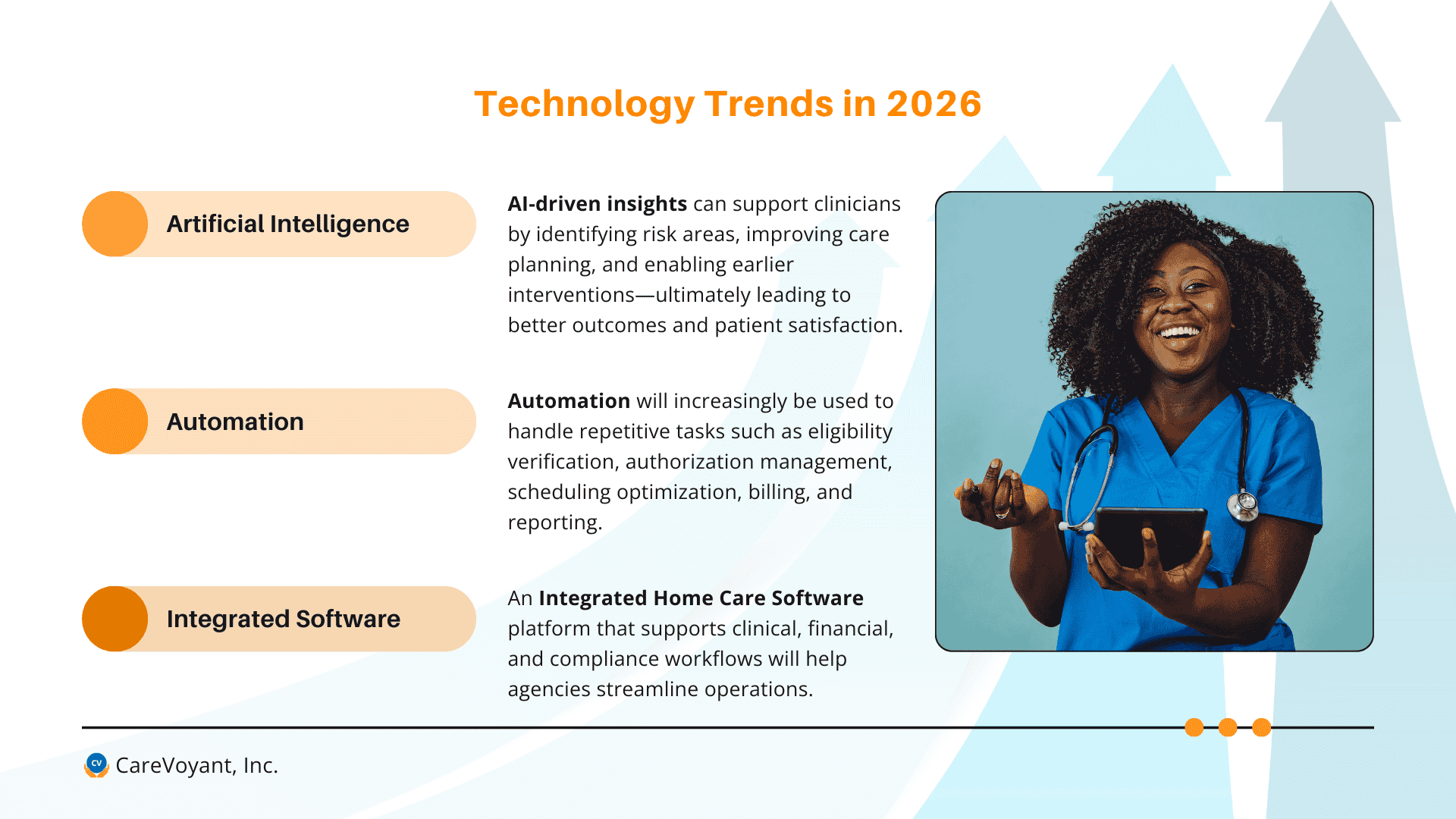
Health system research from the American Hospital Association shows AI increasingly supporting administrative efficiency and clinical decision-making. Automation will increasingly be used to handle repetitive tasks such as eligibility verification, authorization management, scheduling optimization, billing, and reporting. These capabilities will help agencies reduce administrative burden, improve accuracy, and operate more efficiently.
AI-driven insights can support clinicians by identifying risk areas, improving care planning, and enabling earlier interventions—ultimately leading to better outcomes and patient satisfaction.
Trend #7 Integrated Technology Platforms Will Become Essential
As home care agencies expand services and face increasing complexity, integrated technology platforms will become essential in 2026. Disconnected systems and manual processes will limit scalability and efficiency.
An integrated Home Care Software platform that supports clinical, operational, financial, and compliance workflows will help agencies eliminate redundant data entry, improve visibility, and streamline operations.
Technology platforms that proactively surface exceptions, enable real-time communication, and support care coordination across teams will be critical to managing growth while maintaining quality and compliance.
Conclusion
The Home Care industry in 2026 will continue to be shaped by strong demand, workforce constraints, expanding care models, regulatory pressure, and rapid technological advancement. While challenges remain significant, the opportunities for growth and innovation are equally substantial.
Home care agencies that invest in their employees, diversify services, embrace value-based care, and leverage integrated technology platforms will be well positioned to succeed. The future of home care remains bright, with home-based services playing an increasingly central role in delivering high-quality, patient-centered care.
By preparing for these trends today, home care agencies can continue to grow, adapt, and thrive in 2026 and beyond.
Frequently Asked Questions
-
The biggest home health care trends in 2026 include continued growth in home-based care, persistent workforce shortages, expansion of higher-acuity services, increased adoption of value-based care models, tighter regulatory requirements, and greater reliance on integrated technology platforms and AI-driven automation.
-
Demand for home-based care is increasing due to an aging population, patient preference for aging in place, hospital capacity constraints, and payer initiatives focused on reducing overall healthcare costs while improving outcomes through care delivered in the home.
-
Workforce shortages will continue to challenge home health care agencies in 2026 by increasing labor costs, limiting service capacity, and driving competition for caregivers, nurses, and therapists. Agencies will need to invest in retention strategies, flexible scheduling, and technology to improve caregiver productivity.
-
Value-based care will play a central role in home health care in 2026 as Medicare Advantage plans, managed care organizations, and health systems increasingly tie reimbursement to quality outcomes, care coordination, and cost efficiency rather than volume of services delivered.
-
Technology is transforming home health care operations by automating scheduling, documentation, billing, and authorization management, improving care coordination, and providing real-time insights into clinical outcomes and operational performance through integrated home care software platforms.
-
Higher-acuity services delivered in home health care in 2026 include therapy at home, chronic disease management, wound care, respiratory care, behavioral health services, and hospital-at-home programs that reduce inpatient stays and improve continuity of care.
-
Regulatory and reimbursement changes will continue to affect home health agencies in 2026 through evolving Medicare and Medicaid payment models, expanded Electronic Visit Verification (EVV) requirements, increased audit activity, and stricter documentation and compliance standards.
-
In 2026, AI and automation will primarily support administrative efficiency and clinical decision-making by optimizing scheduling, managing authorizations, identifying care risks, reducing documentation burden, and improving accuracy across operational workflows.
-
Integrated home care software platforms are essential in 2026 because they unify clinical, operational, financial, and compliance workflows, eliminate redundant data entry, improve visibility across teams, and enable agencies to scale efficiently while maintaining quality and regulatory compliance.
-
Home health care agencies can prepare for 2026 by investing in workforce retention, expanding service offerings, embracing value-based care models, strengthening care coordination, and adopting integrated technology solutions that support efficiency, compliance, and data-driven decision-making.
About CareVoyant
CareVoyant is a leading provider of cloud-based integrated enterprise-scale home health care software that can support all home-based services under ONE Software, ONE Patient, and ONE Employee, making it a Single System of Record. We support all home based services, including Home Care, Private Duty Nursing, Private Duty Non-Medical, Home and Community Based Services (HCBS), Home Health, Pediatric Home Care, and Outpatient Therapy at Home.
CareVoyant functions – Intake, Authorization Management, Scheduling, Clinical with Mobile options, eMAR/eTAR, Electronic Visit Verification (EVV), Billing/AR, Secure Messaging, Notification, Reporting, and Dashboards – streamline workflow, meet regulatory requirements, improve quality of care, optimize reimbursement, improve operational efficiency and agency bottom line.
For more information, please visit CareVoyant.com or call us at 1-888-463-6797.
Request for Information
To learn more about CareVoyant Software and how we improve the operational efficiency of Home Healthcare Agencies, contact us:
