

Explore the importance of Medicaid Awareness Month, challenges with Medicaid billing in home care, and how CareVoyant helps streamline the process—improving efficiency, compliance, and cash flow.
Overview
April is Medicaid Awareness Month—a time dedicated to highlighting the vital role Medicaid plays in providing access to healthcare for millions of Americans. For home care agencies, Medicaid is not just a funding source; it is a lifeline that enables them to deliver essential services to vulnerable populations, including seniors, individuals with disabilities, and those with chronic conditions.

However, while Medicaid expands access to care, it also introduces significant administrative complexity—especially when it comes to billing. From ever-changing regulations to state-specific requirements and claim denials, Medicaid billing can be a major operational burden for agencies.
That’s where CareVoyant’s comprehensive billing solutions come in.
Why Medicaid Awareness Month Matters for Home Care
Medicaid is one of the largest payers for home-based care services in the United States. As the demand for aging-in-place continues to rise, Medicaid-funded programs such as Home and Community-Based Services (HCBS) are becoming increasingly critical.
For home care agencies, Medicaid Awareness Month is an opportunity to:
· Educate staff and stakeholders about Medicaid policies
· Evaluate billing processes and compliance practices
· Identify opportunities to improve reimbursement cycles
· Advocate for better systems and tools to support operations
Despite its importance, Medicaid remains one of the most complex payers to manage —especially compared to private pay or Medicare.
Challenges in Medicaid Billing for Home Care
Medicaid billing is not a one-size-fits-all process. Each state has its own rules, fee schedules, EVV (Electronic Visit Verification) requirements, and documentation standards. This creates a fragmented and often confusing billing environment.
Here are some of the most common challenges agencies face:
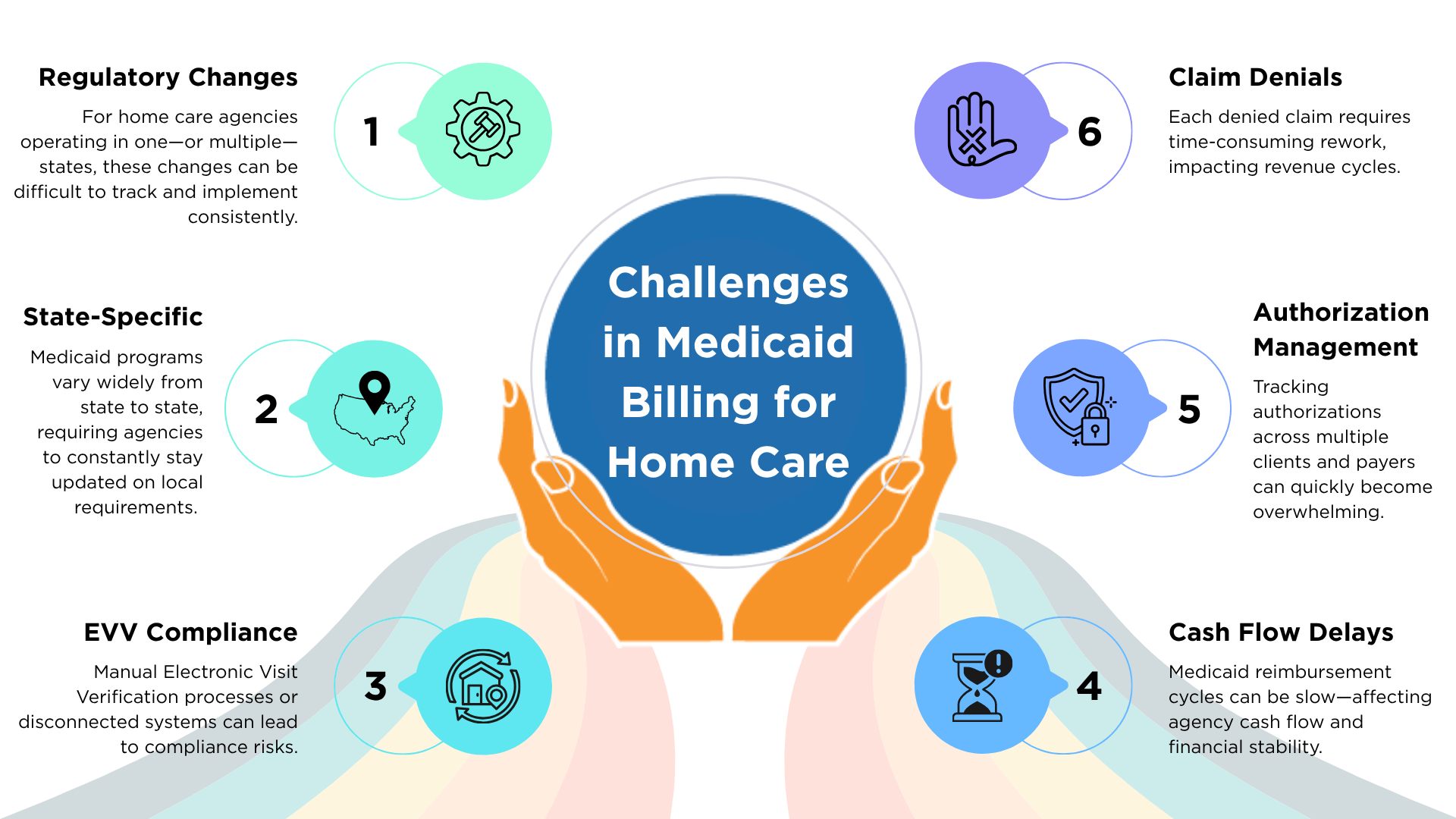
Navigating the six primary hurdles of Medicaid billing in the home care industry.
1. Medicaid Regulations Are Constantly Changing

Medicaid is jointly funded by federal and state governments, which means each state administers its own program within federal guidelines. As a result, regulations are frequently updated to reflect:
Policy changes at the federal level
New compliance mandates (like EVV requirements)
Updates to billing codes, modifiers, and reimbursement rates
For home care agencies operating in one—or multiple—states, these changes can be difficult to track and implement consistently.
2. State-Specific Regulations

Medicaid programs vary widely from state to state, requiring agencies to constantly stay updated on local requirements. This includes:
Service authorization rules
Billing codes and modifiers
Visit limits and eligibility criteria
Failure to comply with these requirements can lead to denied claims or delayed payments.
3. Electronic Visit Verification (EVV) Compliance
EVV is now mandatory for many Medicaid-funded personal care and home health services. Agencies must ensure:
Accurate time tracking
Real-time visit verification
Integration with state EVV systems
Manual processes or disconnected systems can lead to compliance risks.
4. Claim Denials and Rejections

Medicaid claims are often denied due to:
Missing or incorrect documentation
Authorization mismatches
Billing errors
Each denied claim requires time-consuming rework, impacting revenue cycles.
5. Complex Authorization Management
Tracking authorizations across multiple clients and payers can quickly become overwhelming. Agencies must ensure that:
Services provided match authorized units
Expired authorizations are updated promptly
Billing aligns with approved care plans
6. Cash Flow Delays

Because of these complexities, Medicaid reimbursement cycles can be slow—affecting agency cash flow and financial stability.
How CareVoyant Keeps Agencies Up to Date with Medicaid Changes
CareVoyant is built specifically for home-based care providers, with features designed to help agencies adapt to regulatory changes quickly and efficiently.
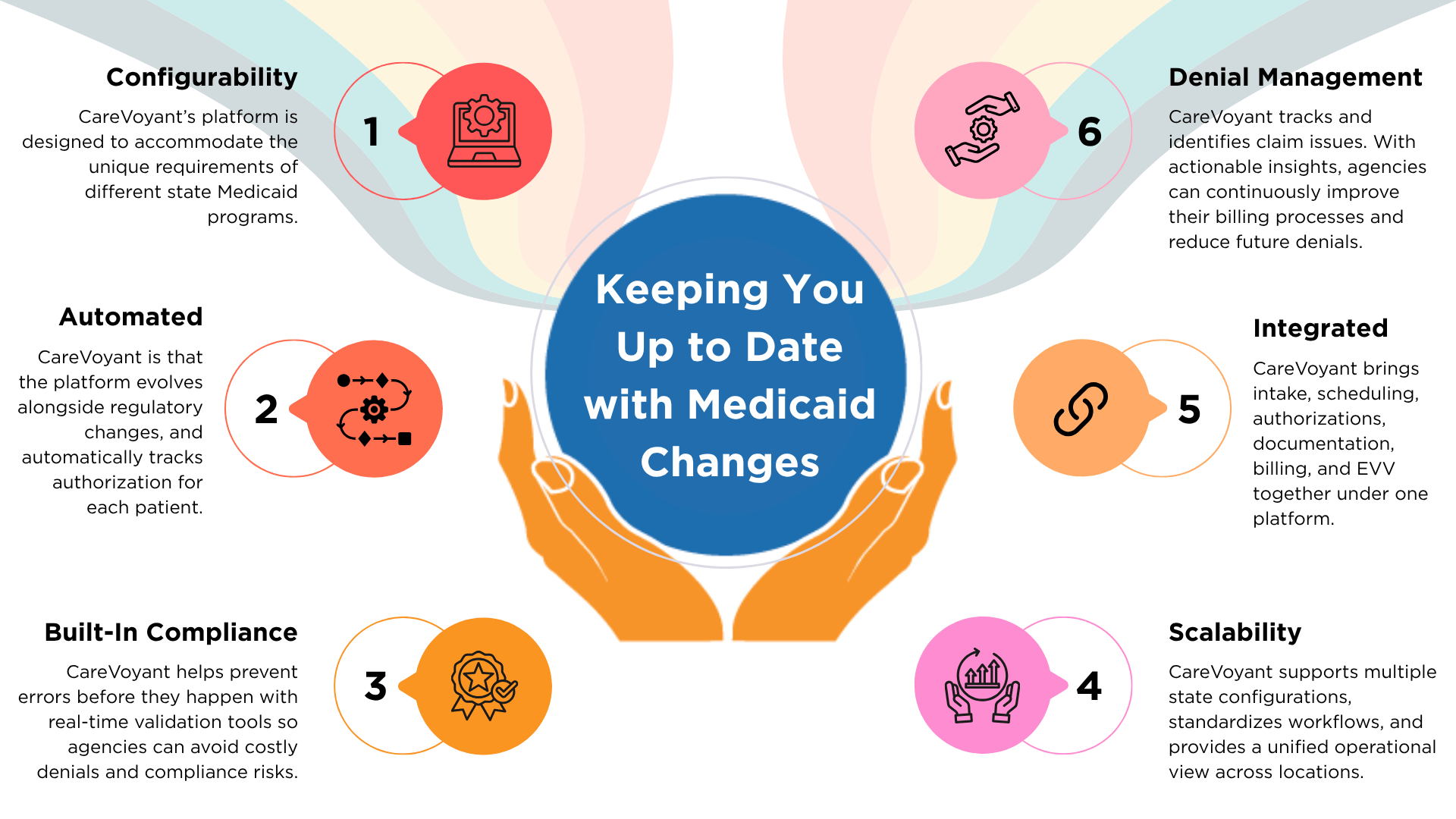
CareVoyant’s comprehensive approach to maintaining Medicaid compliance and operational efficiency.
Here’s how CareVoyant helps agencies stay compliant and ahead of the curve:
1. State-Specific Configuration and Flexibility
CareVoyant’s platform is designed to accommodate the unique requirements of different state Medicaid programs.

Key capabilities include:
Customizable billing rules based on state regulations
Support for state-specific codes, modifiers, and fee schedules
Flexibility to adapt workflows as requirements change
This ensures that agencies can maintain compliance without overhauling their entire system every time regulations are updated.
2. Automatic Updates to Billing Rules and Requirements
One of the biggest advantages of using CareVoyant is that the platform evolves alongside regulatory changes.

CareVoyant continuously updates its system to reflect:
Updates to EVV mandates
Modifications to payer rules and guidelines
This reduces the burden on agencies to manually track and implement every change.
3. Built-In Compliance Checks
CareVoyant helps prevent errors before they happen with real-time validation tools.

These include:
Alerts for missing or incorrect documentation
Validation of billing codes and authorizations
Pre-submission checks to ensure claim accuracy
By catching issues early, agencies can avoid costly denials and compliance risks.
4. Integrated Electronic Visit Verification (EVV)
As EVV requirements continue to evolve, CareVoyant’s Integrated Electronic Visit Verification (EVV) ensures agencies remain compliant with built-in functionality.

CareVoyant’s EVV features allow agencies to:
Capture real-time visit data with mobile devices
Track caregiver clock-in and clock-out times
Ensure visits meet Medicaid verification standards
Because EVV is fully integrated with scheduling and billing, any regulatory updates are reflected across the system automatically. For agencies looking for guidance on their local mandates, we provide a comprehensive directory of state-specific EVV information to help you stay compliant.
5. Authorization Management Made Easy
CareVoyant simplifies authorization tracking by:

Linking authorizations directly to care plans and schedules
Automatically tracking utilized vs. remaining units
Alerting users when authorizations are nearing expiration
This reduces the risk of overbilling or underbilling and keeps agencies aligned with payer requirements.
6. Denial Management and Reporting
When issues do arise, CareVoyant provides the actionable tools needed to resolve issues quickly and reduce unbilled claims and improve cash flow.

Detailed claim status tracking
Denial reason analysis
Customizable reports for performance monitoring
With actionable insights, agencies can continuously improve their billing processes, reduce future denials and make informed decisions.
7. Scalable for Multi-State Agencies
For agencies operating in multiple states, managing different Medicaid programs can be especially challenging. CareVoyant simplifies this by providing a configurable home care software for enterprise agencies that adapts to local needs without losing central control.

CareVoyant supports your growth strategy by:
Supporting multiple state configurations within one platform
Standardizing workflows while allowing for local customization
This makes it easier to scale without sacrificing compliance.
The Value of an Integrated Platform
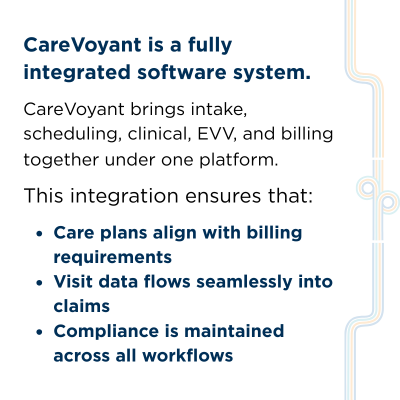
CareVoyant’s biggest advantage is its fully integrated system. Unlike fragmented solutions that require multiple platforms for scheduling, documentation, and billing, CareVoyant brings everything together in one place.
This integration ensures that:
Care plans align with billing requirements
Visit data flows seamlessly into claims
The result is a more efficient, scalable operation that can handle the complexities of Medicaid with confidence.
FAQs: Medicaid Billing for Home Care Agencies
-
Medicaid billing involves state-specific regulations, strict documentation requirements, EVV compliance, and frequent policy changes, making it more complex than other payer types.
-
Medicaid regulations can change frequently at both the federal and state levels, making it essential for agencies to stay informed and adaptable.
-
The biggest risks include claim denials, compliance violations, delayed payments, and potential financial losses.
-
CareVoyant offers built-in validation checks, automated updates, EVV integration, and reporting tools to help agencies maintain compliance.
-
CareVoyant uses automated validation checks, real-time alerts, and integrated workflows to ensure claims are accurate and compliant before submission.
-
Electronic Visit Verification (EVV) is a system that tracks caregiver visits in real time. It is required for many Medicaid services to ensure accountability and prevent fraud.
-
Yes, CareVoyant includes integrated EVV functionality to help agencies meet Medicaid requirements.
-
Yes, CareVoyant supports state-specific configurations, making it easier for agencies operating in multiple states to manage varying requirements.
-
Yes, CareVoyant is designed to handle state-specific requirements, making it ideal for multi-state operations.
-
By reducing errors, accelerating claim submission, and minimizing denials, CareVoyant helps agencies get paid faster and maintain healthier revenue cycles.
About CareVoyant
CareVoyant is a leading provider of cloud-based integrated enterprise-scale home health care software that can support all home-based services under ONE Software, ONE Patient, and ONE Employee, making it a Single System of Record. We support all home based services, including Home Care, Private Duty Nursing, Private Duty Non-Medical, Home and Community Based Services (HCBS), Home Health, Pediatric Home Care, and Outpatient Therapy at Home.
CareVoyant functions – Intake, Authorization Management, Scheduling, Clinical with Mobile options, eMAR/eTAR, Electronic Visit Verification (EVV), Billing/AR, Secure Messaging, Notification, Reporting, and Dashboards – streamline workflow, meet regulatory requirements, improve quality of care, optimize reimbursement, improve operational efficiency and agency bottom line.
For more information, please visit CareVoyant.com or call us at 1-888-463-6797.
Request for Information
To learn more about CareVoyant Software and how we improve the operational efficiency of Home Healthcare Agencies, contact us:
