

Private Duty Nursing scheduling requires shift-based software—not visit-based tools. CareVoyant simplifies split shifts, automates blended overtime calculations, and applies complex rate differentials to ensure compliance, accuracy, and operational efficiency.
Introduction: The "Square Peg in a Round Hole" Problem
If you manage a Private Duty Nursing (PDN) agency, you know that scheduling is never just about filling a slot. It is a high-stakes puzzle composed of 12-hour blocks, 24/7 coverage requirements, complex family dynamics, and strict labor laws.
Unlike intermittent home health visits, private duty nursing requires specialized software designed for continuous, hourly care rather than short, visit-based encounters (learn why PDN needs different technology). For many agencies, this puzzle becomes impossible to solve because they are using the wrong pieces.
Most standard home health software is built for intermittent visits - short, distinct 45-minute sessions for Physical Therapy or Skilled Nursing visits. When you try to force continuous, hourly care into a visit-based platform, the logic breaks. This is one of the key differences between home health and private duty care that directly impacts scheduling accuracy and compliance (see why the distinction matters).
Schedulers end up relying on manual workarounds, sticky notes, and Excel spreadsheets to handle complex scenarios like split shifts and overtime compliance.
To grow a Private Duty agency, you need software that thinks in shifts, not just visits. Here is how specialized technology, CareVoyant Private Duty Nursing Software solves the three biggest pieces of the scheduling puzzle.
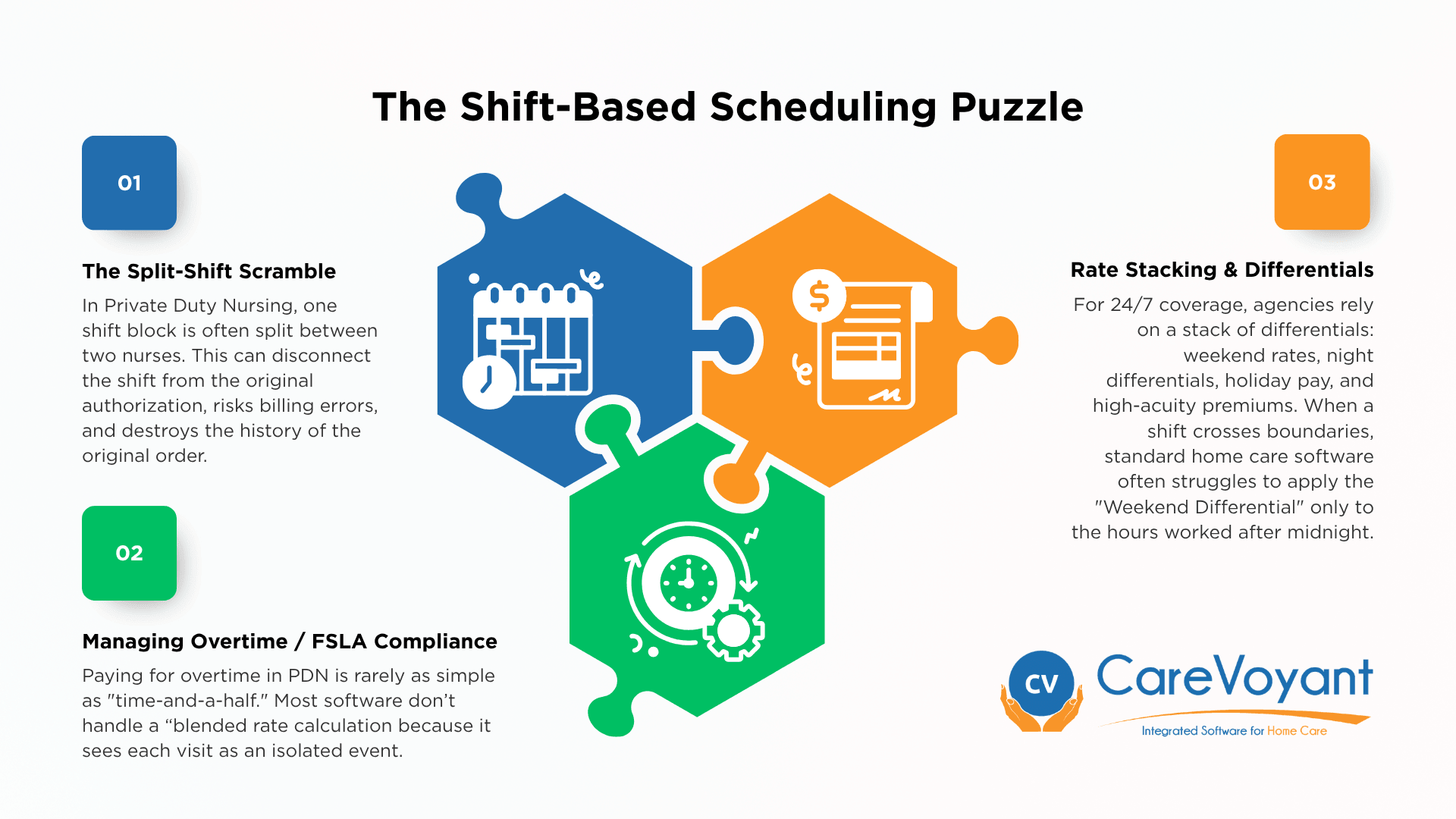
Puzzle Piece #1: The "Split Shift" Scramble
In traditional labor law, a "split shift" usually refers to one employee working morning and evening with a gap in between. But in the trenches of Private Duty scheduling, a "split shift" means something entirely different: Splitting one shift block between two nurses, a scenario that highlights ongoing scheduling efficiency challenges in private duty nursing.
The Scenario:
You have a medically fragile patient authorized for 24/7 care. The Tuesday day shift runs from 7:00 AM to 7:00 PM. Suddenly, Nurse A calls to say she has a family emergency and must leave at 1:00 PM. You scramble and find Nurse B to cover the remaining hours (1:00 PM to 7:00 PM).
The "Visit-Based" Software Struggle:
In standard software, that 7A–7P block is a rigid unit. To split it, a scheduler often has to:
Delete the original 12-hour shift.
Create a new 6-hour shift for Nurse A.
Create a second 6-hour shift for Nurse B.
This manual process is dangerous. It often disconnects the shift from the original authorization, risks billing errors, and destroys the history of the original order.

The CareVoyant Solution:
CareVoyant Private Duty Nursing Software is designed for the fluidity of hourly care. It allows schedulers to manage partial shift coverage without breaking the authorization. You can simply assign multiple caregivers to a single scheduled block. The software understands that while the authorization is for 12 hours, the fulfillment is shared. This ensures your clinical documentation, billing, and payroll flow seamlessly without manual data reentry, a major improvement over legacy systems that struggle with the unique challenges of private duty nursing operations.

Puzzle Piece #2: Managing Overtime and FLSA Compliance
As staffing shortages continue, overtime is inevitable. However, paying for overtime in Private Duty Nursing is rarely as simple as "time-and-a-half."
The Scenario:
Consider a nurse who works with two different patients in the same week:
Case A: 30 hours at $25/hr
Case B: 20 hours at $30/hr (High Acuity)
Total: 50 Hours
The Compliance Risk:
Under the Fair Labor Standards Act (FLSA), you cannot simply pay the overtime premium based on the lower rate or even the rate of the job where the overtime occurred. You are often required to calculate a Weighted Average Overtime (WAOT), or "blended rate," to determine the correct regular rate for the multiplier (understand overtime pay requirements).
The "Spreadsheet" Struggle:
Visit-based software rarely handles this calculation because it sees each visit as an isolated event. This forces payroll teams to export hours into spreadsheets every week to manually calculate the blended rate for every single nurse. One formula error can lead to underpayment lawsuits or costly overpayments.
The CareVoyant Solution:
CareVoyant Private Duty Nursing Software automates the math. Its integrated payroll engine is built to handle complex labor logic.
The system automatically looks at the total hours worked across all cases and pay rates.
It calculates the blended regular rate in the background.
It applies the correct overtime premium to the payroll batch.
By automating, CareVoyant removes the "math trap," ensuring FLSA compliance while saving your payroll staff hours of manual calculation every week.
Puzzle Piece #3: Rate Stacking and Differentials
PDN is not a flat-rate industry. To ensure 24/7 coverage, agencies rely on a stack of differentials: weekend rates, night differentials, holiday pay, and high-acuity premiums.
The Scenario:
The complexity arises when a shift crosses boundaries. If a nurse clocks in on Friday at 11:00 PM and works until Saturday at 11:00 AM, standard software often struggles to apply the "Weekend Differential" only to the hours worked after midnight.

The CareVoyant Solution:
CareVoyant Private Duty Nursing Software utilizes a flexible scheduling rules engine that supports complex Rate Stacking. You can configure rules that automatically trigger differentials based on:
Time of day (Shift Differentials)
Day of week (Weekend Diffs)
Patient Acuity levels
Specific Holidays
This ensures that your nurses are paid accurately for the difficult shifts they cover, improving retention without requiring manual payroll adjustments.
When paired with electronic visit verification (EVV), agencies gain precise time tracking across shift boundaries (explore EVV software). Tools like mobile EVV with GPS further improve accuracy and reduce payroll disputes (see how mobile EVV saves time and money).
CareVoyant’s rules engine supports real-time monitoring in private duty care, ensuring the correct differentials are applied automatically (why real-time matters). Its configurable architecture supports complex scheduling and payroll rules without manual adjustments.
Solve the Puzzle with CareVoyant Private Duty Nursing Software
If your schedulers are spending more time fixing errors and calculating hours than they are coordinating care, your software is the missing piece of the puzzle.
You shouldn't have to force your complex, shift-based operations into a simple, visit-based box. CareVoyant Private Duty Nursing Software offers an integrated platform that handles the unique challenges of continuous care from splitting shifts to automating blended overtime rates.
Frequently Asked Questions
-
Shift-based scheduling in private duty nursing (PDN) refers to managing continuous care in extended hourly blocks (e.g., 8–12 hours or 24/7 coverage), rather than short, visit-based appointments. It ensures accurate staffing, billing, and payroll for long-duration care cases.
-
Visit-based software is designed for short, intermittent care sessions and lacks the flexibility to manage continuous hourly shifts. This leads to manual workarounds, scheduling errors, and compliance risks when used for private duty nursing operations.
-
Advanced private duty nursing software allows multiple caregivers to be assigned to a single shift block without deleting or recreating schedules. This maintains authorization integrity, ensures accurate documentation, and prevents billing discrepancies.
-
In private duty nursing, a split shift typically means dividing a single scheduled shift between two or more caregivers due to availability changes, rather than the traditional labor definition of separated work periods within a day.Item description
-
Overtime in private duty nursing is often calculated using a weighted average or blended rate when caregivers work multiple cases with different pay rates. This ensures compliance with labor laws and accurate compensation.
-
A blended overtime rate is the average hourly rate calculated across all pay rates an employee earns in a workweek. This rate is then used to determine the correct overtime premium, as required by labor regulations.
-
FLSA compliance ensures that caregivers are paid correctly for overtime, including blended rate calculations. Non-compliance can lead to legal penalties, employee disputes, and financial liabilities for home care agencies.
-
Rate differentials are additional pay adjustments applied based on specific conditions such as night shifts, weekends, holidays, or high-acuity cases. These incentives help agencies maintain 24/7 coverage and improve caregiver retention.
-
Modern private duty nursing software uses configurable rules engines to automatically apply multiple pay differentials based on time, day, patient acuity, or holidays. This eliminates manual payroll adjustments and ensures accuracy.
-
Electronic Visit Verification (EVV) tracks caregiver clock-in and clock-out times in real time, ensuring accurate shift data. When integrated with scheduling and payroll systems, EVV reduces errors, prevents fraud, and supports compliance.
About CareVoyant
CareVoyant is a leading provider of cloud-based integrated enterprise-scale home health care software that can support all home-based services under ONE Software, ONE Patient, and ONE Employee, making it a Single System of Record. We support all home based services, including Home Care, Private Duty Nursing, Private Duty Non-Medical, Home and Community Based Services (HCBS), Home Health, Pediatric Home Care, and Outpatient Therapy at Home.
CareVoyant functions – Intake, Authorization Management, Scheduling, Clinical with Mobile options, eMAR/eTAR, Electronic Visit Verification (EVV), Billing/AR, Secure Messaging, Notification, Reporting, and Dashboards – streamline workflow, meet regulatory requirements, improve quality of care, optimize reimbursement, improve operational efficiency and agency bottom line.
For more information, please visit CareVoyant.com or call us at 1-888-463-6797.
Request for Information
To learn more about CareVoyant Software and how we improve the operational efficiency of Home Healthcare Agencies, contact us:
