

Home care agencies face recurring challenges like caregiver no-shows, poor communication, turnover, and billing confusion. By addressing these issues with proactive processes and integrated technology, agencies can reduce client complaints, improve care quality, and strengthen trust.
Introduction
Home care agencies face growing pressure to meet rising client expectations as the U.S. elderly population continues its historic expansion, with over 11,000 Medicare-certified agencies now serving roughly 3 million beneficiaries. In 2026, the primary hurdle for providers is not referral volume, which remains high but rather operational capacity. Recent data indicates that referral conversion rates have declined to approximately 64%, signaling that agencies are struggling to process the patients they are sent. Even the most well-intentioned agencies encounter home care client complaints that highlight gaps in service. These home care agency challenges are further exacerbated by a workforce supply projected to meet only 91.9% of demand this year. Understanding these operational complexities and implementing practical solutions enables agencies to enhance efficiency, improve care outcomes, and elevate the client experience.
Why Addressing Agency Challenges Matters?
Client complaints often serve as valuable insights into operational blind spots within home care agencies. Addressing these challenges not only resolves immediate issues but also leads to significant improvements in overall service quality. This is a critical financial imperative in 2026, as the CMS Final Rule (CMS-1828-F) has expanded the Home Health Value-Based Purchasing (HHVBP) model, directly tying reimbursement rates to clinical outcomes and patient experience scores.
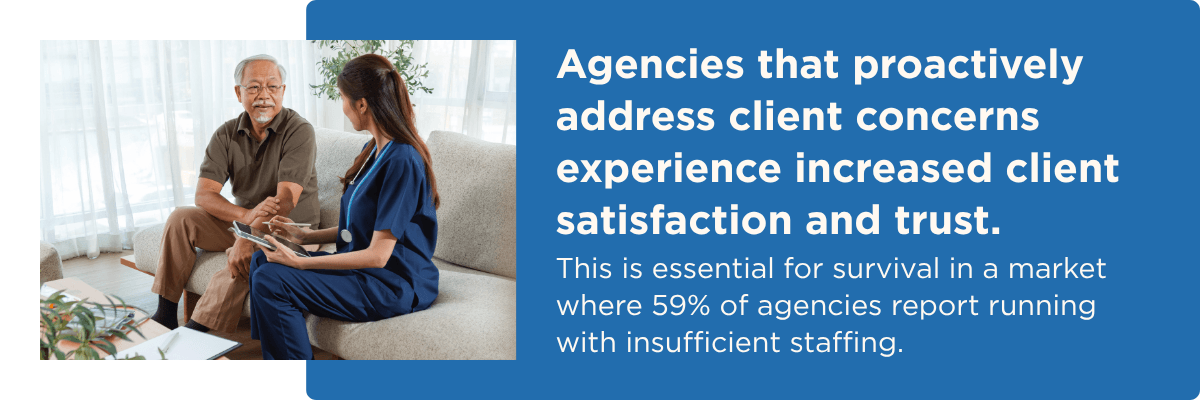
Agencies that proactively address client concerns experience increased client satisfaction and stronger trust, which is essential for survival in a market where 59% of agencies report running with insufficient staffing. Furthermore, addressing operational friction such as scheduling instability leads to improved retention rates. This focus on retention is vital for profitability; losing a single caregiver in today’s market costs an agency between $2,600 and $5,000 in recruitment and training expenses. By embracing modern technology and proactive communication, agencies can ensure long-term sustainability while delivering consistent, compassionate care.
How to Solve the Top 10 Home Care Agency Challenges
Even the best agencies encounter challenges, but recognizing the most common home care client complaints helps leaders proactively strengthen operations. Below are the top 10 complaints and how agencies can resolve them with CareVoyant’s integrated Home Care Software.
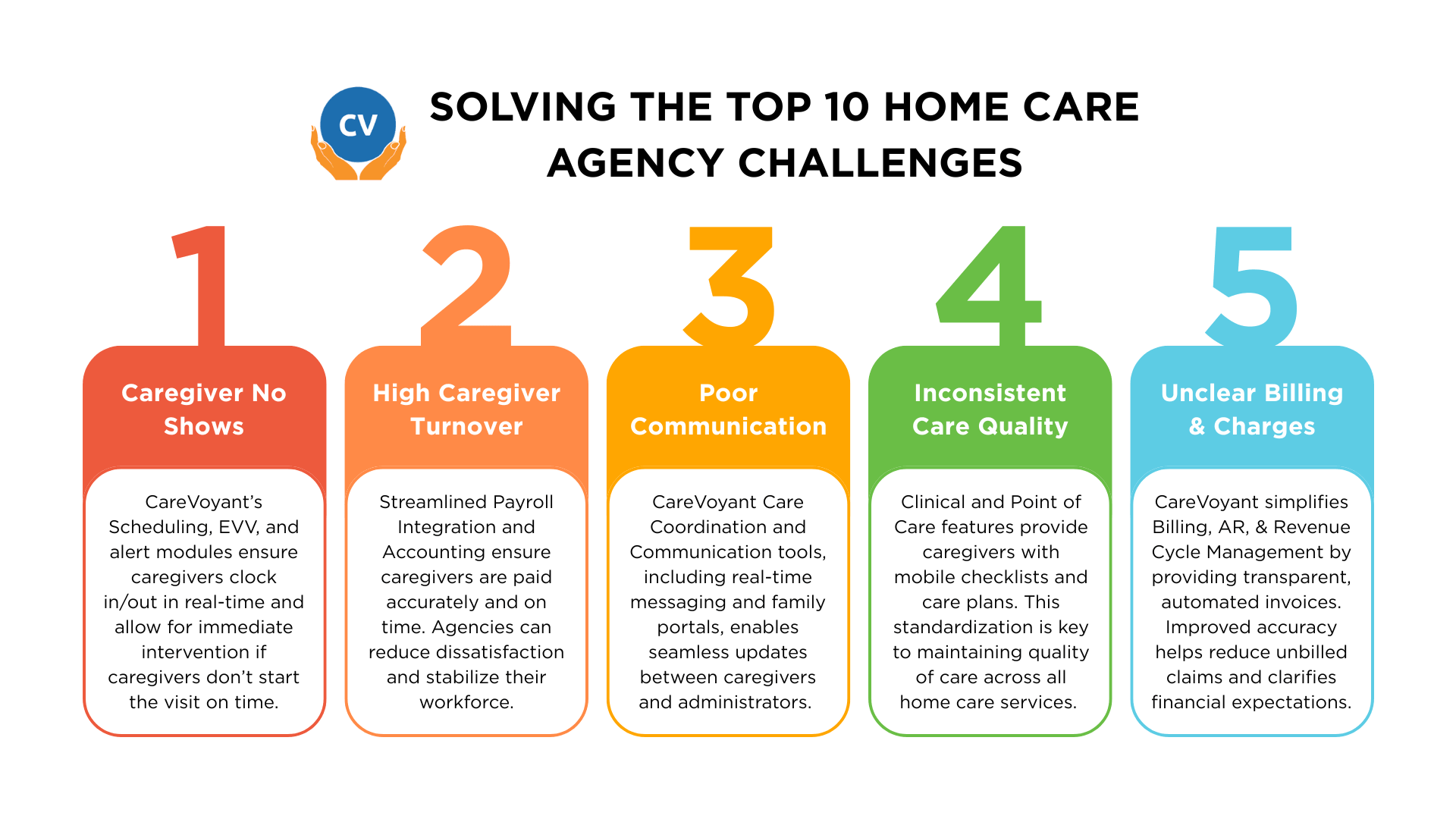
1. Caregiver No-Shows or Tardiness
Challenge: Few issues frustrate families more than caregivers arriving late or missing shifts entirely. These lapses compromise patient safety and destroy brand reputation.

Market Statistic: This is a direct consequence of a massive labor gap; in 2026, the direct care workforce supply is projected to meet only 91.9% of total demand. See the latest figures in the PHI National Direct Care Workforce State Index.
Solution: CareVoyant’s Scheduling and Electronic Visit Verification (EVV) modules ensure caregivers check in/out in real-time. Automated alerts for missed visits allow for immediate intervention, effectively reducing caregiver no-shows and restoring family confidence.
2. High Caregiver Turnover
Challenge: Constantly seeing “new faces” is unsettling for clients and disrupts continuity of care. Turnover remains one of the most persistent home care agency challenges.

Market Statistic: Replacing a single caregiver in today’s competitive environment costs an agency between $2,600 and $5,000 in recruitment and onboarding expenses. Review turnover trends in the Activated Insights Home Care Benchmarking Report.
Solution: By streamlining Payroll Integration and Accounting, CareVoyant ensures caregivers are paid accurately and on time. Coupled with proactive employee retention strategies, agencies can reduce dissatisfaction and stabilize their workforce.
3. Poor Communication from the Agency
Challenge: Unanswered calls and delayed updates regarding care changes quickly erode trust between the agency and the family.

Market Statistic: Approximately 59% of home care agencies report running with insufficient administrative staffing, leading to significant communication bottlenecks. Reference the National Alliance for Care at Home workforce studies.
Solution: With Care Coordination and Communication tools, CareVoyant enables seamless updates between caregivers and administrators. Real-time messaging and family portals are essential for improving care team communication.
4. Inconsistent Quality of Care
Challenge: Varied performance among staff leads to missed tasks or rushed visits, which clients perceive as a failure in oversight.

Market Statistic: Operational capacity hurdles have caused referral conversion rates to decline to approximately 64%, as agencies struggle to maintain quality while processing high patient volumes. Monitor patient satisfaction via the CMS Home Health Care Consumer Assessment (HHCAHPS).
Solution: CareVoyant’s Clinical and Point of Care features provide caregivers with mobile checklists and care plans at the bedside. This standardization is key to maintaining quality of care across all home care services.
5. Unclear Billing and Unexpected Charges
Challenge: Confusing invoices, especially involving Medicaid or private insurance, are a frequent source of client frustration.

Market Statistic: Under the CMS Final Rule (CMS-1828-F), reimbursement is now directly tied to clinical outcomes and patient experience scores, making billing transparency a financial necessity. Read the CMS CY 2026 Home Health Prospective Payment System Fact Sheet.
Solution: CareVoyant simplifies Billing & AR / Revenue Cycle Management, providing transparent, automated invoices. Improved accuracy helps reduce unbilled claims and clarifies financial expectations for families.
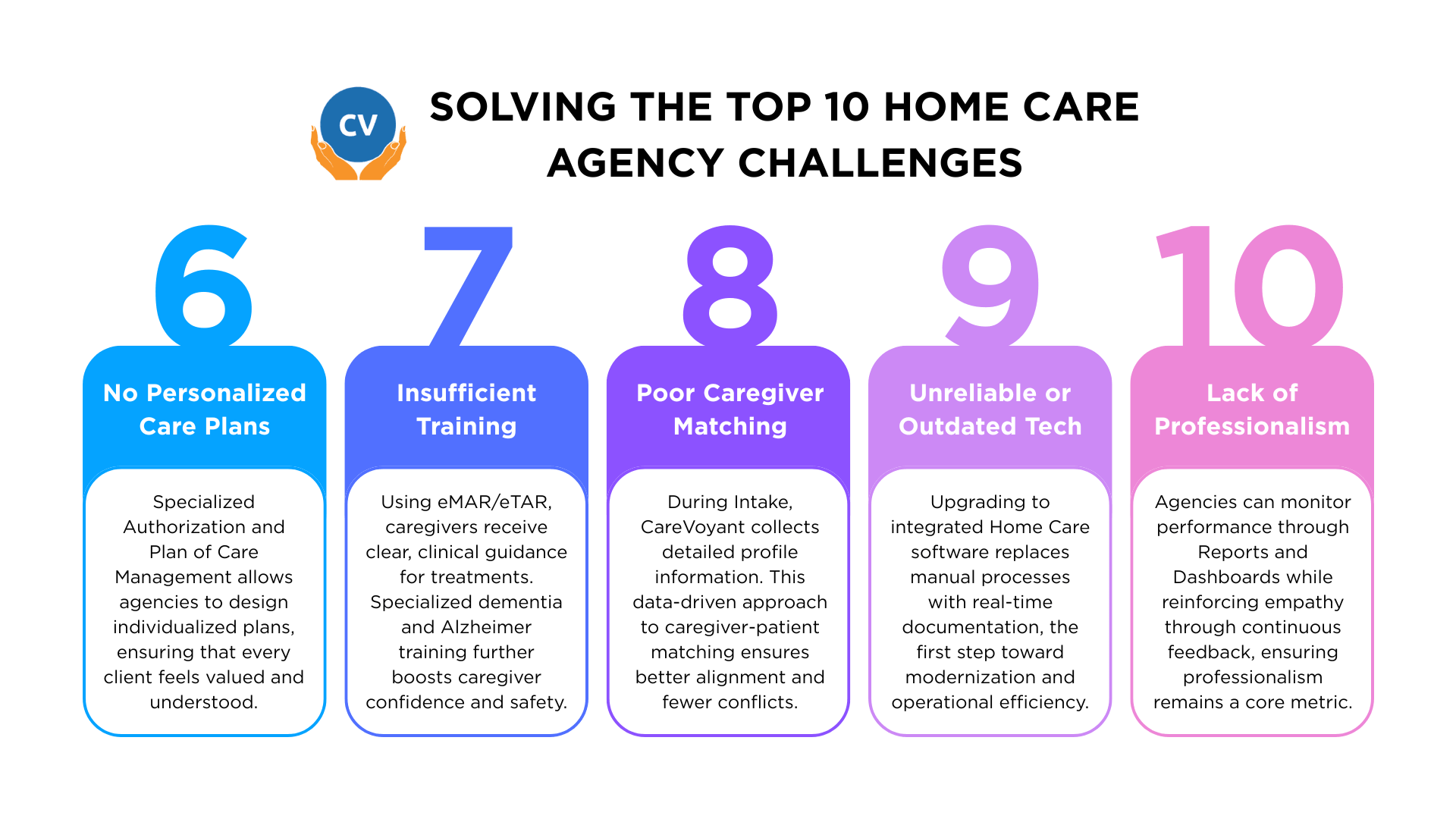
6. Lack of Personalized Care Plans
Challenge: Families increasingly reject “cookie-cutter” care that ignores the specific clinical needs or personal preferences of their loved ones.

Market Statistic: With over 3 million beneficiaries currently served by Medicare-certified agencies, personalization is the primary differentiator for agencies seeking to improve patient retention. Explore the AARP Long-Term Services and Supports State Scorecard.
Solution: Specialized Authorization and Plan of Care Management allows agencies to design individualized plans. Understanding the benefits of effective care planning ensures that every client feels valued and understood.
7. Insufficient Training of Caregivers
Challenge: Families notice immediately when caregivers struggle with specialized tasks like medication management or dementia support.

Market Statistic: Industry data highlights that improving clinical competency is now a survival requirement as the nursing shortage forces agencies to rely on less experienced staff. Review the HRSA Data Warehouse for workforce projections.
Solution: Using eMAR/eTAR, caregivers receive clear, clinical guidance for treatments. Integrating specialized dementia and Alzheimer training further boosts caregiver confidence and safety.
8. Poor Client-Caregiver Matching
Challenge: Mismatched personalities or language barriers can undermine the therapeutic relationship and lead to frequent service conflicts.

Market Statistic: Failure to address matching is a primary driver of the 64% referral conversion rate, as agencies struggle to align available staff with specific patient needs. See research on caregiver matching and retention from the NCBI.
Solution: During Intake, CareVoyant collects detailed profile information. This data-driven approach to caregiver-patient matching ensures better alignment and fewer service conflicts.
9. Unreliable or Outdated Technology
Challenge: Paper-based systems cause delays and lack of transparency, which clients find unprofessional in a digital age.

Market Statistic: Agencies leveraging integrated technology are better positioned to "do more with less" in a market where workforce supply only meets 91.9% of demand. Consult the HealthIT.gov Health IT Playbook for Home and Community-Based Services.
Solution: Upgrading to integrated Home Care software replaces manual processes with real-time documentation. Recognizing the signs your agency needs to invest in modern technology is the first step toward modernization.
10. Lack of Respect, Compassion, or Professionalism
Challenge: Caregivers who appear inattentive or unprofessional cause lasting emotional harm to clients and damage the agency's brand.

Market Statistic: Patient experience scores are a core metric of the expanded Home Health Value-Based Purchasing (HHVBP) model, meaning professionalism now has a direct impact on agency revenue. Review HHVBP Expanded Model Resources via CMS.gov.
Solution: Agencies can monitor performance through Reports and Dashboards while reinforcing empathy through continuous feedback. Tracking operational efficiency helps ensure that professionalism remains a core metric of agency success.
Conclusion
Addressing the top 10 home care client complaints is essential for agencies striving to deliver consistent, reliable, and compassionate care. From caregiver no-shows to poor communication and unclear billing, these issues represent some of the most common home care agency challenges. The good news is that with the right strategies and the right technology agencies can transform complaints into opportunities for growth.
By prioritizing effective care coordination, investing in specialized caregiver training, and adopting modern home care tools, agencies see measurable improvements in care quality, client satisfaction, and operational efficiency.
CareVoyant provides the integrated home care software your agency needs to thrive in 2026. From advanced scheduling and billing to EVV compliance and comprehensive caregiver management, CareVoyant helps agencies do more with less while improving clinical outcomes.
Learn how CareVoyant can help your agency strengthen trust, improve compliance, and deliver better care, every visit, every time. Schedule a demo today.
Top 10 FAQs: Home Care Agency Operations
-
Replacing a single caregiver currently costs home care agencies between $2,600 and $5,000. These costs include recruitment, background checks, and onboarding. High turnover not only impacts profitability but also disrupts the continuity of care, which can negatively affect patient experience scores and HHVBP reimbursements.
-
Under the expanded Home Health Value-Based Purchasing (HHVBP) model, CMS ties reimbursement rates directly to clinical outcomes and patient satisfaction. Agencies with high performance see a potential increase in payments, while those with poor outcomes or low survey scores may face significant financial penalties.
-
The industry average for referral conversion has dropped to approximately 64%. This decline is typically caused by operational capacity hurdles, such as insufficient staffing or slow intake processes. Integrated software can help by streamlining the transition from referral to active care, ensuring no patient is left behind.
-
The most effective solution is implementing real-time Electronic Visit Verification (EVV) and automated scheduling alerts. These tools notify administrators immediately if a caregiver has not checked in at the scheduled time, allowing for proactive intervention before the client or their family notices the delay.
-
Integrated software automates the Revenue Cycle Management (RCM) process, linking care hours directly to invoices. This reduces human error in Medicaid and private insurance claims, provides families with clear, itemized bills, and ensures the agency is paid accurately and on time.
-
In 2026, the direct care workforce supply is projected to meet only 91.9% of the total demand. This shortage makes it essential for agencies to focus on caregiver retention and operational efficiency to manage a high volume of patients with a limited number of staff.
-
Personalized care plans move away from "cookie-cutter" services by addressing specific clinical needs and personal preferences. When clients feel that their unique requirements such as specialized dementia care or language preferences are met, their satisfaction and loyalty to the agency increase significantly.
-
Key signs include frequent billing errors, a reliance on paper-based documentation, high administrative burnout, and "communication black holes" where messages between caregivers and families are lost. If your referral conversion is low despite high demand, your current technology is likely a bottleneck.
-
Proper matching reduces personality conflicts and language barriers, which are primary drivers of client complaints. Using data-driven intake processes to align caregiver skills and personalities with patient needs leads to a stronger therapeutic relationship and better clinical outcomes.
-
Yes. Integrated software like CareVoyant helps agencies track the specific clinical and experience metrics required under the CMS Final Rule (CMS-1828-F). By standardizing documentation and monitoring outcomes via real-time dashboards, agencies can ensure they remain compliant and maximize their reimbursement potential.
About CareVoyant
CareVoyant is a leading provider of cloud-based integrated enterprise-scale home health care software that can support all home-based services under ONE Software, ONE Patient, and ONE Employee, making it a Single System of Record. We support all home based services, including Home Care, Private Duty Nursing, Private Duty Non-Medical, Home and Community Based Services (HCBS), Home Health, Pediatric Home Care, and Outpatient Therapy at Home.
CareVoyant functions – Intake, Authorization Management, Scheduling, Clinical with Mobile options, eMAR/eTAR, Electronic Visit Verification (EVV), Billing/AR, Secure Messaging, Notification, Reporting, and Dashboards – streamline workflow, meet regulatory requirements, improve quality of care, optimize reimbursement, improve operational efficiency and agency bottom line.
For more information, please visit CareVoyant.com or call us at 1-888-463-6797.
Request for Information
To learn more about CareVoyant Software and how we improve the operational efficiency of Home Healthcare Agencies, contact us:
