

Manual travel time tracking is a top source of payroll errors and caregiver mistrust. CareVoyant auto-calculates it from verified EVV visit data instead. Caregivers see their own hours in the Employee Portal, which builds trust and cuts disputes before they start. With wages claiming 50 to 60% of agency revenue, tighter payroll accuracy is a direct lever on your bottom line.
Introduction
Travel time between visits is one of the most common sources of both wage-and-hour risk and caregiver frustration in home care, yet many agencies still rely on caregivers to self-report it. That single gap in the payroll process touches almost everything else an agency cares about: compliance exposure, caregiver trust, and ultimately, the bottom line.
The stakes are larger than a single pay period suggests. Home health care agencies typically spend 50 to 60 percent of their revenue on wages, most of it for the field employees providing direct care. When that much of the revenue line depends on how efficiently hours are scheduled, tracked, and paid, payroll stops being a back-office function and starts being a margin decision.
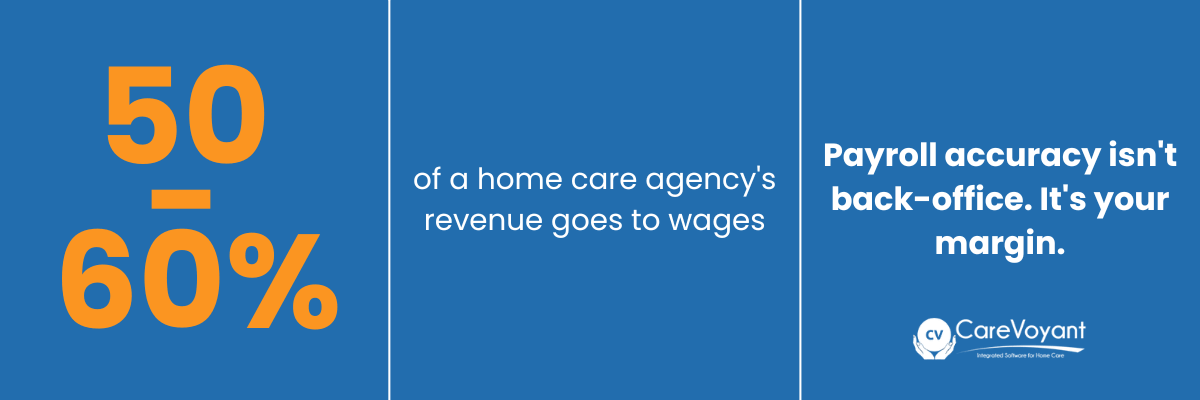
Payroll is usually treated as something to get through every pay period without a fire drill. But in home care, payroll works more like a three-lever system. Get accuracy right, and you build caregiver trust. Build trust, and you protect retention and margin. Get it wrong at any one point, and the effects ripple through all three.
This guide walks through how travel time actually gets calculated, why manual self-reporting creates risk, how payroll accuracy connects directly to caregiver retention, and where the real cost savings show up on your agency's bottom line, plus a practical checklist you can use to evaluate your current setup.
How Travel Time Calculation Actually Works (and Why Self-Reporting Doesn't)
The FLSA baseline
Under the Fair Labor Standards Act, travel time is generally treated as part of the continuous workday. Time a caregiver spends traveling between client visits during a shift is typically compensable hours worked. The caregiver's commute to their first visit of the day and home from their last is generally not, per the U.S. Department of Labor's Fact Sheet #22: Hours Worked Under the FLSA. That distinction sounds simple in principle. In practice, it depends entirely on having a reliable record of when each visit actually started and ended. That's where most agencies run into trouble.
Why self-declared travel time is a payroll risk
When caregivers are left to estimate or self-report the time between visits, agencies inherit whatever inconsistency comes with that. Manually tracking hours and relying on self-declaration of travel time is a well-documented source of payroll errors in home care. It introduces the exact kind of inconsistency that leads to underpayment, overpayment, and disputes that eat up administrative time to resolve. Without a system of record, every travel time entry is essentially a caregiver's best guess, defensible only as far as their memory and goodwill hold up during an audit.
Addressing travel time before the shift is even scheduled
Most of the conversation around travel time focuses on how it's paid after a visit happens. CareVoyant also addresses it earlier, at the point a shift is assigned. Intelligent matching considers distance, availability, skills, and patient preferences when suggesting a caregiver for a shift, reducing unnecessary travel before it's ever scheduled rather than just calculating it after the fact. CV Miles, CareVoyant's dedicated feature for optimizing travel time and cost, works alongside this matching to keep travel efficient at the scheduling stage.
How CareVoyant closes the gap at payroll
Beyond scheduling-stage optimization, CareVoyant removes the guesswork at calculation time by tying travel time directly to verified visit data rather than a separate estimate:
Electronic Visit Verification (EVV) captures the actual start and end time of every visit, through GPS-enabled mobile clock-in/out, Fixed Visit Verification (FVV), or verified manual entry, depending on the visit and connectivity available.
That verified visit data flows directly into Payroll Integration, which automatically calculates travel miles, travel time, overtime, and shift, weekend, and holiday differentials.
Pay rates apply automatically based on employee, service line, payer, and patient. No manual lookup, no re-entry, no separate spreadsheet to reconcile.
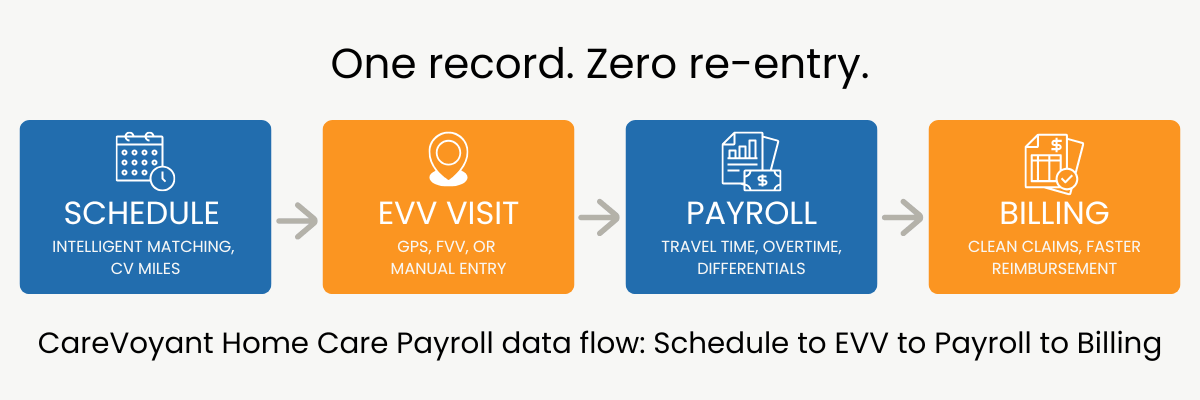
The result is one continuous flow of data from schedule to verified visit to paycheck, rather than a second, disconnected step where travel time gets estimated after the fact.
State and payer variability
Travel time rules don't stop at FLSA. Medicaid HCBS and Consumer Directed Services (CDS) programs often layer additional documentation and reimbursement requirements on top of federal wage law under the 21st Century Cures Act's EVV mandate, and those requirements vary by state. Because CareVoyant supports all state-designated EVV aggregators and every home-based service line within one platform, agencies operating across multiple states or payer programs don't need a separate workaround for each one. The variability is handled inside the same system that's already calculating pay. This same verified-visit foundation is also what makes accurate time tracking possible across every service line an agency runs.
Payroll Accuracy as the Trust Mechanism Behind Retention
Caregivers can see their own hours
Payroll accuracy matters most where caregivers actually experience it: in their paycheck, and in whether they can trust it before it arrives. CareVoyant's Employee Portal gives caregivers direct, self-service access to their schedule, shift offers, available shifts, and their own payroll hours. That means pay isn't just accurate behind the scenes; it's verifiable to the caregiver themselves, in advance, from a phone.
Why that transparency matters
Reliable pay that consistently reflects a caregiver's actual work is directly tied to job satisfaction. When caregivers can see that their hours are logged correctly and their paycheck lines up with what they actually worked, disputes go down and trust goes up, in an industry where burnout and turnover are already persistent challenges.
The resulting business case
That trust doesn't stay abstract. Caregivers who leave the field often cite payment inconsistency and a lack of communication about pay as contributing factors, a pattern we've written about in the context of managing overtime and payroll. Agencies that reduce payroll disputes and pay accurately and on time are addressing one of the more controllable factors behind turnover (not the only one, but a real one). The retention benefit is the outcome of getting payroll right, not the reason to do it.
Trust compounds operationally
The effect isn't limited to caregiver sentiment. Fewer disputes mean fewer manual corrections, and fewer manual corrections free up payroll staff to spend time on higher-value work (caregiver engagement, scheduling quality, client satisfaction) instead of chasing down discrepancies every pay period.
From Payroll Errors to Bottom-Line Impact
Direct costs
Every payroll error carries a direct cost, even when it's "just" a correction. Late timesheets that get misallocated to the wrong pay period, overtime calculated incorrectly because a shift change wasn't reflected in time, and manual payroll re-runs all consume staff hours that a properly integrated system wouldn't require in the first place.
Indirect costs
The indirect costs compound further. When caregivers leave due to payroll frustration, the agency's remaining staff often absorb the coverage gap through additional overtime, which increases labor cost and burnout risk simultaneously. On the compliance side, mismatches between EVV data and billed claims lead to denials and slower reimbursement through Billing & Revenue Cycle Management, which affects cash flow independent of any wage issue.
Where integration recovers the cost
The consistent theme across payroll challenges in home care is that they rarely originate in payroll itself. They originate upstream, in scheduling, time capture, and documentation, and simply surface at payroll time. Removing duplicate entry and manual reconciliation between scheduling, EVV, payroll, and billing is what actually prevents these costs from accumulating in the first place, rather than treating each payroll cycle as a fresh cleanup exercise.
Proactive, configurable alerts at the point of scheduling (flagging duplicate schedules or a visit scheduled outside of authorization, for example) catch costly exceptions before a shift happens rather than after it's already been worked and billed. That reduces non-billable time on the front end instead of writing it off after the fact.
Visibility into labor cost trends
None of this is manageable without visibility. Reports and dashboards that surface labor cost, overtime trends, and travel time patterns let administrators catch a developing budget problem, such as a service line trending into excessive overtime, before it shows up as a surprise in the next financial report.
How CareVoyant Closes the Loop
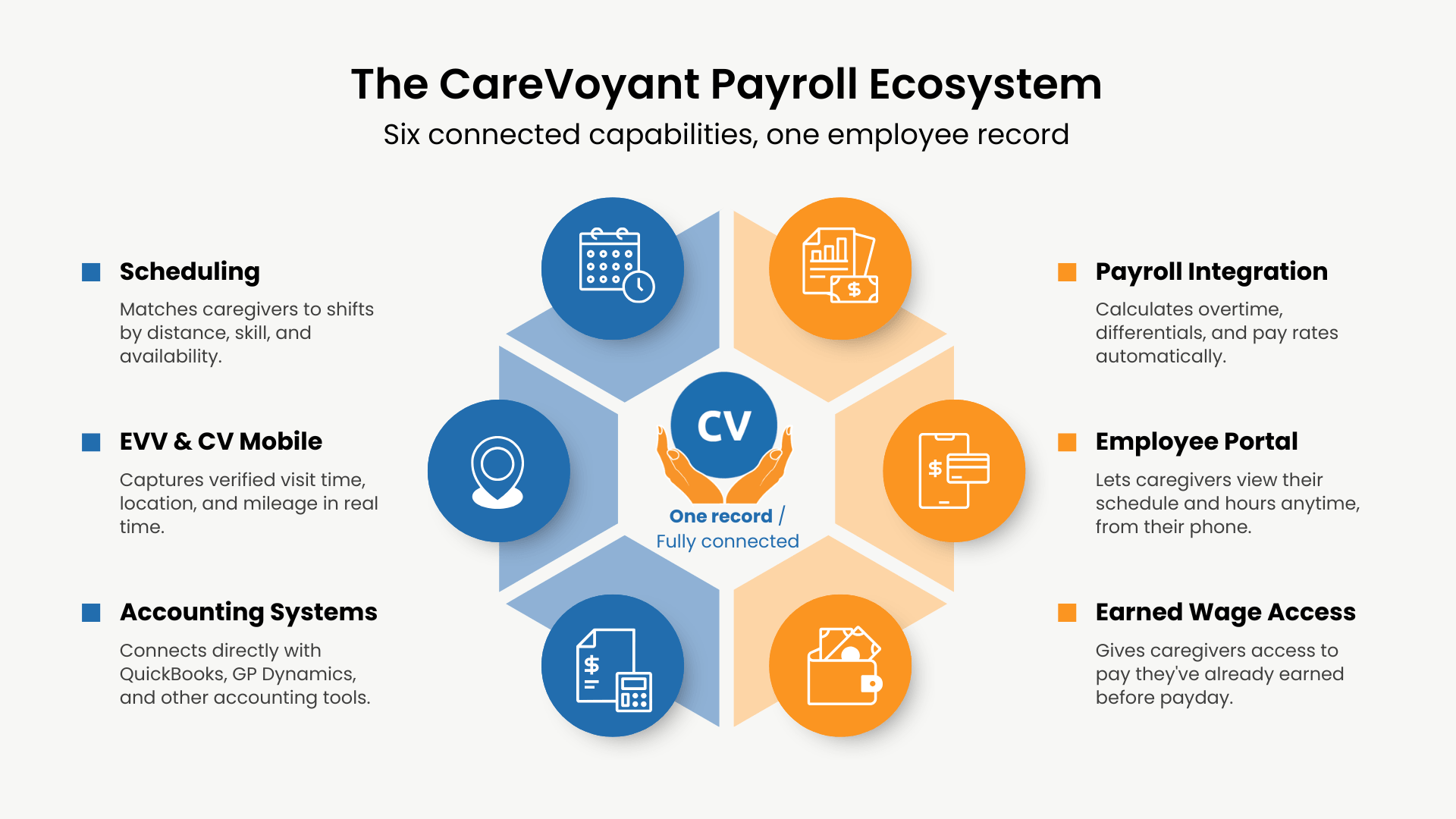
1. One employee record, one data flow

Intake, scheduling, EVV, payroll, and billing operate on one connected data model in CareVoyant. A visit scheduled and verified through CV Mobile doesn't need to be re-entered anywhere downstream. It flows automatically into payroll and, from there, into billing. Charges and payroll are created automatically from verified schedules, so the schedule itself becomes the source record rather than a separate step to reconcile later.
2. Scheduling that accounts for travel from the start

CareVoyant's Scheduling module uses intelligent matching, by distance, availability, skills, and patient preferences, to reduce unnecessary travel before a shift is even assigned, with CV Miles optimizing travel time and cost as part of that process. Scheduling also manages overtime, shift differentials, and split schedules for one employee across multiple services, and publishes shift offers and open shifts directly through the Employee Portal.
3. Configurable pay rates and differentials

Payroll Integration maintains different pay rates by employee, service, payer, and patient, and automatically applies overtime, shift, weekend, and holiday differentials as part of that same calculation. A single employee record supports multiple lines of service without separate manual tracking for each, a workflow we've also covered in streamlining payroll processing and in effective HR and payroll management.
4. EVV breadth across states and payers

CareVoyant interfaces with all state-designated EVV aggregators, including HHAeXchange, Sandata, Tellus, AuthentiCare, CareBridge, and Netsmart, across every home-based service line, so agencies operating in multiple states or payer programs manage EVV, and the payroll data it feeds, from one platform instead of stitching together separate systems.
5. Employee Portal

Beyond supporting the trust case above, the Employee Portal reduces the everyday back-and-forth between caregivers and office staff. Schedule questions, shift offer confirmations, and payroll hour lookups become self-service rather than phone calls or emails waiting on a reply.
6. Payroll and accounting interoperability

Standard interfaces to payroll services like ADP, and Paychex, plus accounting software integration with QuickBooks and GP Dynamics, mean agencies aren't forced to change their existing payroll or accounting relationships to get the benefit of integrated data.
7. Earned Wage Access

CareVoyant's Payroll Integration also interfaces with Earned Wage Access providers, giving agencies a way to support caregivers who need access to earned pay before the standard pay cycle, a meaningful factor in caregiver financial stress and, by extension, retention.
Conclusion
Accurate travel time and payroll calculation isn't a back-office detail. It's the connective layer between compliance, caregiver trust, and margin. When travel time, overtime, and differentials calculate automatically from the same verified visit data that feeds scheduling and billing, agencies remove one of the most common sources of both payroll error and caregiver dissatisfaction at the same time.
See how CareVoyant's Payroll Integration and EVV work together. Request more information to walk through it with your own service lines and states.
Frequently Asked Questions (FAQs)
-
CareVoyant calculates travel time and mileage automatically as part of Payroll Integration, using verified visit start and end times captured through EVV rather than caregiver self-reporting.
-
Generally, under the FLSA's continuous workday principle, travel time between client visits during a shift is compensable, while a caregiver's commute to their first visit and home from their last typically is not. Specific rules can vary by state and payer program.
-
Visit start and end times captured through EVV, via GPS-enabled mobile clock-in/out, Fixed Visit Verification, or verified manual entry, feed directly into Payroll Integration, which applies the appropriate pay rates, overtime, and differentials without manual re-entry.
-
Yes. CareVoyant's Employee Portal gives caregivers self-service access to their schedule, shift offers, and their own payroll hours.
-
Payroll inconsistency is a factor caregivers commonly cite when leaving a role. Reducing payroll disputes and ensuring accurate, on-time pay addresses one of the more controllable contributors to turnover.
-
Many Medicaid HCBS and Consumer Directed Services programs layer additional documentation requirements on top of federal wage law, and these vary by state. CareVoyant supports all state-designated EVV aggregators and service lines within one platform to help manage that variability.
-
Earned Wage Access allows employees to access pay they've already earned before the standard payroll date. CareVoyant's Payroll Integration interfaces with Earned Wage Access providers, giving agencies a tool to support caregivers facing financial stress between pay periods.
-
Both. CareVoyant's intelligent matching considers distance, availability, skills, and patient preferences when assigning a shift, reducing unnecessary travel before it's scheduled. CV Miles supports travel time and cost optimization at this stage, while Payroll Integration calculates actual travel time and mileage from verified visit data once the visit is complete.
-
CareVoyant maintains one employee record that supports multiple lines of service, applying the correct pay rate, overtime calculation, and differentials for each portion of a split shift automatically.
About CareVoyant
CareVoyant is a leading provider of cloud-based integrated enterprise-scale home health care software that can support all home-based services under ONE Software, ONE Patient, and ONE Employee, making it a Single System of Record. We support all home based services, including Home Care, Private Duty Nursing, Private Duty Non-Medical, Home and Community Based Services (HCBS), Home Health, Pediatric Home Care, and Outpatient Therapy at Home.
CareVoyant functions – Intake, Authorization Management, Scheduling, Clinical with Mobile options, eMAR/eTAR, Electronic Visit Verification (EVV), Billing/AR, Secure Messaging, Notification, Reporting, and Dashboards – streamline workflow, meet regulatory requirements, improve quality of care, optimize reimbursement, improve operational efficiency and agency bottom line.
For more information, please visit CareVoyant.com or call us at 1-888-463-6797.
Request for Information
To learn more about CareVoyant Software and how we improve the operational efficiency of Home Healthcare Agencies, contact us:
