

CMS extended Review Choice Demonstration for five more years. Home health agencies in IL, OH, TX, NC, FL, and OK face intensive documentation scrutiny and denial risk. CareVoyant’s integrated platform automates OASIS documentation, pre-claim review workflows, EVV, billing, and compliance dashboards helping agencies achieve the 90% affirmation threshold required for reduced oversight.
Introduction
In June 2024, CMS extended the Review Choice Demonstration (RCD) for Home Health Services for another five years through at least May 2029 and added Oklahoma as the sixth participating state. For home health agencies operating in Illinois, Ohio, Texas, North Carolina, Florida, and Oklahoma, RCD is a permanent feature of the Medicare compliance landscape.
The stakes are real: in FY 2024, CMS reported that while 97% of pre-claim review (PCR) requests were affirmed, only 84.4% of combined pre- and post-payment reviews were approved. More tellingly, 51.6% of initially denied claims were overturned on first appeal meaning that for many agencies, the problem is not medical necessity but documentation execution.
The good news: documentation execution is exactly what home health software solves. Agencies that integrate clinical documentation, OASIS management, authorization tracking, EVV, and billing into a single platform are achieving the 90% affirmation threshold required to advance to Spot Check review dramatically reducing administrative burden and protecting cash flow.
This guide explains how CareVoyant’s comprehensive home health care software equips your agency to not just survive CMS Review Choice but to move through it efficiently and come out stronger.

What Is the CMS Review Choice Demonstration (RCD) for Home Health?
The CMS Review Choice Demonstration (RCD) is a Medicare oversight initiative designed to reduce improper payments, strengthen compliance, and ensure quality in home health care. Administered by Palmetto GBA (MAC Jurisdiction M), RCD requires home health agencies in participating states to submit clinical documentation for review before or after payment to verify medical necessity and compliance with Medicare coverage rules.
RCD was originally launched in Illinois in 2019, expanded to additional states, and was extended for five years effective June 1, 2024. Oklahoma was added in December 2023. CMS has authority to expand RCD to additional MAC Jurisdiction M states where evidence of fraud, waste, or abuse is identified. For detailed procedures, refer to the Review Choice Demonstration Operational Guide and the RCD FAQs.
Which States Are Subject to CMS Review Choice Demonstration in 2026?

RCD is currently active in the following six states:
Illinois (IL) – Active since June 2019 (original launch state)
Ohio (OH) – Active since 2020
Texas (TX) – Active since 2020
North Carolina (NC) – Full implementation September 2021
Florida (FL) – Full implementation September 2021
Oklahoma (OK) – Active since December 2023 (newest addition)
Important update: As of June 2024, CMS removed Choice 3 (Minimal Review with 25% Payment Reduction) from the initial RCD choice selections. Agencies now select from Choice 1 (Pre-Claim Review) or Choice 2 (Post payment Review) at the start of each six-month cycle.
Understanding Your RCD Review Options
Under RCD, home health agencies select from the following choices at the start of each six-month cycle:
Choice 1 – Pre-Claim Review (PCR): Submit documentation before billing. If affirmed, Palmetto GBA issues a Unique Tracking Number (UTN) that must be attached to the claim. Reduces post-payment denial risk and creates payment predictability.
Choice 2 – Postpayment Review: Receive payment upfront but undergo claim audits after payment. Creates retroactive denial and recoupment risk without strong documentation workflows.
Choice 4 – Spot Check Review (Selective): Available after achieving a ≥90% affirmation/approval rate over a minimum of 10 submissions in a six-month cycle. Reduces ongoing administrative burden significantly.
The path to Choice 4 is the operational goal. Home health software that ensures documentation completeness from the first visit is what gets agencies there fastest.
Top 5 RCD Compliance Challenges Home Health Agencies Face in 2026
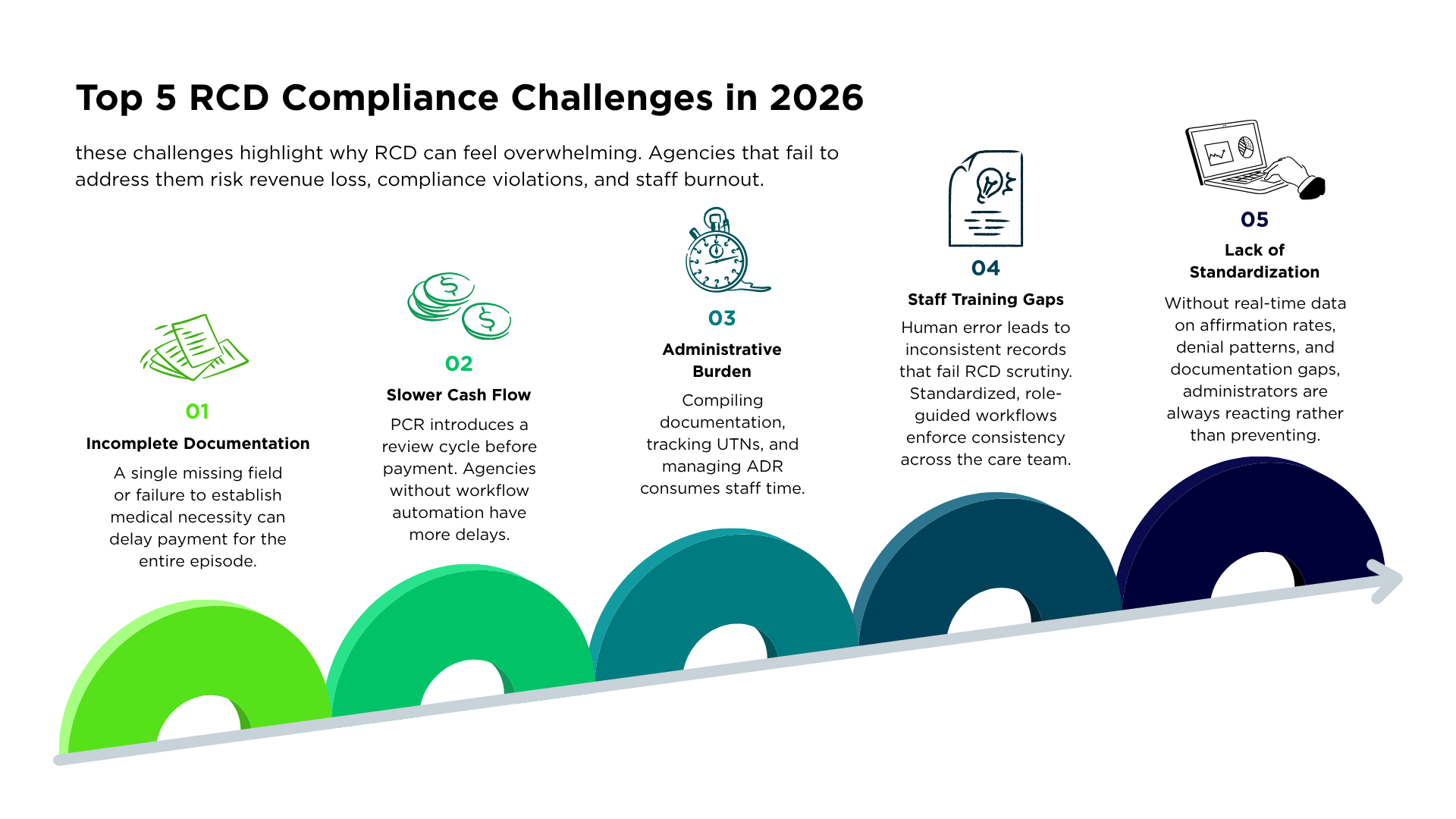

1. Incomplete or Inaccurate Documentation
Missing physician signatures, incomplete OASIS fields, incorrect ICD-10 coding, or visit notes that fail to establish medical necessity are the leading causes of non-affirmation. Under PCR, a single missing field can delay payment for the entire episode. See how improving OASIS accuracy directly reduces denial risk.

2. Slower Cash Flow
PCR introduces a review cycle before payment. Agencies without workflow automation experience weeks of delays between service delivery and reimbursement, straining payroll, and operations. Learn how reducing unbilled claims protects cash flow under RCD.

3. Administrative Burden
Compiling documentation packages, submitting to Palmetto GBA, tracking UTNs, and managing ADR responses consumes significant staff time. Without automation, this pulls clinical staff from direct patient care and compounds existing staffing pressures.

4. Staff Training Gaps
Different clinicians documenting differently leads to inconsistent records that fail RCD scrutiny. Standardized, role-guided workflows enforce consistency across the care team. See how home health documentation supports Medicare compliance.

5. Lack of Standardization
Without real-time dashboards showing affirmation rates, denial patterns, and documentation gaps, administrators are always reacting rather than preventing. Learn about key performance indicators for home care relevant to RCD compliance.
Together, these challenges highlight why RCD can feel overwhelming. Agencies that fail to address them risk revenue loss, compliance violations, and staff burnout.
How Home Health Software Helps You Pass CMS Review Choice Demonstration
Surviving RCD requires more than careful attention to paperwork, it demands a systematic approach to documentation, compliance, and operational efficiency. Leveraging CareVoyant’s comprehensive home health care software integrates clinical, administrative, and financial processes to help agencies navigate RCD with confidence.
1. Automate OASIS & Clinical Documentation for RCD Compliance

CareVoyant’s clinical and point-of-care documentation includes built-in clinical templates, OASIS and Form 485 creation at the point of care, and auto-validation of required fields. Electronic physician order tracking prevents delays caused by missing signatures. Automated compliance alerts catch errors before submission reaches Palmetto GBA not after. Integrated eFax accelerates physician order retrieval and documentation assembly.
2. Streamline Pre-Claim Review (PCR) Submissions – Step by Step

For agencies on Choice 1, CareVoyant’s authorization and plan-of-care management combined with intelligent scheduling tools creates a structured PCR submission workflow:
Intake & eligibility verification confirms Medicare coverage before services begin.
Authorization management tracks required approvals and flags expiring authorizations.
Point-of-care documentation guides clinicians through OASIS and visit notes at the patient’s home.
EVV via CV Mobile timestamps and geo-verifies each visit.
Pre-submission checklist auto-validates all required documentation fields before PCR is sent to Palmetto GBA.
UTN tracking captures and stores the Unique Tracking Number from Palmetto GBA and attaches it to the associated claim in the billing module.
Real-time status alerts notify billing staff of affirmation, non-affirmation, or requests for additional documentation.
This end-to-end workflow reduces the manual coordination that causes submission errors and delays. See authorization management for efficient RCM for more detail.
3. Why an Integrated EMR, EVV & Billing Platform Reduces RCD Denials

Fragmented systems where clinical, EVV, and billing data are managed separately are a major denial risk under RCD. When data must be re-entered between systems, errors multiply. CareVoyant eliminates this by integrating clinical documentation, scheduling, electronic visit verification (EVV), billing, payroll, and accounting into a single platform. Claims data is auto populated from clinical records, eliminating manual re-entry. Learn about billing, AR & revenue cycle management for the full feature set.
4. Stay Audit-Ready: Real-Time RCD Compliance Dashboards

CareVoyant’s reports and dashboards give agency administrators real-time visibility into affirmation rates, denial trends by payer and diagnosis, documentation completion rates, and outstanding physician orders. Historical data storage ensures documentation is instantly retrievable during ADR responses or post-payment audits. Trend analysis identifies recurring documentation gaps by clinician, service type, or diagnosis so training can be targeted before the six-month cycle review. Use reports and dashboards to track trends and stay ahead of compliance gaps.
5. Role-Based Workflows and Mobile Tools for Field Clinicians

Even the best software is only effective if staff can use it efficiently. CareVoyant supports agencies with role-based workflows that guide clinical and administrative staff through compliant documentation. Mobile-friendly tools such as CV Mobile with EVV and point-of-care documentation empower caregivers in the field offline if needed, with automatic sync when connectivity is restored while integrated care coordination and communication tools keep the entire care team aligned in real time. Achieve EVV compliance and support point-of-care documentation with intuitive interfaces.
6. Tracking Your Path to Spot Check Review (Choice 4)

The goal for every RCD agency is advancing to Choice 4: Spot Check Review. To qualify, your agency must achieve a ≥90% full provisional affirmation rate (PCR) or claim approval rate (post payment) over a minimum of 10 submissions in a six-month cycle. Palmetto GBA notifies agencies within 30 days of cycle end. Beyond compliance, CareVoyant’s software enhances operational efficiency through automation, workflow standardization, and predictive analytics allowing agencies to track their running affirmation rate in real time and intervene before the cycle ends. Agencies that leverage these capabilities not only survive CMS Review Choice, but they thrive achieving faster approvals, reduced denials, and a stronger financial foundation.
Conclusion
The CMS Review Choice Demonstration presents significant challenges for home health agencies, from high denial rates and delayed reimbursements to administrative burdens and compliance pressures. These hurdles can strain both operations and cash flow, making it difficult for agencies to focus on delivering quality patient care.
However, the right software-driven strategies provide practical solutions. By leveraging CareVoyant Home Healthcare Software, agencies can automate documentation and compliance checks, streamline pre-claim and billing workflows, and maintain audit-ready records. This not only reduces the risk of denials but also improves overall operational efficiency, ensures consistent regulatory compliance, and supports financial stability.
Agencies that adopt technology strategically can transform RCD from a potential threat into a manageable, even advantageous, process. Explore how CareVoyant’s comprehensive software solutions covering clinical documentation, scheduling, electronic visit verification, billing, and reporting can help your agency survive and thrive under CMS Review Choice, protecting both your revenue and your capacity to deliver high-quality care.
Frequently Asked Questions: CMS Review Choice Demonstration
-
The CMS Review Choice Demonstration (RCD) is a Medicare oversight program requiring home health agencies in select states to submit clinical documentation for review before or after payment to verify medical necessity and compliance with Medicare rules. It is currently active in Illinois, Ohio, Texas, North Carolina, Florida, and Oklahoma, and was extended for five years in June 2024.
-
RCD applies to six states: Illinois (IL), Ohio (OH), Texas (TX), North Carolina (NC), Florida (FL), and Oklahoma (OK, added December 2023). CMS can expand to additional MAC Jurisdiction M states where improper billing is identified. See the full CMS RCD state overview.
-
A UTN is issued by Palmetto GBA when a pre-claim review request is affirmed. It must be entered in the appropriate field on the claim form before billing. Home health billing software should automatically capture and attach the UTN to the corresponding claim to avoid payment delays or rejections.
-
Focus on: (1) complete OASIS documentation at point of care via clinical software; (2) timely physician signature tracking through authorization management; (3) ICD-10 coding accuracy; (4) visit notes that clearly establish medical necessity; and (5) pre-submission validation to catch errors before documentation reaches Palmetto GBA.
-
Agencies that do not meet the 90% threshold (minimum 10 submissions) in a six-month cycle must remain in their initial choice and cannot advance to Spot Check Review (Choice 4). Sustained low rates may attract additional CMS scrutiny. Review strategies to improve OASIS accuracy to close documentation gaps.
-
Yes. As part of the June 2024 five-year extension, CMS removed Choice 3 (Minimal Review with 25% Payment Reduction) from the initial choice selections. Agencies now choose between Choice 1 (Pre-Claim Review) or Choice 2 (Postpayment Review). See the CMS RCD announcement for details.
-
While direct submission to Palmetto GBA’s eServices portal requires agency action, integrated home health software like CareVoyant automates the preparation, validation, and tracking of all documentation required for RCD including OASIS scrubbing, auto-population of claim fields, UTN capture, and real-time status alerts significantly reducing manual effort and error rates.
-
CMS extended RCD for five years effective June 1, 2024, running through at least May 2029. CMS retains authority to extend or expand the program further. Refer to the CMS RCD page for the latest updates.
About CareVoyant
CareVoyant is a leading provider of cloud-based integrated enterprise-scale home health care software that can support all home-based services under ONE Software, ONE Patient, and ONE Employee, making it a Single System of Record. We support all home based services, including Home Care, Private Duty Nursing, Private Duty Non-Medical, Home and Community Based Services (HCBS), Home Health, Pediatric Home Care, and Outpatient Therapy at Home.
CareVoyant functions – Intake, Authorization Management, Scheduling, Clinical with Mobile options, eMAR/eTAR, Electronic Visit Verification (EVV), Billing/AR, Secure Messaging, Notification, Reporting, and Dashboards – streamline workflow, meet regulatory requirements, improve quality of care, optimize reimbursement, improve operational efficiency and agency bottom line.
For more information, please visit CareVoyant.com or call us at 1-888-463-6797.
Request for Information
To learn more about CareVoyant Software and how we improve the operational efficiency of Home Healthcare Agencies, contact us:
