

Introduction
An aide has been with the same client on Monday, Wednesday, and Friday mornings for eight months. In the last six weeks she has answered the same question about the client’s late husband on four separate visits. She has watched unopened mail collect on the dining table. Twice she arrived at eleven in the morning to find the client wearing a cardigan over a nightgown, dressed for the day as she understands it.
None of that appears in a fifteen-minute office visit.
September is World Alzheimer’s Month, and the 2026 theme from Alzheimer’s Disease International is that a dementia diagnosis matters, and that the earlier you know, the more you can do. Most of what is published against that theme speaks to families or to physicians. This article is written for home care agencies, because the person most likely to notice cognitive decline first is neither the doctor nor the adult child who visits on Sundays. It is the caregiver who is in the home twelve hours a week.
What follows is how agencies can turn what caregivers already see into something a physician can act on.
The diagnosis gap is really an observation gap
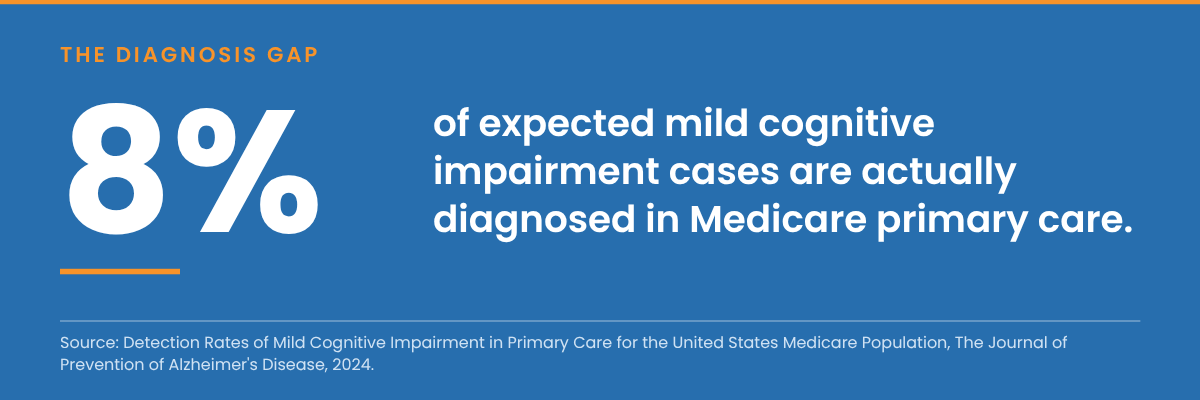
A study of Medicare beneficiaries aged 65 and older, covering 226,756 primary care clinicians and 54,597 practices, compared how often mild cognitive impairment was actually diagnosed against how often it should have been expected. The average detection rate was 0.08. Roughly eight percent of expected cases were being identified. Only one tenth of one percent of clinicians and practices diagnosed at the expected rate.
That is not a story about inattentive physicians. It is a story about where the evidence lives.
A clinical visit is short, scheduled in advance, and frequently a good day. Long standing routines carry a person through twenty minutes of conversation, and someone with early cognitive changes can often describe their own functioning in a way that sounds reasonable and is not accurate. Detecting cognitive impairment is a required element of Medicare’s Annual Wellness Visit, and CMS notes that it can be identified through direct observation and through input from the patient and family. For the detailed cognitive assessment and care planning service billed under CPT code 99483, an independent historian is expected to be present.
Home care agencies employ independent historians. They rarely think of the role in those terms.
What caregivers actually notice, in plain terms
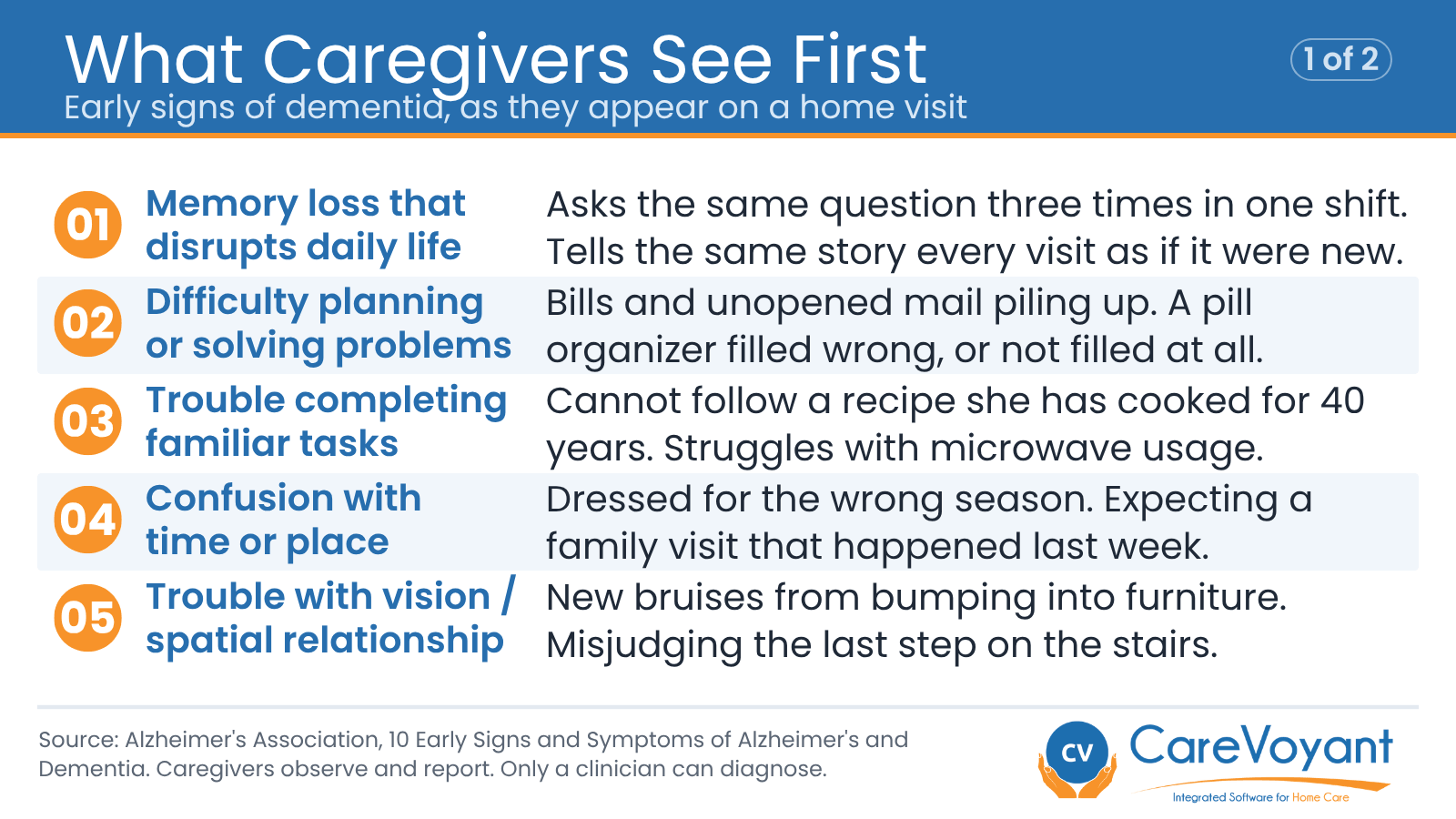
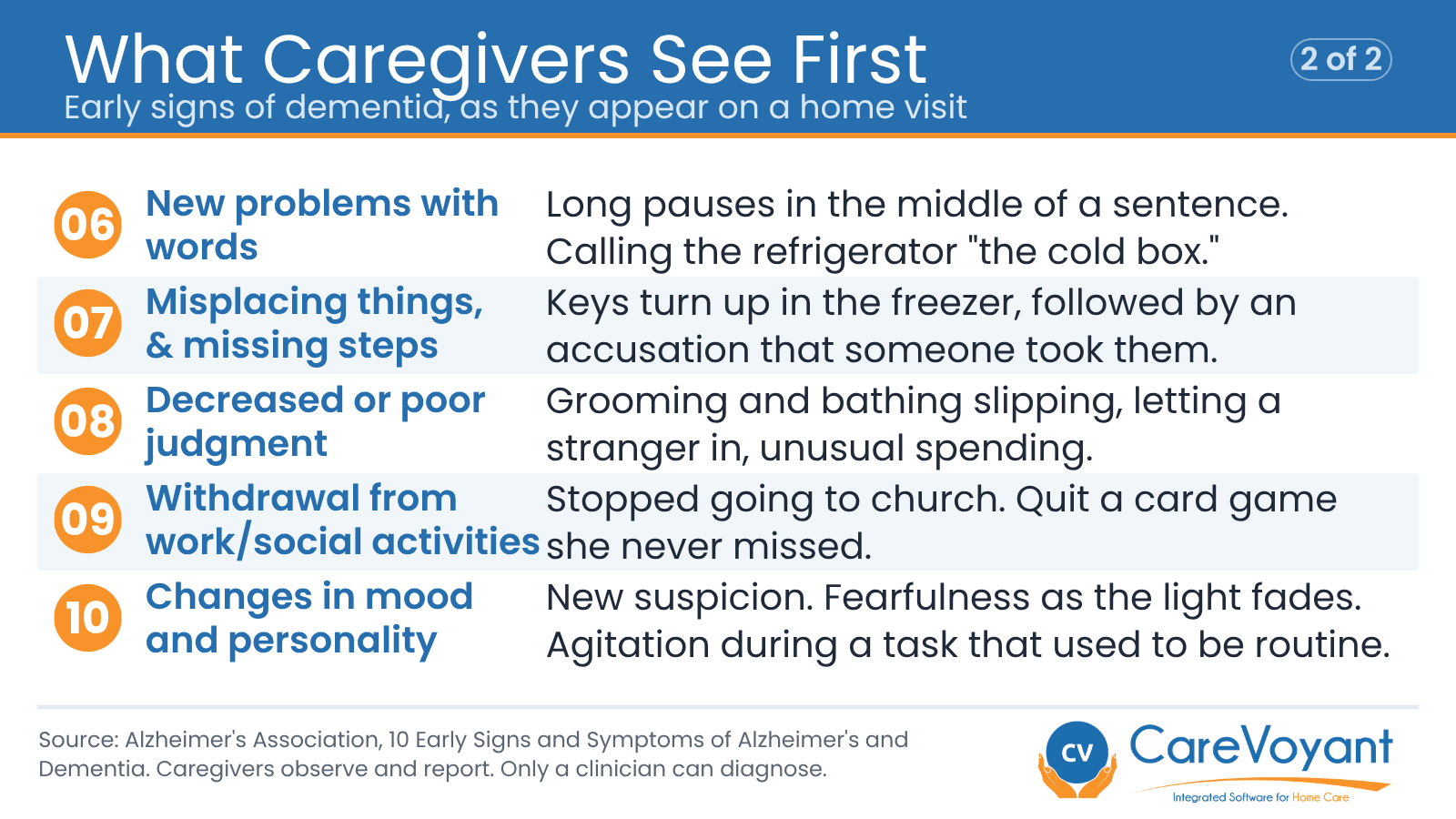
The Alzheimer’s Association publishes ten early signs and symptoms of Alzheimer’s and dementia. In a clinical setting they read as categories. In a home, on a Tuesday morning, they look like this.
| The recognized warning sign | What it looks like on a home visit |
|---|---|
| Memory loss that disrupts daily life | Asks the same question three times in one shift, or tells the same story every visit as if it were new. |
| Difficulty planning or solving problems | Bills and unopened mail piling up, checkbook entries that do not reconcile, a pill organizer filled wrong or not at all. |
| Trouble completing familiar tasks | Cannot follow a recipe she has cooked for forty years, or struggles with the microwave and the TV remote she has always used. |
| Confusion with time or place | Dressed for the wrong season, expecting a family visit that happened last week, unsure how she got to the living room. |
| Trouble with vision or spatial relationships | New bruises from bumping into furniture, misjudging the last step, difficulty telling the tub from the floor tile. |
| New problems with words | Long pauses in the middle of a sentence, calling the refrigerator “the cold box,” dropping out of conversation. |
| Misplacing things and losing the ability to retrace steps | Keys turn up in the freezer, followed by an accusation that someone took them. |
| Decreased or poor judgment | Grooming and bathing slipping, letting a stranger in, unusual spending or repeated donations to phone solicitors. |
| Withdrawal from work or social activities | Stopped going to church, quit a card game she never missed, screens calls from a longtime friend. |
| Changes in mood and personality | New suspicion, fearfulness as the light fades, agitation during a task that used to be routine. |
One incident proves nothing. Everyone loses keys. The signal is frequency, pattern, and change over time, and the only person positioned to see all three is someone in the same rooms with the same person week after week.
Where the line is: observe and report, never diagnose
Caregivers do not assess, interpret, or diagnose. They observe and they report. Where that duty comes from depends on the kind of agency you run.
For private duty and non-medical personal care, no single federal rule applies in the same way, and requirements vary by state licensure. Illinois, for example, requires that home services worker training cover “Observing, reporting and documenting client status and the care or service provided, including changes in functional ability and mental status demonstrated by the client.” That is a training requirement rather than a reporting mandate, which is why it is worth reading your own state’s home care licensure rules rather than assuming. Where nothing applies, write the expectation into agency policy anyway. An observation that never reaches a supervisor is an observation that never happened.
The difference between a useful report and a useless one is language. Compare these two entries.
Weak
“Client seems confused lately, maybe getting dementia.”
Strong
“9/14, 9/16, 9/19: Client asked me what day it is 4 times during a 3 hour shift on each visit. On 9/16 she was unable to locate the bathroom in her own home and asked me to show her. Reported to supervisor 9/19.”
The second entry is dated, specific, countable, and functional. It contains no conclusion about what is wrong with the client, and that is exactly what makes it usable by someone qualified to reach one.
Turning observations into something a physician can act on
Four things need to be in place. None of them are complicated, and most agencies are missing at least two.
A place to put the observation. If cognitive and behavioral changes live only in free text shift notes, nobody can see the pattern across eight weeks. Structured fields captured at the visit make change visible over time instead of leaving it scattered through a hundred paragraphs.
A defined escalation path. Who the caregiver tells, how quickly, what the supervisor does with it, and when the family and the physician are contacted. One page, written down, and distributed to every field staff member.
A supervisory visit that looks for it. Add a cognitive and behavioral observation prompt to the supervisory visit form so the question is asked on a schedule rather than only after something goes wrong.
A clean handoff to the clinician. A dated, plain language summary of observed changes, sent ahead of the appointment, is precisely the independent history a physician needs and rarely receives.
The first and the fourth are software problems. Point of care clinical documentation gives caregivers structured fields at the visit instead of a blank box, and care coordination and communication tools move what they record to the supervisor, the family, and the physician without a chain of phone calls.
What an earlier diagnosis changes for the agency
More than 7 million Americans are living with Alzheimer’s, nearly 13 million family members and friends provide their unpaid care, and the country will need close to 800,000 additional direct care workers between 2024 and 2034, the largest projected shortage in any single occupation. Agencies will serve this population whether they prepare for it or not.
Preparing earlier changes several things at once.
A plan of care written against a known diagnosis is better than one written against “the client is a little forgetful.”
Caregiver matching and continuity can begin before behaviors escalate, when the relationship is easier to build.
Families make decisions on their own timeline instead of in an emergency department at two in the morning.
Crisis hospitalizations and unplanned discharges fall when the plan of care fits the condition.
Training investment pays back sooner, which is the argument for specialized dementia and Alzheimer’s training for caregivers.
Five things your agency can do this month
Send every field caregiver the ten warning signs in a one-page format they can keep in the car and confirm they know the difference between reporting and diagnosing.
Add a cognitive and behavioral observation prompt to your visit note and to your supervisory visit form.
Write the escalation path on one page: caregiver to supervisor within one shift, supervisor to family and physician within 48 hours.
Give families the Alzheimer’s Association 24/7 helpline number, 800.272.3900, and make sure caregivers know it exists.
Pick one client whose file already holds scattered observations and pull them into a single dated summary for the next physician visit. That is the whole practice, done once.
Conclusion
Return to the aide from the first paragraph. She is not a diagnostician, and she should never be asked to be one. What she is the only person in that client’s life who sees the same rooms, the same routines, and the same person often enough to notice what changed.
Whether that observation reaches someone who can act on it is not a clinical question. It is an operational one, and the agency decides the answer.
Knowing earlier is what makes everything else possible.
CareVoyant is an integrated home care software platform for private duty, home health, and pediatric agencies. It helps you capture what caregivers see at the point of care and get it to the right person quickly. Request a demo to see how it works for your agency.
Frequently Asked Questions (FAQs)
-
No. Aides observe and report. Only a physician or qualified clinician can diagnose dementia or Alzheimer’s disease. The caregiver’s role is to document specific, dated observations of change and report them to a supervising nurse or to the agency, which then communicates with the family and the physician.
-
The most common early observations in a home setting are repeated questions within a single visit, unopened mail and unpaid bills, medications left in the organizer, dressing for the wrong season, difficulty with a long familiar task such as cooking, misplacing items in unusual places, withdrawal from activities the person always enjoyed, and new suspicion or agitation.
-
Record what was observed, when it happened, and how often, using objective language and no conclusions. Report it to the supervising nurse or agency supervisor the same day, following agency policy. For Medicare certified home health agencies, reporting changes in the patient’s condition to a registered nurse or other appropriate skilled professional is required under federal conditions of participation.
-
An earlier diagnosis opens access to treatment, support services, and planning while the person can still take part in decisions about their own care. It also lets an agency build the plan of care, caregiver assignment, and training around the actual condition rather than reacting to a crisis later.
-
A physician visit is short and the person may present well. Documentation from caregivers who see the client repeatedly over weeks supplies the pattern and the functional detail a clinician cannot observe in the office, which is the kind of history a detailed cognitive assessment calls for.
About CareVoyant
CareVoyant is a leading provider of cloud-based integrated enterprise-scale home health care software that can support all home-based services under ONE Software, ONE Patient, and ONE Employee, making it a Single System of Record. We support all home based services, including Home Care, Private Duty Nursing, Private Duty Non-Medical, Home and Community Based Services (HCBS), Home Health, Pediatric Home Care, and Outpatient Therapy at Home.
CareVoyant functions – Intake, Authorization Management, Scheduling, Clinical with Mobile options, eMAR/eTAR, Electronic Visit Verification (EVV), Billing/AR, Secure Messaging, Notification, Reporting, and Dashboards – streamline workflow, meet regulatory requirements, improve quality of care, optimize reimbursement, improve operational efficiency and agency bottom line.
For more information, please visit CareVoyant.com or call us at 1-888-463-6797.
Request for Information
To learn more about CareVoyant Software and how we improve the operational efficiency of Home Healthcare Agencies, contact us:
