

The Medicare Advantage Squeeze on Home Health Agencies
It is 4:45 on a Friday. An on-call scheduler books three weekend visits for a patient recovering from hip surgery. The nurse makes the visits and signs the notes. On Monday, the billing team finds that the patient's Medicare Advantage authorization expired on Thursday. The clinician time, the mileage, and the documentation for all three visits may never be paid.
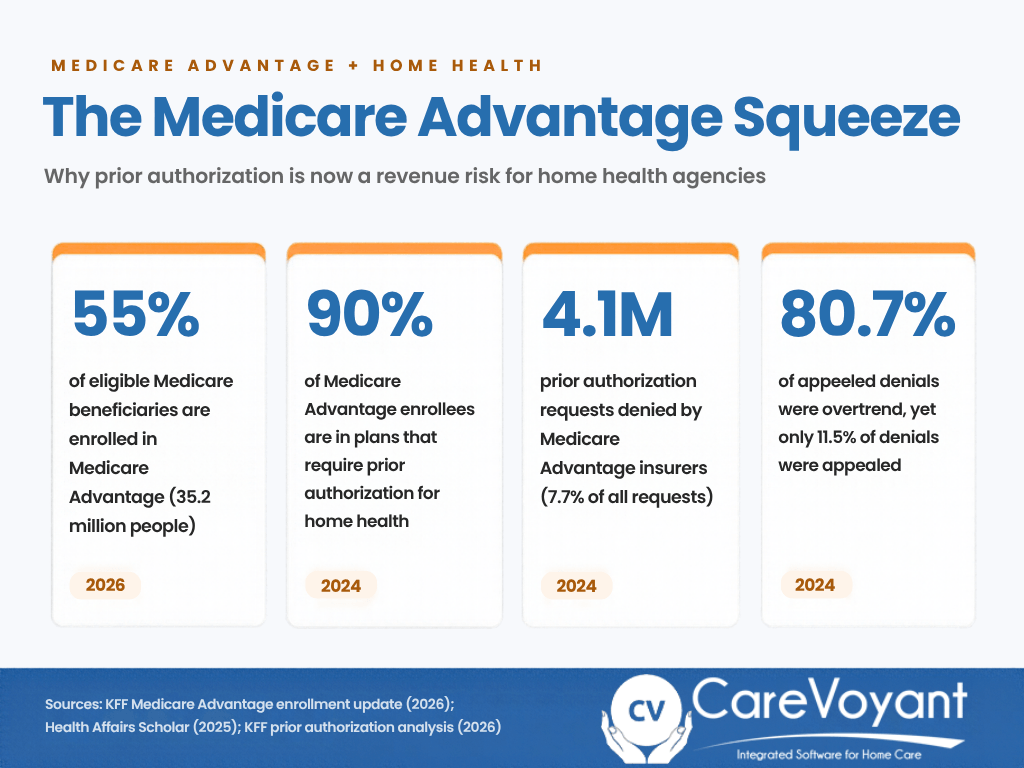
Home health agencies face this risk more often every year. According to KFF's 2026 Medicare Advantage enrollment update, 55% of eligible Medicare beneficiaries, or 35.2 million people, are now enrolled in Medicare Advantage plans. Researchers at Johns Hopkins, Brown University, and the University of Colorado studied this directly. Their 2025 study in Health Affairs Scholar reports that 90% of Medicare Advantage enrollees were in a plan that required prior authorization for home health care in 2024.
The approval process also carries real risk. KFF's analysis of 2024 prior authorization data found that Medicare Advantage insurers made 52.8 million prior authorization determinations and denied 4.1 million of them (7.7%). The HHS Office of Inspector General found that 13% of the denied prior authorization requests in its review met Medicare coverage rules and would likely have been approved under traditional Medicare.
Agencies lose revenue in two ways: denials they have to fight, and lapses they cause themselves. Lapses include visits completed after an authorization period ends, visits scheduled beyond approved units, and re-authorization requests that miss the window. Denials depend partly on the payer. Lapses are within the agency's control, and fixing them starts with the systems behind the schedule.
Why Medicare Advantage Authorization Lapses Keep Happening in Home Health
Lapses rarely come from a lack of effort. They come from asking people to track a complex, payer-specific process with tools that were not built for it. A national survey published in Health Affairs Scholar found that billing and coding specialists at provider organizations spend a median of 11 hours per week on prior authorization work.
Most lapses trace back to three structural failures:
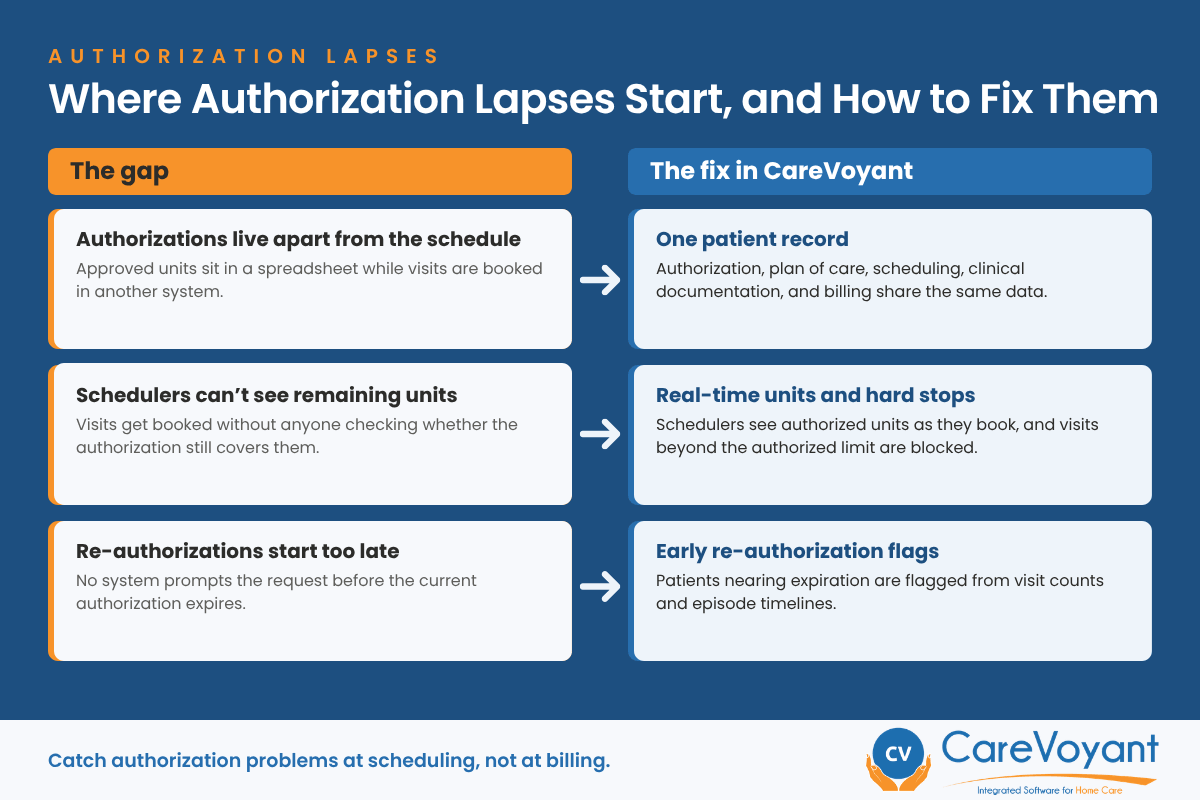
Authorization records live apart from the schedule. The approved units sit in one system or spreadsheet, and visits are booked in another.
Schedulers cannot see remaining units when they book. A visit gets added without anyone checking whether the authorization still covers it.
Re-authorization requests start too late, or not at all. Everyone knows the authorization will expire, but no system prompts the request in time.
The payer mix makes all three harder. The 2025 Health Affairs Scholar study documented wide differences in authorization processes, visit limits, and approval criteria from one Medicare Advantage plan to the next. An agency with several plans in its contract mix is effectively running several authorization systems at once.
Manual workarounds break under that load. Soft alerts get clicked past. Spreadsheets fall behind when the coordinator is out. On-call staff book weekend visits without an authorization check. Appeals help, but only when someone has time to file them. According to KFF, only 11.5% of denied Medicare Advantage requests were appealed in 2024, even though 80.7% of appealed denials were fully or partially overturned.
What agencies need is a system where authorization compliance is enforced by the platform, rather than dependent on someone remembering to check.
What Changed in 2026: New CMS Prior Authorization Rules for Medicare Advantage
Two federal rules now shape how Medicare Advantage plans handle home health prior authorization.
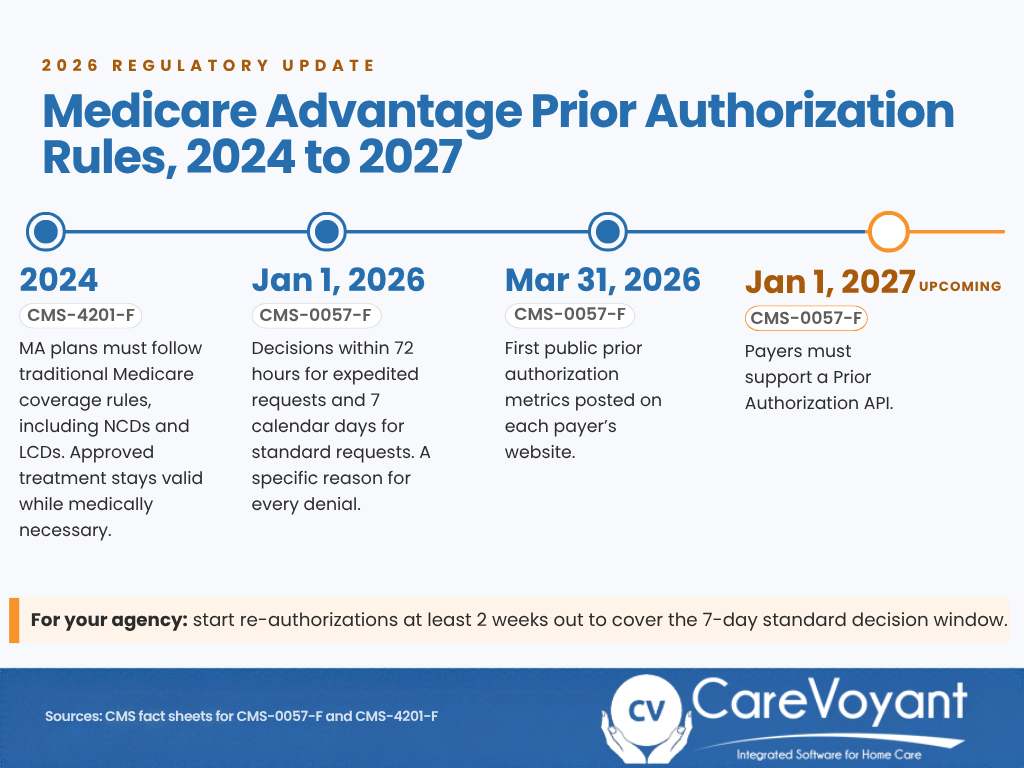
The CMS Interoperability and Prior Authorization Final Rule (CMS-0057-F). According to the CMS fact sheet, starting January 1, 2026, Medicare Advantage organizations must:
Send prior authorization decisions within 72 hours for expedited (urgent) requests and within 7 calendar days for standard requests.
Give a specific reason for every denied prior authorization request
Publicly report prior authorization metrics on their websites each year, with the first reports due March 31, 2026
Payers must also support a Prior Authorization API by January 1, 2027.
The 2024 Medicare Advantage Final Rule (CMS-4201-F). Under this rule, Medicare Advantage plans must follow the same coverage rules as traditional Medicare, according to the CMS fact sheet. That includes national coverage determinations, local coverage determinations, and general coverage conditions. Plans may use prior authorization only to confirm diagnoses or other medical criteria, or to confirm medical necessity. An approval for a course of treatment must remain valid for as long as it is medically reasonable and necessary.
Check the coverage criteria before you appeal a denial. Ask the plan which criteria it applied, and compare them with the Medicare national or local coverage determination for the service. Under the 2024 rule, Medicare Advantage plans cannot apply stricter criteria where Medicare's own coverage rules are fully established. Since January 2026, every denial must also state a specific reason you can respond to.
What this means for your agency:
Plan re-authorizations around the 7-day clock. If a standard decision can take up to 7 calendar days, starting re-authorizations at least two weeks before expiration leaves room for a full review plus a request for more information.
Use the denial reason to build stronger appeals. A specific reason tells your team which documentation to supply, as long as that documentation is easy to retrieve.
Compare payers with their published metrics. Public approval rates and decision times give agencies data to bring into contract discussions.
Fix internal lapses yourself. A faster decision does not help if nobody submitted the request on time.
Soft Alerts vs. Hard Stops in Home Health Scheduling
A hard stop is the most important control in authorization management for home health agencies. It is the difference between a warning staff can dismiss and a system-enforced gate that blocks a visit when no valid authorization covers it.
Think of a credit card declined at the point of sale. The friction happens before the cost, not after.
| Criteria | Soft alert | Hard stop |
|---|---|---|
| What it does | Shows a warning about the authorization | Blocks the visit from being booked |
| Can staff click past it? | Yes, in seconds | No, the authorization issue must be resolved first |
| When the problem is found | Often at billing, after the visit | At scheduling, before the visit |
| Weekend and on-call coverage | Depends on who is working | Applies to every user, every shift |
| Typical result | Unbillable visits and retro-authorization requests | Visits that stay within an active authorization |
Decide who can override a hard stop before you turn it on. Set how overrides are logged, and who on-call staff should contact when a weekend visit hits an expired authorization. A hard stop with no escalation path pushes staff back to workarounds.
How CareVoyant Builds Authorization Management Into the Workflow
CareVoyant addresses the authorization problem at its source by connecting authorization management to scheduling, clinical documentation, and home health billing and revenue cycle management within a single patient record. The four areas below are where authorization failures most often occur.
1. One Platform and One Patient Record, With No Data Silos
The root cause of most authorization lapses is fragmented data: authorizations in one system, scheduling in another, billing in a third. Every manual transfer between them is a chance for an error.
In CareVoyant, one patient record covers the home care intake process, authorization, plan of care, scheduling, clinical documentation, and billing. Authorization data is entered once and flows into every downstream workflow.
Authorization and plan of care data links directly to scheduling and billing, which supports authorization management for an efficient home care RCM, so authorized unit counts are current wherever decisions are made
Medicare, Medicare Advantage, Medicaid, and private insurance are managed within the same patient account, with no switching between systems to check authorization status
Multiple lines of service, including Medicare Certified, Private Duty Nursing, Home and Community Based Services, and Pediatric Home Care, run under one patient record and one employee record
No redundant data entry across service lines or payer types
Learn more: Authorization and Plan of Care Management
2. Scheduling Hard Stops Tied to Authorized Units
CareVoyant's approach to scheduling and authorization management for home care agencies is built on direct integration between the two:
Schedulers see authorized unit counts in real time as they book visits, with no need to check a separate system or call the billing team.
The system prevents scheduling services beyond authorized limits, so visits that would exceed the approved unit count cannot be booked without an active authorization on file.
Authorization compliance is enforced when the visit is scheduled, not discovered at billing after the visit can no longer be paid.
The system also flags underused authorizations, so agencies can deliver the authorized care before the period expires
The Friday afternoon scenario at the top of this article ends differently: the weekend visits cannot be booked until someone resolves the expired authorization.
Learn more: Home Health Scheduling Features
3. A Re-Authorization Pipeline That Starts Early
Hard stops keep visits within valid authorizations. The bigger goal is securing the re-authorization before the current one expires, so the hard stop never has to fire.
Agencies almost always know when an authorization is about to expire. The gap is a system that acts on that knowledge at the right time, with the right clinical documentation ready. CareVoyant handles both.
Process: CareVoyant's plan of care management features flag re-authorization needs based on visit counts and episode timelines. Patients approaching expiration are surfaced early enough to submit the request and absorb the payer's decision window.
Start re-authorizations at least two weeks before expiration. A standard Medicare Advantage decision can take up to 7 calendar days, and a request for more information adds more time. Two weeks leaves room for both. Set an earlier trigger for any plan whose contract specifies its own submission window.
Documentation: CareVoyant's point of care documentation, a core part of clinical documentation for home health care agencies, produces OASIS assessments and 485 plan of care orders from visit notes completed in the field, with no double entry. That clinical record flows into the authorization module, so re-authorization packages are built from current clinical data instead of a last-minute paperwork rush.
The Care Coordination and Communication module is one of CareVoyant's care coordination tools for home health care agencies. It keeps scheduling, clinical, and billing teams aligned on re-authorization status without email chains or status meetings.
Learn more: Clinical and Point of Care Features
4. Authorization Dashboards Across Every Payer and Branch
Managing authorizations at scale requires a live view of expiration dates, remaining units, pending re-authorization requests, and utilization across all active patients and all payers.
Most agencies have no single view of this. Authorization data is scattered across billing systems, scheduling tools, and payer portals, which makes proactive management very difficult.
CareVoyant's Reports and Dashboards module gives administrators real-time visibility into authorization status across the entire census. Authorization lapse rate, re-authorization turnaround time, and utilization rate by payer can be tracked as key performance indicators for home care agencies, rather than billing problems discovered after the fact.
Review three numbers every month. Track authorization lapse rate, re-authorization turnaround time, and utilization by payer. A rising lapse rate signals a process gap, slow turnaround points to a payer or documentation problem, and low utilization means authorized care is going undelivered.
Because CareVoyant is cloud-based, administrators managing multiple branches see the same live data as every branch team.
Learn more: Reports and Dashboards Features
Medicare Advantage Authorization Checklist for Home Health Agencies
Use this checklist to find the gaps in your current authorization process:
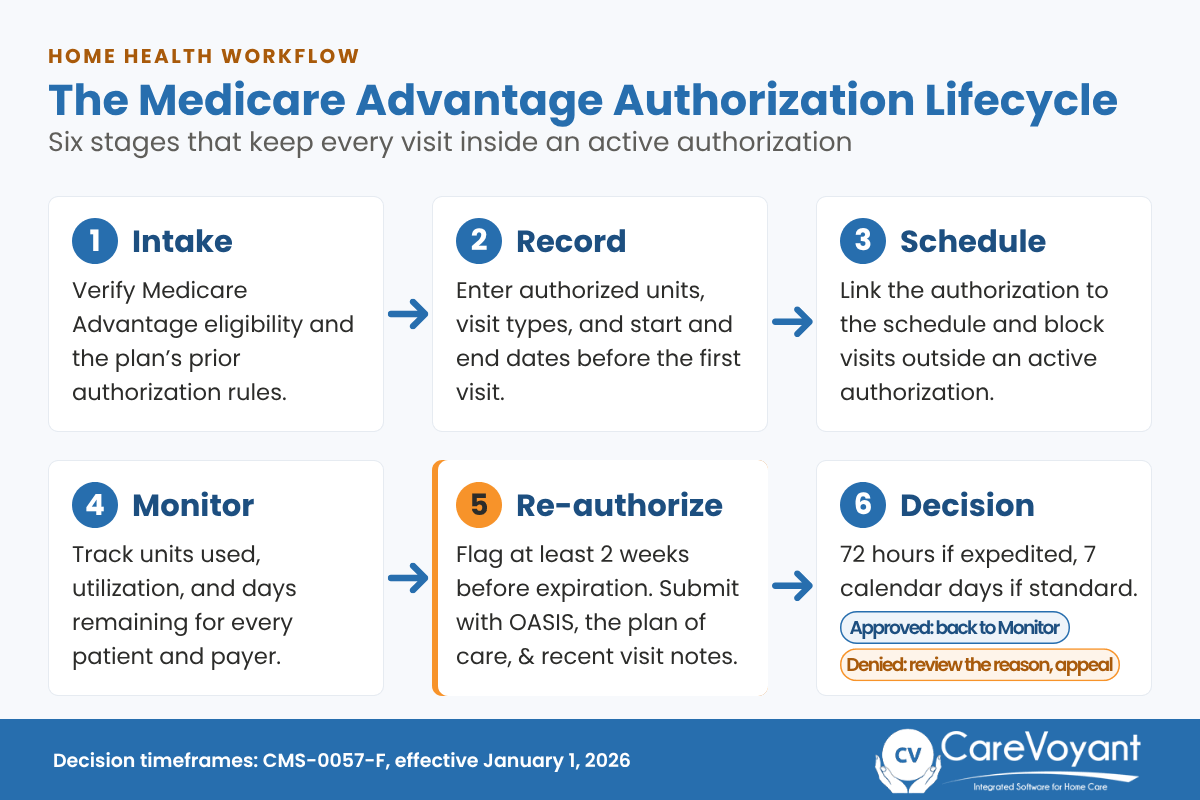
Verify Medicare Advantage eligibility and the plan's prior authorization rules at intake.
Record authorized units, visit types, and start and end dates in the patient record before the first visit.
Connect each authorization to the schedule so remaining units are visible at booking.
Block visits that fall outside an active authorization.
Flag re-authorizations at least two weeks before expiration.
Build re-authorization requests from current clinical documentation, including OASIS, the plan of care, and recent visit notes.
Track each payer's decision against the 72-hour and 7-day CMS-0057-F timeframes, and follow up when a plan misses them.
Review the stated reason on every denial and appeal when your documentation supports medical necessity.
Report lapse rate, re-authorization turnaround, and utilization by payer every month.
How CareVoyant Supports Every Role in Authorization Management
CareVoyant spreads authorization accountability across the agency, instead of leaving it in one coordinator's spreadsheet.
Schedulers get real-time unit visibility and hard stops, so no visit is booked beyond authorized limits. Among the must-have scheduling features for home care, this is the one that most directly protects revenue.
Billing and RCM teams receive cleaner claims because authorization compliance is enforced upstream. As our guide to effective revenue cycle management for home care explains, problems caught before a visit cost far less than problems caught at billing.
Agency administrators get dashboard-level visibility into authorization use and denial trends across every branch. Our guides to home care software for administrators and home care software for enterprise agencies cover what to look for at larger scale.
Stop Losing Revenue to Medicare Advantage Authorization Gaps
Medicare Advantage enrollment continues to grow, and every plan in your contract mix brings its own authorization rules. The 2026 CMS rules make payers faster and more transparent, but they cannot prevent a visit booked after an authorization has expired. Agencies working to reduce unbilled claims and improve cash flow in home care need authorization compliance built into the system rather than left to individual effort.
CareVoyant has served home care agencies since 1996. Our home health care software for Medicare Certified agencies treats authorization management as a core workflow across intake, scheduling, clinical documentation, and revenue cycle, rather than a billing task added at the end.
See how CareVoyant handles Medicare Advantage authorizations in a live workflow. Schedule a demo.
Frequently Asked Questions
-
Medicare Advantage plans are run by private insurers that use prior authorization to manage costs. In 2024, 90% of Medicare Advantage enrollees were in a plan that required prior authorization for home health care. Medicare Advantage insurers denied 4.1 million prior authorization requests that year, or 7.7% of all determinations. Under CMS rules in effect since 2024, plans must follow the same coverage criteria as traditional Medicare, but each plan still sets its own submission process, visit limits, and re-authorization timelines.
-
An authorization lapse occurs when a visit is completed after the authorization period has ended or after the approved units have been used. The Medicare Advantage plan usually will not pay for that visit, so the agency absorbs the clinician time, mileage, and documentation cost. To estimate your exposure, multiply your annual Medicare Advantage visits by your lapse rate and your average reimbursement per visit. For example, an agency with 300 Medicare Advantage patients averaging two visits per week completes about 31,200 visits a year. Even a 1% lapse rate means about 312 visits that may never be paid.
-
A scheduling hard stop is a system rule that blocks a visit from being booked when the patient's authorized units are used up or the authorization period has ended. A soft alert shows a warning that staff can dismiss with one click. A hard stop requires the authorization issue to be resolved before the visit can be scheduled. Hard stops protect agencies during busy periods, on weekends, and when on-call staff are covering.
-
Under CMS-0057-F, Medicare Advantage plans must decide expedited prior authorization requests within 72 hours and standard requests within 7 calendar days, starting January 1, 2026. Plans must also give a specific reason for every denial and publish prior authorization metrics each year. These rules help agencies plan re-authorization timing and build targeted appeals, but they do not prevent lapses caused by late requests or visits scheduled outside an active authorization.
-
Start early enough to cover the payer's full decision window plus time for requests for more information. With standard decisions allowed up to 7 calendar days under CMS-0057-F, starting at least two weeks before expiration is a practical rule. Check each plan's contract, because some plans set their own submission windows. Strong re-authorization requests include current OASIS data, the plan of care, and recent visit notes that show continued medical necessity.
-
CareVoyant uses three connected controls. The Authorization and Plan of Care module tracks approved and used units for every patient across all payers. That data feeds the scheduling system, where hard stops block visits that would exceed the authorization. The platform also flags patients approaching expiration based on visit counts and episode timelines, so re-authorization requests go out on time.
About CareVoyant
CareVoyant is a leading provider of cloud-based integrated enterprise-scale home health care software that can support all home-based services under ONE Software, ONE Patient, and ONE Employee, making it a Single System of Record. We support all home based services, including Home Care, Private Duty Nursing, Private Duty Non-Medical, Home and Community Based Services (HCBS), Home Health, Pediatric Home Care, and Outpatient Therapy at Home.
CareVoyant functions – Intake, Authorization Management, Scheduling, Clinical with Mobile options, eMAR/eTAR, Electronic Visit Verification (EVV), Billing/AR, Secure Messaging, Notification, Reporting, and Dashboards – streamline workflow, meet regulatory requirements, improve quality of care, optimize reimbursement, improve operational efficiency and agency bottom line.
For more information, please visit CareVoyant.com or call us at 1-888-463-6797.
Request for Information
To learn more about CareVoyant Software and how we improve the operational efficiency of Home Healthcare Agencies, contact us:
