

Tracking the right private duty nursing KPIs helps PDN agencies improve care quality, ensure regulatory compliance, and boost profitability. Focus on 10 essential nursing agency metrics to optimize operations, empower caregivers, and enhance patient satisfaction.
Introduction
Private Duty Nursing (PDN) agencies provide essential in-home care for patients with complex medical needs, enabling them to remain in the comfort of their homes. However, without effective tracking of Key Performance Indicators (KPIs), agencies may struggle with operational inefficiencies, compliance issues, and financial challenges. Implementing a robust KPI framework allows agencies to monitor clinical outcomes, optimize resource allocation, and enhance patient satisfaction.
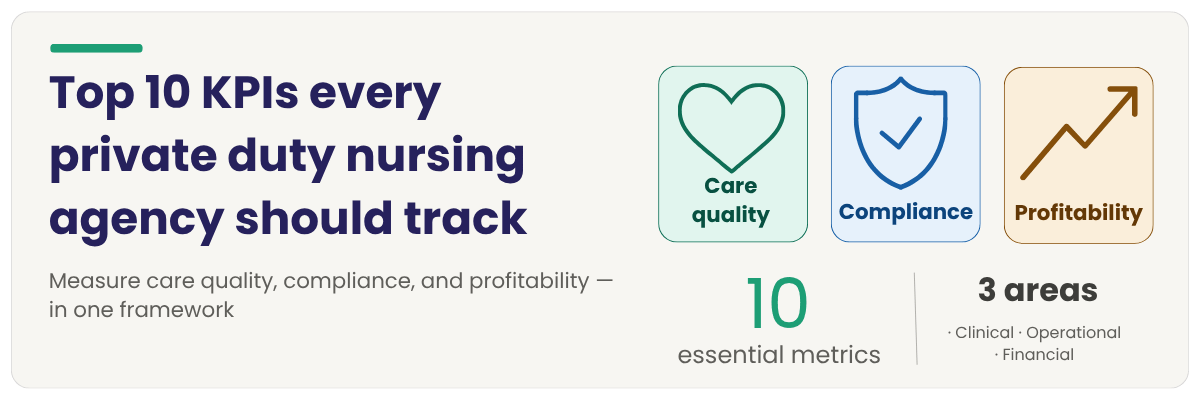
This article explores the top 10 KPIs every PDN agency should track to ensure high-quality care and sustainable operations.
Why KPIs Matter for Private Duty Nursing Agencies
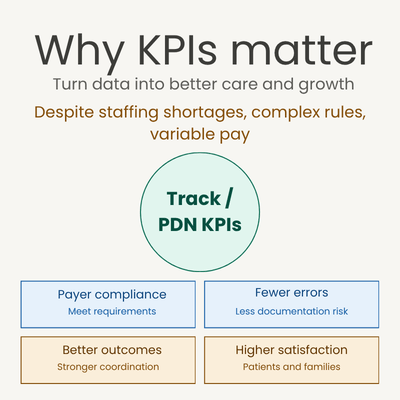
Healthcare KPIs are essential tools for PDN agencies to measure clinical quality, operational efficiency, and financial health. By tracking PDN performance indicators, agencies can ensure compliance with payer requirements, reduce documentation errors, and enhance patient outcomes. For instance, verifying Medicaid eligibility quickly improves payer compliance and reduces billing delays.
Monitoring nursing agency metrics provides actionable insights that improve care coordination, strengthen caregiver accountability, and boost patient and family satisfaction. In today’s home health environment, PDN agencies face multiple challenges, including staffing shortages, complex regulatory requirements, and variable reimbursement structures. Without a clear view of performance through KPIs, agencies risk inefficient operations, non-compliance, and reduced profitability. Systematically tracking the right private duty nursing KPIs enables agencies to proactively address these challenges, optimize resources, and maintain high-quality care.
Top 10 KPIs Every PDN Agency Should Track
Clinical quality KPIs
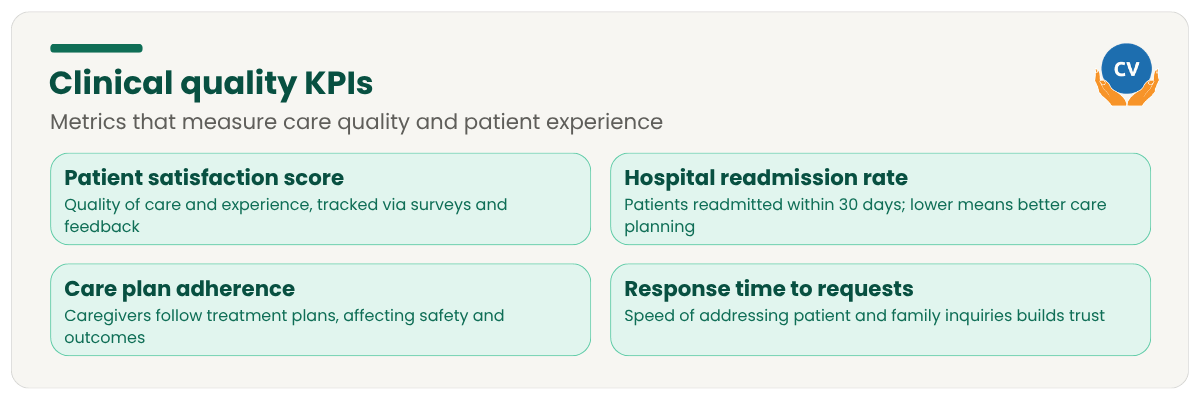
These metrics show how well your agency delivers safe, effective, patient-centered care. Tracking them helps you catch gaps early, improve outcomes, and strengthen your reputation with families and referral sources.
1. Patient Satisfaction Score
Patient satisfaction is a critical private duty nursing KPI that reflects the quality of care, caregiver professionalism, and overall patient experience. Agencies can track it using surveys, online reviews, or direct feedback from families. High scores indicate effective care coordination and a strong community reputation. Learn more in 4 ways to measure and grow home care patient satisfaction.
2. Hospital Readmission Rate
A vital healthcare KPI, readmission rate tracks patients readmitted within 30 days. Lower rates indicate effective care planning and follow-up, supporting payer compliance and better clinical outcomes. Related reading: benefits of effective care planning in home health care.
3. Care Plan Adherence
Tracking adherence ensures caregivers follow prescribed treatment plans, directly affecting patient safety and clinical outcomes. This PDN performance indicator is essential for regulatory compliance and quality reporting. Resources include patient-clinician matching with private duty home care software and care coordination tools for home health care agencies.
4. Response Time to Patient/Family Requests
Fast responses enhance satisfaction and trust. This healthcare KPI tracks the time taken to address patient or family inquiries, ensuring proactive care management. Recommended reading: enhancing care team communication to improve quality of care and how to improve care team communication in home care.
Operational efficiency KPIs
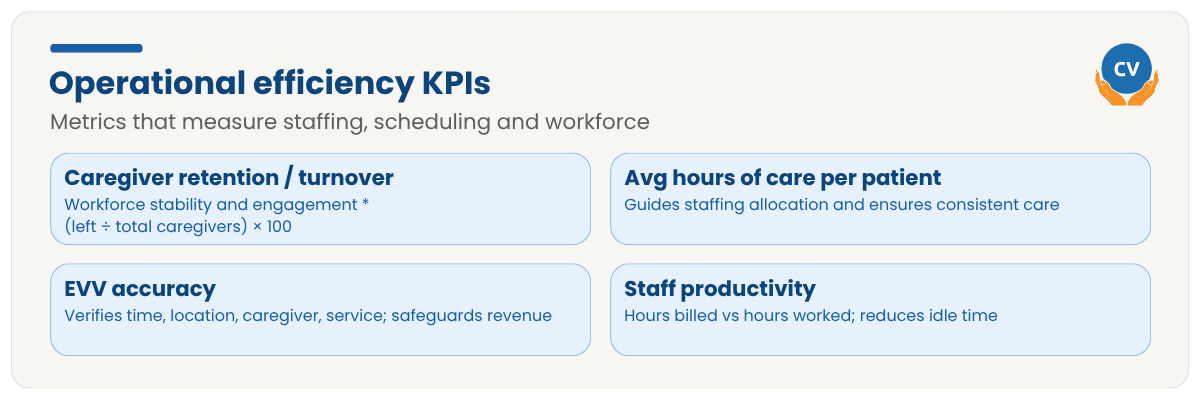
These metrics reveal how smoothly your staffing, scheduling, and daily workflows run. Monitoring them helps you retain caregivers, control costs, and make sure the right care reaches the right patient at the right time.
5. Caregiver Retention & Turnover Rate
Tracking caregiver retention helps PDN agencies reduce recruitment costs and maintain continuity of care. Calculate turnover as (# of caregivers who leave ÷ total caregivers) × 100. This PDN performance indicator highlights workforce stability and employee engagement. Useful references: strategies to improve employee retention in home care and 5 reasons employees quit their home care jobs.
6. Average Hours of Care per Patient
Monitoring hours of care per patient helps agencies allocate staffing efficiently and ensure patients receive consistent care. This is a key nursing agency metric for operational planning. See optimize home care staff utilization with intelligent scheduling for practical strategies.
7. Visit Verification Compliance (EVV Accuracy)
Electronic Visit Verification (EVV) ensures accurate documentation of time, location, caregiver ID, and services. This private duty nursing KPI minimizes billing errors, supports state compliance, and safeguards revenue. For guidance, see how to achieve EVV compliance with CareVoyant home care software or explore our EVV software solutions.
8. Staff Productivity / Hours Billed vs. Hours Worked
Compare hours billed to hours worked to measure caregiver efficiency. This private duty nursing KPI identifies gaps, reduces idle time, and supports optimal workforce utilization. See 6 steps to improve clinician utilization for home health care agencies for actionable strategies.
Financial health KPIs
These metrics keep your revenue cycle and compliance on track. Watching them closely helps you reduce claim rejections, get reimbursed faster, and stay aligned with state and federal requirements.
9. Billing Accuracy & Claim Rejection Rate
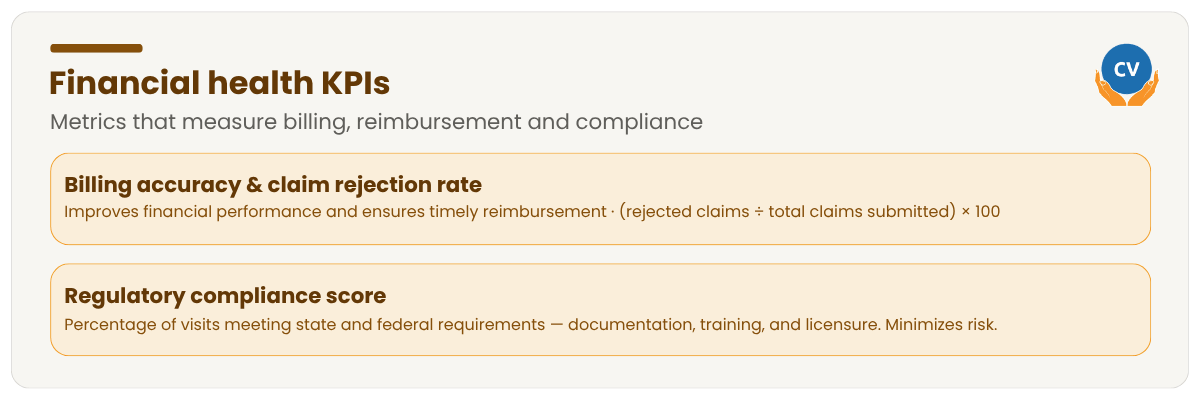
Calculate claim rejection as (# of rejected claims ÷ total claims submitted) × 100. Monitoring this nursing agency metric improves financial performance and ensures timely reimbursement. Learn more in effective revenue cycle management for home care agencies and home care accounts receivable over 90 days solutions.
10. Regulatory Compliance Score
Measure the percentage of visits meeting state and federal requirements, including documentation, training, and licensure. This PDN performance indicator minimizes risk, ensures compliance, and strengthens relationships with payers. Relevant resources: stay compliant with OIG home care billing and Medicaid changes 2025 home care agencies.
How to Implement KPI Tracking in a PDN Agency
Effective KPI tracking allows PDN agencies to make data-driven decisions and optimize operations. Integrated Private Duty Nursing software automates the collection of private duty nursing KPIs, ensuring accuracy and reducing administrative burden. Dashboards and automated reports make it easy to monitor nursing agency metrics like caregiver productivity, visit verification, and patient satisfaction in real time.
Tracking PDN performance indicators consistently also supports regulatory compliance and payer requirements, while enabling proactive interventions to improve outcomes. Regularly reviewing healthcare KPIs ensures agencies stay aligned with organizational goals and maintain sustainable, high-quality care.
Common Mistakes Agencies Make with KPIs
Even with KPIs in place, PDN agencies can face pitfalls if they are not tracked strategically. Common mistakes include:
Focusing on too many irrelevant private duty nursing KPIs, which dilutes actionable insights.
Ignoring operational or clinical healthcare KPIs in favor of only financial metrics.
Failing to act on data from PDN performance indicators, rendering KPI tracking ineffective.
Relying on manual tracking instead of automated systems, increasing the risk of errors and inefficiency.
Avoiding these mistakes ensures KPI tracking supports nursing agency metrics, improves care quality, and strengthens financial and regulatory compliance.
Conclusion
Tracking the right private duty nursing KPIs is essential for PDN agencies seeking to improve care quality, operational efficiency, and financial performance. By monitoring key nursing agency metrics and PDN performance indicators, agencies can proactively address staffing challenges, maintain regulatory compliance, and enhance patient and family satisfaction. Regularly reviewing healthcare KPIs enables data-driven decision-making, better resource allocation, and sustainable growth.
For agencies looking to simplify KPI tracking and gain actionable insights, leveraging CareVoyant Private Duty Nursing Software can streamline operations, automate reporting, and support compliance. Start tracking the top 10 KPIs today to ensure high-quality, efficient, and profitable care delivery.
Frequently Asked Questions (FAQs)
-
Private Duty Nursing (PDN) KPIs are measurable performance indicators that help agencies evaluate clinical quality, operational efficiency, caregiver performance, compliance, and financial health. Common private duty nursing KPIs include patient satisfaction, caregiver retention, EVV compliance, hospital readmission rates, and billing accuracy.
-
KPIs provide actionable insights that help agencies improve patient outcomes, maintain regulatory compliance, optimize staffing, reduce costs, and increase profitability. Tracking the right nursing agency metrics allows leaders to make data-driven decisions and proactively address operational challenges.
-
There is no single most important KPI because agencies must balance clinical, operational, and financial performance. However, patient satisfaction, caregiver retention, EVV compliance, care plan adherence, and claim rejection rates are among the most critical indicators for long-term success.
-
Most agencies should review key performance indicators weekly or monthly. High-priority metrics such as caregiver scheduling, EVV compliance, and claim rejections may require daily monitoring, while strategic KPIs like patient satisfaction and caregiver retention can be reviewed monthly or quarterly.
-
Agencies can improve retention by offering competitive compensation, flexible scheduling, ongoing training opportunities, career advancement programs, recognition initiatives, and effective communication. Monitoring caregiver turnover rates helps identify workforce challenges before they impact patient care.
-
While turnover rates vary by market and organization size, agencies should strive to keep turnover as low as possible to maintain continuity of care and reduce recruitment costs. Tracking turnover trends over time is often more valuable than comparing against industry averages alone.
-
EVV helps agencies accurately track caregiver visits, verify service delivery, improve documentation accuracy, reduce billing errors, and maintain compliance with state Medicaid requirements. EVV compliance is a key performance indicator for many private duty nursing agencies.
-
Private Duty Nursing software automates data collection, reporting, scheduling, billing, documentation, and compliance monitoring. Real-time dashboards allow agencies to track KPIs such as patient satisfaction, caregiver productivity, EVV compliance, and revenue cycle performance from a single platform.
-
Key financial KPIs include claim rejection rate, billing accuracy, accounts receivable aging, revenue per patient, reimbursement turnaround time, caregiver utilization, and profitability per service line. These metrics help agencies maintain healthy cash flow and sustainable growth.
-
KPIs help agencies identify care gaps, improve care plan adherence, enhance communication, reduce hospital readmissions, and ensure timely interventions. By continuously monitoring performance, agencies can deliver higher-quality, patient-centered care while meeting compliance requirements.
About CareVoyant
CareVoyant is a leading provider of cloud-based integrated enterprise-scale home health care software that can support all home-based services under ONE Software, ONE Patient, and ONE Employee, making it a Single System of Record. We support all home based services, including Home Care, Private Duty Nursing, Private Duty Non-Medical, Home and Community Based Services (HCBS), Home Health, Pediatric Home Care, and Outpatient Therapy at Home.
CareVoyant functions – Intake, Authorization Management, Scheduling, Clinical with Mobile options, eMAR/eTAR, Electronic Visit Verification (EVV), Billing/AR, Secure Messaging, Notification, Reporting, and Dashboards – streamline workflow, meet regulatory requirements, improve quality of care, optimize reimbursement, improve operational efficiency and agency bottom line.
For more information, please visit CareVoyant.com or call us at 1-888-463-6797.
Request for Information
To learn more about CareVoyant Software and how we improve the operational efficiency of Home Healthcare Agencies, contact us:
