

Frequent CDS audit findings often stem from timesheet errors, EVV discrepancies, unapproved services, eligibility gaps, payroll issues, and documentation lapses. Proactive Consumer Directed Services compliance with CareVoyant integrated CDS software helps agencies prevent penalties and stay audit-ready.
Introduction
Consumer Directed Services (CDS) programs routinely become audit targets but that scrutiny is intensifying. Under Medicaid’s self-directed models, participants hire and manage their own caregivers through CDS, giving them greater flexibility than traditional agency models. Yet as states expand oversight, Home care Medicaid audits and Medicaid self-directed audits are rising in frequency. Many CDS audit findings trace back to weak CDS program documentation requirements, mismatches in EVV verification, and gaps in FMS compliance. Without proactive Consumer Directed Services compliance, providers risk penalties and funding loss. This article examines the most common audit findings, their root causes, and best practices to stay audit-ready.
Understanding CDS Program Compliance Requirements
Compliance in Consumer Directed Services (CDS) programs is rooted in federal and state Medicaid regulations designed to ensure accountability and appropriate use of funds. According to the Centers for Medicare & Medicaid Services (CMS), states must verify that self-directed care meets documentation, service authorization, and payment integrity standards.
Participants are responsible for managing attendants and approving timesheets, while attendants must accurately record service hours and follow care plans. Financial Management Services (FMS) providers oversee payroll, taxes, and documentation to ensure regulatory compliance.
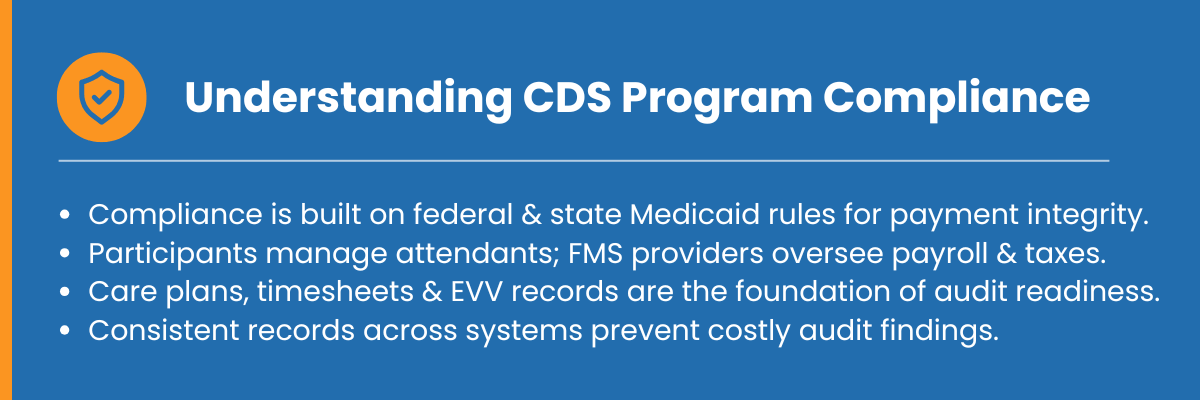
Strong CDS program documentation requirements—including care plans, timesheets, and EVV records—form the foundation of audit readiness. Auditors often focus on EVV audit discrepancies, Timesheet and EVV compliance, authorization overages, and attendant eligibility or payroll errors. Maintaining clear, consistent records across all systems is critical for sustaining Consumer Directed Services compliance and preventing costly Home care Medicaid audit findings.
Common CDS Audit Findings Identified in Medicaid Self-Directed Audits
Below are the common CDS audit findings identified in Medicaid Self-Directed Audits:

1. Incomplete or Inaccurate Timesheets
Timesheet errors are a frequent source of CDS audit findings. Common issues include missing signatures from attendants or participants, incorrect shift hours, or duplicate time entries. When visits are not verified via EVV, auditors often flag these as Timesheet and EVV compliance violations.

2. EVV Audit Discrepancies
Discrepancies between EVV records and paper documentation—such as GPS mismatches, late clock-ins, or missing visits—can trigger audit concerns. Lack of correction trails in CDS program documentation compounds the issue.

3. Unapproved or Ineligible Services
Auditors frequently find attendants performing tasks outside the approved care plan or exceeding authorized hours. Missing approvals or documentation can result in service denials.

4. Participant or Attendant Eligibility Issues
Expired background checks, licenses, or training records, along with missing participant eligibility or assessment forms, represent common compliance gaps. Non-adherence to an FMS compliance checklist can escalate these findings.

5. Payroll and Tax Record Errors
Incomplete payroll summaries, inaccurate withholding data, or mismatches between payroll and EVV records are common audit triggers. Failure to maintain proper employer tax documentation increases risk.

6. Documentation Gaps
Missing service logs, care plans, or physician notes, and inconsistent data across payroll, EVV, and authorization files, are frequently cited during audits. Comprehensive, organized records are essential for Consumer Directed Services compliance.
Preventing CDS Audit Findings with Consumer Directed Services Software
By leveraging comprehensive Consumer Directed Services software, agencies can address the root causes of audit findings, from Timesheet and EVV compliance to eligibility tracking and documentation gaps. CareVoyant Consumer Directed Services software ensures Home care Medicaid audits are navigated efficiently, penalties are minimized, and operational efficiency is maximized. For agencies managing self-directed care programs, integrated software isn’t just convenient, it’s essential for sustained compliance and financial security.

1. Automated Timesheet Accuracy

Manual timesheets often result in missing signatures, incorrect shift hours, or duplicate entries—leading to Timesheet and EVV compliance issues. CareVoyant’s EVV and CV Mobile (EVV & CV Mobile) automates visit verification, tracks GPS locations, and records corrections for auditors. Digital approvals from participants and attendants eliminate errors and provide complete audit trails.
2. Eliminating EVV Discrepancies

Discrepancies between EVV records and paper documentation, including late clock-ins or missing visits, are frequent audit triggers. CareVoyant integrates EVV with scheduling (Scheduling) and plan of care management (Authorization & Plan of Care), automatically flagging mismatches. Real-time dashboards (Reports & Dashboards) ensure administrators can address potential EVV audit discrepancies before they escalate.
3. Ensuring Authorized Services Only

Auditors often identify attendants performing non-authorized tasks or exceeding approved hours. CareVoyant enforces service plan limits through authorization and plan of care management, with automated alerts for deviations. All approvals and exceptions are digitally documented, preventing unapproved services from triggering CDS audit findings.
4. Maintaining Participant and Attendant Eligibility

Expired background checks, missing certifications, or incomplete eligibility forms frequently cause compliance issues. CareVoyant tracks credentials, licenses, and participant documentation in real-time. Automated reminders for renewals and integration with FMS processes (Payroll Integration) ensure agencies meet eligibility standards outlined in the FMS compliance checklist.
5. Accurate Payroll and Accounting Management

Payroll errors, mismatched EVV hours, and incomplete tax records are common audit findings. CareVoyant integrates time tracking with payroll and accounting (Billing & Revenue Cycle Management, Accounting Integration) to eliminate discrepancies. Automated calculations and reconciliations help agencies maintain proper documentation and meet federal and state payroll requirements.
6. Centralized Documentation for Audit Readiness

Missing care logs, clinical notes, or inconsistent records across systems are critical audit risks. CareVoyant centralizes all documentation, including clinical and point-of-care notes (Clinical & Point-of-Care), eMAR/eTAR (Medication Administration), and care coordination communication (Care Coordination). Comprehensive digital records satisfy CDS program documentation requirements, making audits smoother and less stressful.
Conclusion
Frequent CDS audit findings—including incomplete timesheets, EVV audit discrepancies, unapproved services, eligibility gaps, payroll errors, and documentation inconsistencies—can have serious consequences for agencies, from financial penalties to reputational damage. These findings highlight the importance of maintaining rigorous Consumer Directed Services compliance.
Prevention is always more effective than remediation. Agencies can reduce audit risks through consistent staff training, robust internal review processes, and the adoption of comprehensive Consumer Directed Services software. Solutions like CareVoyant centralize documentation, automate Timesheet and EVV compliance, track participant and attendant eligibility, and streamline payroll and service authorizations, helping agencies stay audit-ready at all times.
Strengthen your Consumer Directed Services compliance and reduce audit risks with CareVoyant’s all-in-one Consumer Directed Services Software solution.
Frequently Asked Questions (FAQs)
-
The most frequent findings are incomplete or inaccurate timesheets, EVV discrepancies, unapproved or ineligible services, participant or attendant eligibility gaps, payroll and tax record errors, and documentation gaps. Most trace back to weak documentation, EVV mismatches, or gaps in FMS compliance.
-
CDS is a Medicaid self-directed care model where participants hire, manage, and supervise their own caregivers (attendants) instead of using a traditional agency. This gives participants greater flexibility and control, while Financial Management Services (FMS) providers handle payroll, taxes, and compliance documentation.
-
Because participants self-direct care and multiple parties share responsibility, there are more points where records can become inconsistent. As states expand oversight of Medicaid self-directed programs, audits are rising in frequency, with auditors focusing on payment integrity, service authorization, and documentation accuracy.
-
Electronic Visit Verification (EVV) electronically confirms that a visit happened, capturing time, location, and service details. EVV discrepancies, such as GPS mismatches, late clock-ins, or missing visits, are a top audit trigger, so accurate EVV records are central to audit readiness.
-
Core documentation includes care plans, signed timesheets, EVV records, service authorizations, attendant credentials and eligibility records, and payroll and tax documentation. Records must be complete and consistent across all systems, since auditors frequently cite mismatches between payroll, EVV, and authorization files.
-
Responsibility is shared. Participants manage attendants and approve timesheets, attendants accurately record hours and follow the care plan, and FMS providers oversee payroll, taxes, and regulatory documentation.
-
Integrated CDS software addresses the root causes of findings by automating visit verification and timesheet accuracy, flagging EVV mismatches in real time, enforcing authorized service limits, tracking credential and eligibility renewals, reconciling payroll with EVV hours, and centralizing documentation so records stay audit-ready.
-
Consequences can include financial penalties, service denials or clawbacks, funding loss, and reputational damage. This is why prevention through staff training, internal review, and integrated software is more effective than after-the-fact remediation.
About CareVoyant
CareVoyant is a leading provider of cloud-based integrated enterprise-scale home health care software that can support all home-based services under ONE Software, ONE Patient, and ONE Employee, making it a Single System of Record. We support all home based services, including Home Care, Private Duty Nursing, Private Duty Non-Medical, Home and Community Based Services (HCBS), Home Health, Pediatric Home Care, and Outpatient Therapy at Home.
CareVoyant functions – Intake, Authorization Management, Scheduling, Clinical with Mobile options, eMAR/eTAR, Electronic Visit Verification (EVV), Billing/AR, Secure Messaging, Notification, Reporting, and Dashboards – streamline workflow, meet regulatory requirements, improve quality of care, optimize reimbursement, improve operational efficiency and agency bottom line.
For more information, please visit CareVoyant.com or call us at 1-888-463-6797.
Request for Information
To learn more about CareVoyant Software and how we improve the operational efficiency of Home Healthcare Agencies, contact us:
