

Multi-state, multi-payer, and multi-service agencies almost always feed several EVV aggregators and juggling separate portals invites duplicate entry, mismatches, and denied visits. As states shift to hard-deny enforcement in 2026, an unresolved exception is an unpayable claim. CareVoyant captures each visit once and routes it to the right aggregator by state, payer, and program, all in one platform.
Introduction
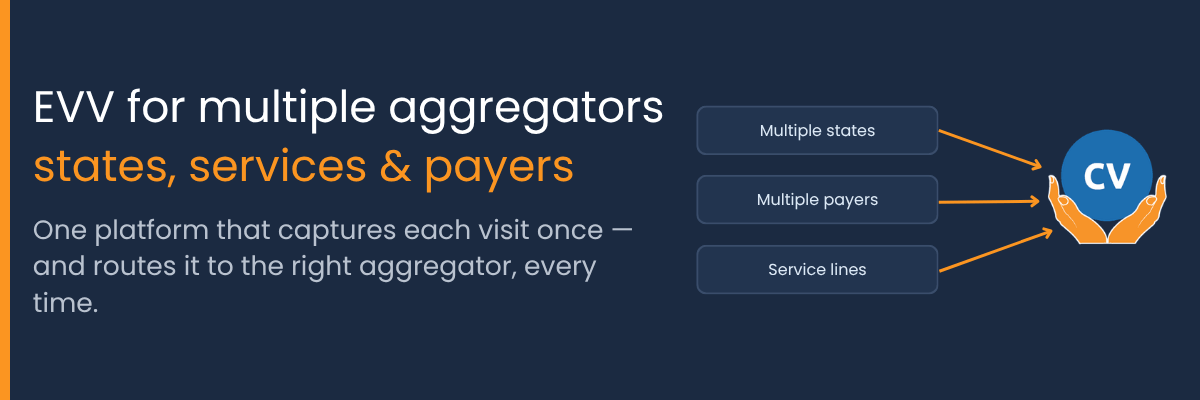
Most home care agencies don't choose to run multiple EVV aggregators. It happens to them. You add a second state, win a contract with a new Medicaid managed care organization, or expand from Personal Care into skilled Home Health — and suddenly your visit data has to reach two, three, or four different aggregators, each with its own rules.
This guide explains why that fragmentation happens, what it costs, and how a single unified platform like CareVoyant keeps every visit compliant no matter how many aggregators, states, or payers are involved.
Why One Agency Ends Up With Multiple EVV Aggregators?
The 21st Century Cures Act required every state to implement Electronic Visit Verification for Medicaid Personal Care and Home Health services. Crucially, it did not require states to use the same system. Each state picked its own model and its own aggregator, the central clearinghouse that collects and verifies visit data from every provider before claims can be paid.
There are three common reasons a single agency ends up sending data to more than one aggregator.
1. Multiple states. This is the most direct path to multiple aggregators. If you operate in two states, you almost certainly answer to two different aggregators. One state may route everything through Sandata; the next door over may mandate HHAeXchange, Netsmart, or its own state-built system.
2. Multiple payers within one state. Even inside a single state, different Medicaid managed care organizations can require different aggregators or different data specs. Some states use one system for fee-for-service Medicaid and a different system for MCO-covered members. Florida, New York, and North Carolina are frequently cited examples of states where the payer not just the state determines where your data goes.
3. Multiple service lines. Personal Care, HCBS waiver services, skilled Home Health, Private Duty Nursing, and Pediatric care can each fall under different programs with different EVV obligations. A single caregiver visit type may be in scope for one aggregator and out of scope for another, and getting that mapping wrong means rejected visits.
Open, Closed, and Hybrid EVV models
Before choosing software, it helps to know which model your states use, because it determines whether you even can use a unified platform.
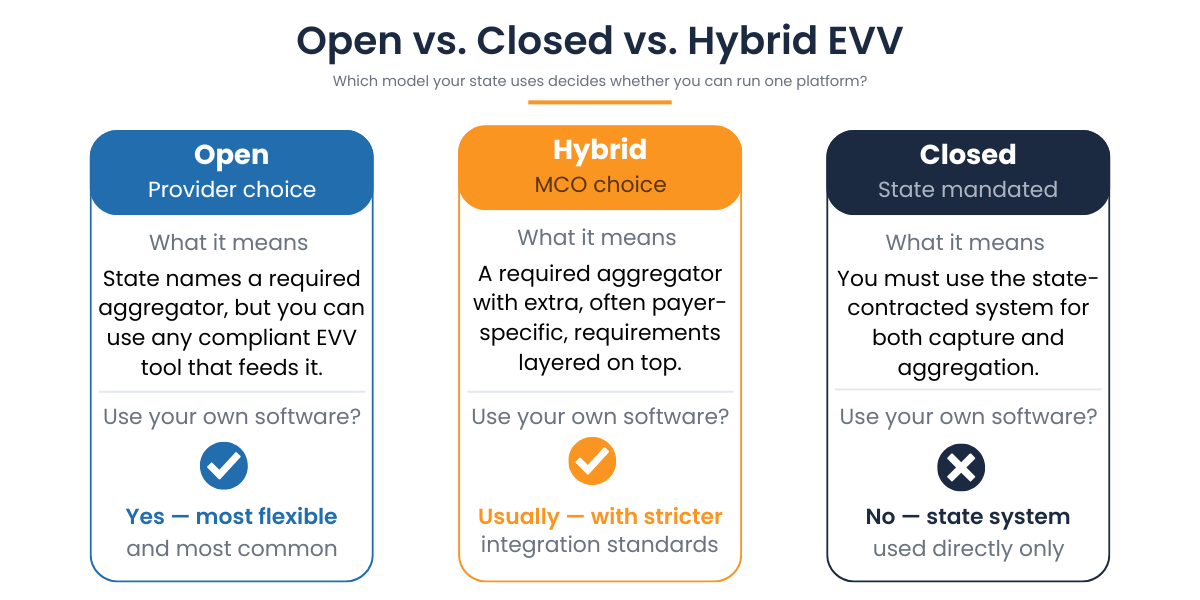
In open and hybrid states, a platform like CareVoyant can serve as your single system of record and transmit to the aggregator on your behalf. In the handful of closed states, agencies use the mandated system directly and a good vendor will tell you honestly which is which.
The Hidden Cost of Managing Multiple EVV Aggregators
Running several aggregators through separate portals quietly drains money and staff time in ways that rarely show up on a single invoice:
Duplicate data entry. The same visit gets keyed into your scheduling system and one or more aggregator portals, multiplying both effort and error.
Reconciliation gaps. When schedule, EVV, and claim data live in different systems, visits drift out of sync and the mismatch surfaces only when a claim is denied.
Denied and recouped claims. Aggregators reject visits when the EVV record doesn't perfectly match the claim wrong service code, mismatched date, location outside tolerance. In 2026, more states moved from soft warnings to hard edits that deny those claims automatically, putting revenue cycle management at direct risk.
Training burden. Every additional portal is another interface caregivers and office staff must learn, with its own quirks and login.
Audit exposure. Each state and payer audits differently. Fragmented records make it far harder to prove compliance when an auditor calls.
No single source of truth. Without one consolidated view, leadership can't see real compliance rates across the whole organization until problems are already costing revenue.
The stakes have risen sharply. With hard-edit enforcement spreading, an unresolved EVV exception that misses the correction window doesn't just flag a problem, the visit becomes permanently unbillable even though care was delivered and documented.
What Agencies Actually Need From a Multi-Aggregator EVV Solution
If your agency touches more than one aggregator, the goal is simple to state and hard to achieve with disconnected tools: capture each visit once, send it everywhere it needs to go, and catch errors before they become denials.
A capable multi-aggregator EVV solution should:
Write once, transmit many. Caregivers verify the visit a single time; the system routes the record to the correct aggregator automatically.
Map payer and service line to the right destination. The platform should know that this client, under this payer, in this program, goes to this aggregator in this format.
Support open, closed, and hybrid states. Acting as your EVV vendor where allowed, syncing with the mandated system where required.
Centralize exceptions. One queue to find and fix mismatches before billing windows close, not one queue per portal.
Unify reporting. Compliance rates, exceptions, and visit status across every state and payer in a single view.
Give caregivers one app. A single mobile experience for clock-in/out with GPS, service, and identity verification, regardless of which aggregator the data ultimately reaches.
How CareVoyant EVV Software Handles Multiple Aggregators
CareVoyant EVV Software is built around exactly this problem: one integrated home care platform that combines EVV, scheduling, billing, and clinical documentation so visit data never has to be re-entered or reconciled across systems.
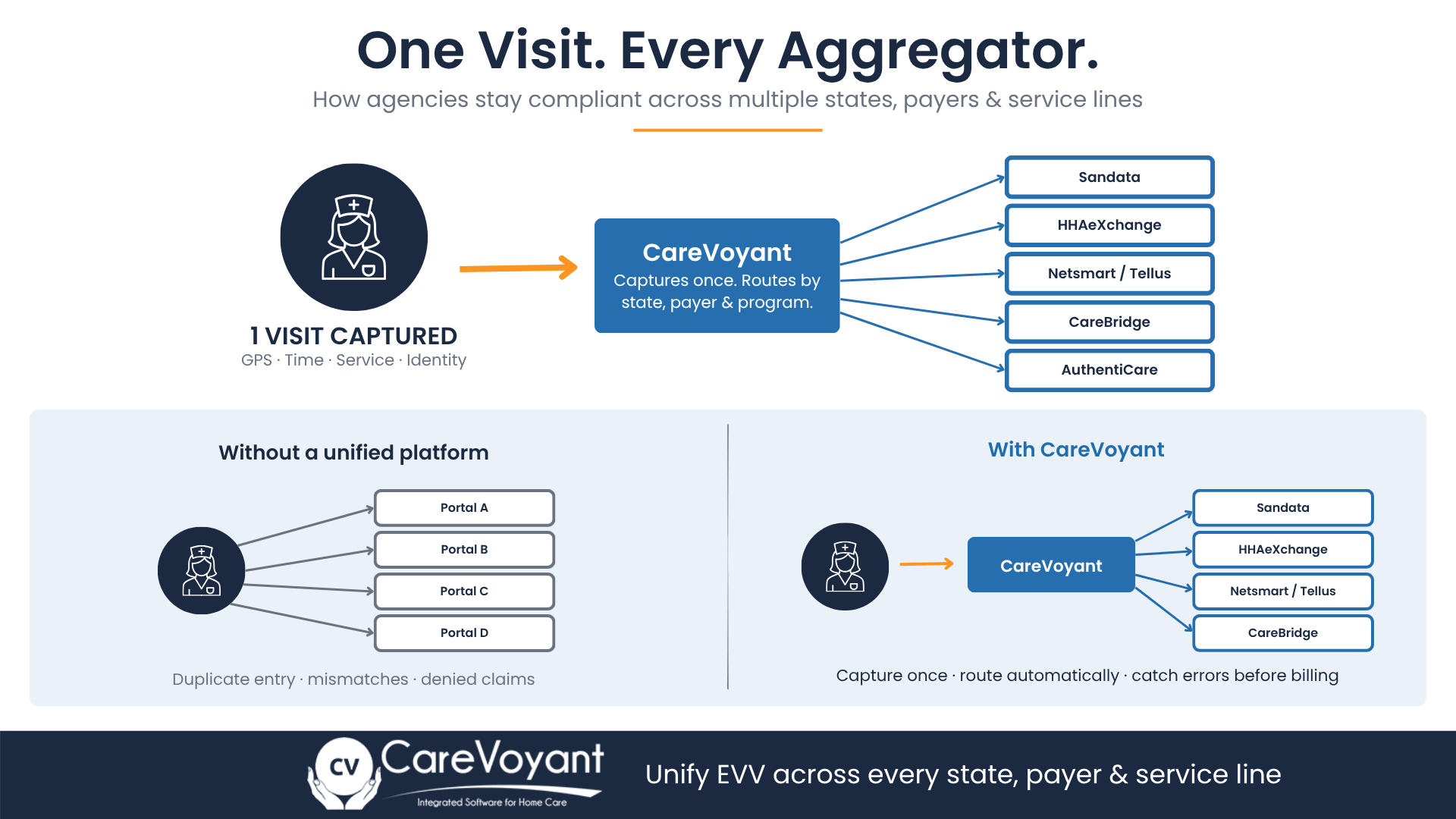
Here's how that helps multi-aggregator agencies specifically:
One system of record, many aggregators. A visit is captured once in CareVoyant, then routed to the appropriate state aggregator based on the client's payer and program. Your team isn't logging into separate portals to re-key the same information.
Automatic payer- and program-based routing. Because EVV, scheduling, and billing share the same data, CareVoyant knows which aggregator and format each visit requires, so a Personal Care visit under one MCO and a Home Health visit under another both go to the right place.
Open-model flexibility. In states using the open/provider-choice model, CareVoyant serves as your EVV vendor and transmits compliant data to the state aggregator on your behalf.
Closed-model coordination. In state-mandated states, CareVoyant helps your operation align with the required system so your back-office data stays consistent.
True multi-service-line support. Private Duty Nursing, Personal Care, HCBS, Home Health, and Pediatric care all run in one platform, no separate systems per line of business.
Pre-billing edits and exception dashboards. CareVoyant surfaces mismatches before claims go out, so you fix the wrong code or the missing field while the visit is still billable, reducing unbilled claims and protecting cash flow.
The result is a single source of truth: leadership sees real compliance across the entire agency, and staff stop spending their days reconciling portals.
Multi-State EVV: One Platform, Every State's Rules
Each state's aggregator and model is different, and they change, Arizona transitioned off Sandata to an in-house AHCCCS system in late 2025, and Michigan moved to HHAeXchange through 2024–2026. CareVoyant maintains state-specific EVV pages so you can confirm exactly how your state works and how CareVoyant fits.
Browse the EVV-by-state hub, or jump straight to your state:
Arizona · California · Colorado · Florida · Georgia · Illinois · Iowa · Kansas · Maine · Michigan · Minnesota · Missouri · Montana · New Jersey · New York · North Carolina · Pennsylvania · Tennessee · Utah · Virginia · Washington · Wisconsin · Wyoming
For any billing-critical decision, always confirm current requirements with your state Medicaid agency or MCO, since aggregator contracts and models change as states respond to CMS guidance.
Multi-Payer EVV Within a Single State
Operating in one state doesn't guarantee one set of rules. Medicaid managed care organizations can each impose their own EVV expectations, different required data points, different service codes, sometimes a different aggregator from the state's fee-for-service system.
This is where agencies get caught: a visit that's perfectly compliant for one payer gets denied by another over a formatting or code difference. CareVoyant's payer-aware setup maps each client's coverage to the correct aggregator and data spec, so the same captured visit is formatted appropriately for whichever payer it bills to without your staff tracking those differences by hand.
Migrating Off Multiple Disconnected Systems
If you're currently running a scheduling tool plus two or three aggregator portals plus spreadsheets to tie it all together, consolidation onto one all-in-one platform is the goal. A sensible migration covers:
Data mapping - clients, payers, service codes, and authorizations aligned to the right programs and aggregators.
Historical visit handling - deciding what to migrate versus archive.
Caregiver retraining - moving everyone to a single mobile app, which usually reduces training over time because there's only one system to learn.
Parallel validation - running a short period to confirm visits transmit and match cleanly before cutting over fully.
Checklist: Choosing a Multi-Aggregator EVV Vendor
Use this when evaluating any vendor for multi-state, multi-payer, or multi-service-line operations:
✅ Which aggregators does it integrate with (Sandata, HHAeXchange, Netsmart/Tellus, CareBridge, AuthentiCare, state-built)?
✅ Does it support open, closed, and hybrid models in your states?
✅ Can one captured visit route to multiple aggregators automatically?
✅ Does it map payer and service line to the correct destination and format?
✅ Are EVV, scheduling, and billing integrated, or separate systems?
✅ Does it catch exceptions before billing windows close?
✅ Is there unified reporting across all states and payers?
✅ Is there a single caregiver mobile app across every program?
✅ Will the vendor tell you honestly where you must use the state system directly?
Conclusion
Multiple aggregators aren't a problem you solve once; they're a permanent condition of growing across states, payers, and service lines. The agencies that handle it well aren't the ones with the most portals open; they're the ones that capture each visit a single time and let one system route it correctly, every time. As enforcement tightens and more states deny unmatched claims outright, that difference stops being an efficiency gain and becomes the line between billable and unbillable care.
CareVoyant EVV Software is built for exactly that reality: one platform that unifies visit verification, scheduling, billing, and clinical documentation across Private Duty Nursing, Personal Care, HCBS, Home Health, and Pediatric care and sends every visit to the right aggregator, in the right format, for the right payer. If your team is spending its days reconciling portals instead of caring for clients, it may be time to consolidate.
See how CareVoyant unifies EVV across every aggregator, state, and payer. Explore CareVoyant EVV Software or book a demo to walk through your specific multi-state setup.
Frequently Asked Questions (FAQs)
-
An EVV aggregator is a centralized system such as Sandata, HHAeXchange, Netsmart/Tellus, CareBridge, or AuthentiCare that a state uses to collect and verify visit data from every provider's EVV tool before Medicaid claims can be paid. It sits between your scheduling system and the state's claim payment system.
-
Yes. A platform built for multi-aggregator operations, like CareVoyant, captures each visit once and transmits it to the correct aggregator based on the client's state, payer, and program so you don't maintain separate systems or re-enter data per portal.
-
Three common reasons: operating in multiple states (each with its own aggregator), serving multiple Medicaid payers within a state (which can require different systems), and running multiple service lines (which may fall under different programs and rules).
-
Open/provider-choice lets you use any compliant tool as long as data reaches the state aggregator. Closed/state-mandated requires you to use the state's system directly. Hybrid adds extra, often payer-specific, requirements on top of a required aggregator.
-
CareVoyant adapts to each state's aggregator and model, acting as your EVV vendor in open states and coordinating with mandated systems in closed states, with dedicated state pages so you can confirm your specific requirements.
-
Yes. CareVoyant runs Private Duty Nursing, Personal Care, HCBS, Home Health, and Pediatric care in one platform and maps each client's payer to the correct aggregator and data format.
-
The visit can't be billed until the mismatch is fixed. In hard-edit states, an unmatched visit is denied automatically, and if the correction window closes it can become permanently unbillable which is why catching exceptions before billing is critical.
About CareVoyant
CareVoyant is a leading provider of cloud-based integrated enterprise-scale home health care software that can support all home-based services under ONE Software, ONE Patient, and ONE Employee, making it a Single System of Record. We support all home based services, including Home Care, Private Duty Nursing, Private Duty Non-Medical, Home and Community Based Services (HCBS), Home Health, Pediatric Home Care, and Outpatient Therapy at Home.
CareVoyant functions – Intake, Authorization Management, Scheduling, Clinical with Mobile options, eMAR/eTAR, Electronic Visit Verification (EVV), Billing/AR, Secure Messaging, Notification, Reporting, and Dashboards – streamline workflow, meet regulatory requirements, improve quality of care, optimize reimbursement, improve operational efficiency and agency bottom line.
For more information, please visit CareVoyant.com or call us at 1-888-463-6797.
Request for Information
To learn more about CareVoyant Software and how we improve the operational efficiency of Home Healthcare Agencies, contact us:
