

Introduction
In pediatric home care, communication is not a service extra. It is the mechanism by which a plan of care survives contact with a rotating team of nurses, aides, and therapists across 12-hour and 16-hour shifts.
The population is larger than most people assume. According to the Health Resources and Services Administration's National Survey of Children's Health data brief on children and youth with special health care needs, more than 1 in 4 US children (26.2%), over 19 million, had a special health care need in 2022 to 2023. Yet only 13.0% of those children received care in what HRSA defines as a well-functioning system of care. Two of the six components of that definition are directly about communication: families acting as partners in decision-making, and receiving needed care coordination.
The burden shows up at home. In the same survey period, 37.5% of families of children with special health care needs reported spending time providing or coordinating care in an average week, rising to nearly 2 in 3 among families of children with functional limitations. Another 18.0% reported leaving a job or reducing hours because of their child's health.
When a parent is already carrying that load, a missed shift notification or a visit note they cannot see is not a minor inconvenience. It is one more coordination task added to their week.
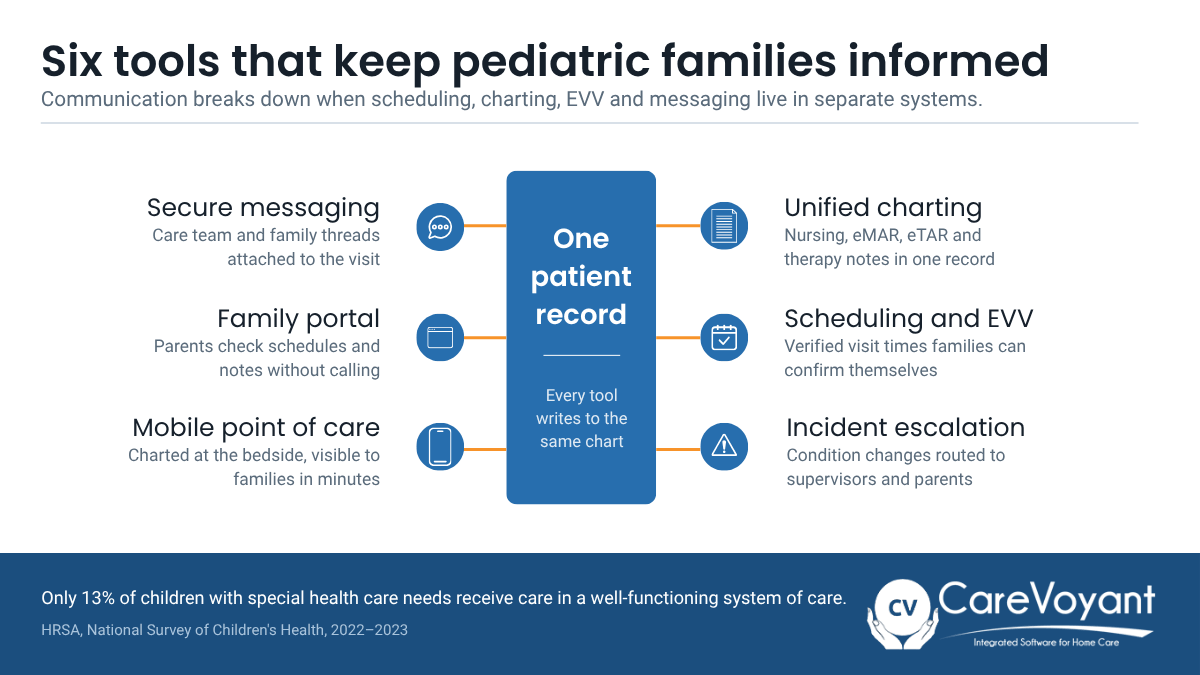
This article covers the specific communication breakdowns pediatric agencies face, the six tool categories that address them, and how CareVoyant's pediatric home care software brings scheduling, messaging, documentation, and family visibility into ONE system.
Where Communication Breaks Down in Pediatric Home Care
1. Continuity across a rotating care team
A medically complex child on continuous nursing may see six to ten different clinicians in a month, plus PT, OT, and speech therapists on separate schedules. Each brings different observations and different shorthand. Without a shared record, the Tuesday night nurse does not know what the Sunday day nurse changed, and the parent becomes the handoff mechanism by default. We covered this pattern in depth in our guide to continuity of care in pediatric home care.
2. Parents who need visibility, not just reports
Families of medically fragile children track feeding tolerance, seizure activity, vent settings, and medication responses hour by hour. A summary delivered at the end of the week does not help them make decisions on Wednesday. Timeliness, not volume, is what builds confidence.
3. Documentation delays that turn into disputes
Late or paper-based charting creates gaps that surface later as billing questions, medication discrepancies, or disagreements about what happened on a shift. Continuous care documentation carries particular risk because a single shift generates hours of entries. Our breakdown of common PDN documentation mistakes covers where these gaps typically open.
4. Coordination across disciplines and payers
Pediatric cases frequently combine Medicaid waiver hours, commercial plan benefits, and school-based nursing. Different authorizations, different documentation requirements, different approvers. Without centralized authorization and plan of care management, instructions get relayed verbally and lost.
5. Pediatric privacy rules that are more layered than adult care
Under the HIPAA Privacy Rule, a parent or guardian is generally treated as the child's personal representative and can exercise the minor's rights over protected health information, subject to specific exceptions defined in 45 CFR 164.502(g) and to state law on minor consent. The HHS Office for Civil Rights has written directly to providers reminding them that portal and record system configurations must not block a parent's lawful access. Agencies therefore need permission settings granular enough to handle custody arrangements, foster placements, and adolescent confidentiality without manual workarounds.
6. Inbound call volume that scales with uncertainty
Every "Is the nurse coming?" call is a symptom, not a problem. When families cannot see the schedule or visit status themselves, the office phone becomes the interface. That is administrative time spent re-transmitting information the system already holds.
Six Communication Tools Pediatric Home Care Agencies Need
| Tool | Pediatric failure it prevents | CareVoyant module |
|---|---|---|
| HIPAA-compliant messaging | Shift instructions living in personal text threads, outside the record and outside audit | In-platform messaging tied to patient and visit |
| Family portal | Custody, foster, and guardian access handled by manual workarounds | Permission-based family portal |
| Mobile point-of-care app | A 12-hour shift reconstructed from memory hours after it ended | CV Mobile |
| Unified clinical documentation | Nursing, therapy, and medication records that disagree with each other | Clinical and point of care, eMAR and eTAR |
| Scheduling and EVV | Missed visits discovered by the parent before the office | Scheduling with integrated EVV |
| Incident reporting and escalation | No reconstructible record of who was notified of a condition change, and when | Care coordination and communication |
1. Secure, HIPAA-compliant messaging
Personal text threads and consumer email are where pediatric care instructions go to die. They are unsearchable, unauditable, and outside the patient record.
In-platform messaging keeps caregiver, supervisor, and family conversations inside the system that holds the chart.
Group threads let a nursing team, therapist, and case manager discuss a shift change without a phone tree.
Every message is timestamped and attached to a patient and visit, which supports both survey readiness and dispute resolution.
Replacing informal channels reduces the risk of PHI sitting on personal devices.
Messaging connected to visits, patients, and care plans keeps every conversation inside the patient's care context instead of a separate inbox.
For a wider view of how messaging fits into team workflow, see our article on improving care team communication in home care.
2. Family portals that create real transparency
Parents and guardians get secure, around-the-clock access to schedules, caregiver assignments, and clinical information.
Permission-based access lets an agency grant a grandparent visit-schedule visibility without exposing full clinical detail.
Real-time schedule visibility removes the most common reason families call the office.
Portal access supports the parental access obligations described in the OCR guidance referenced above.
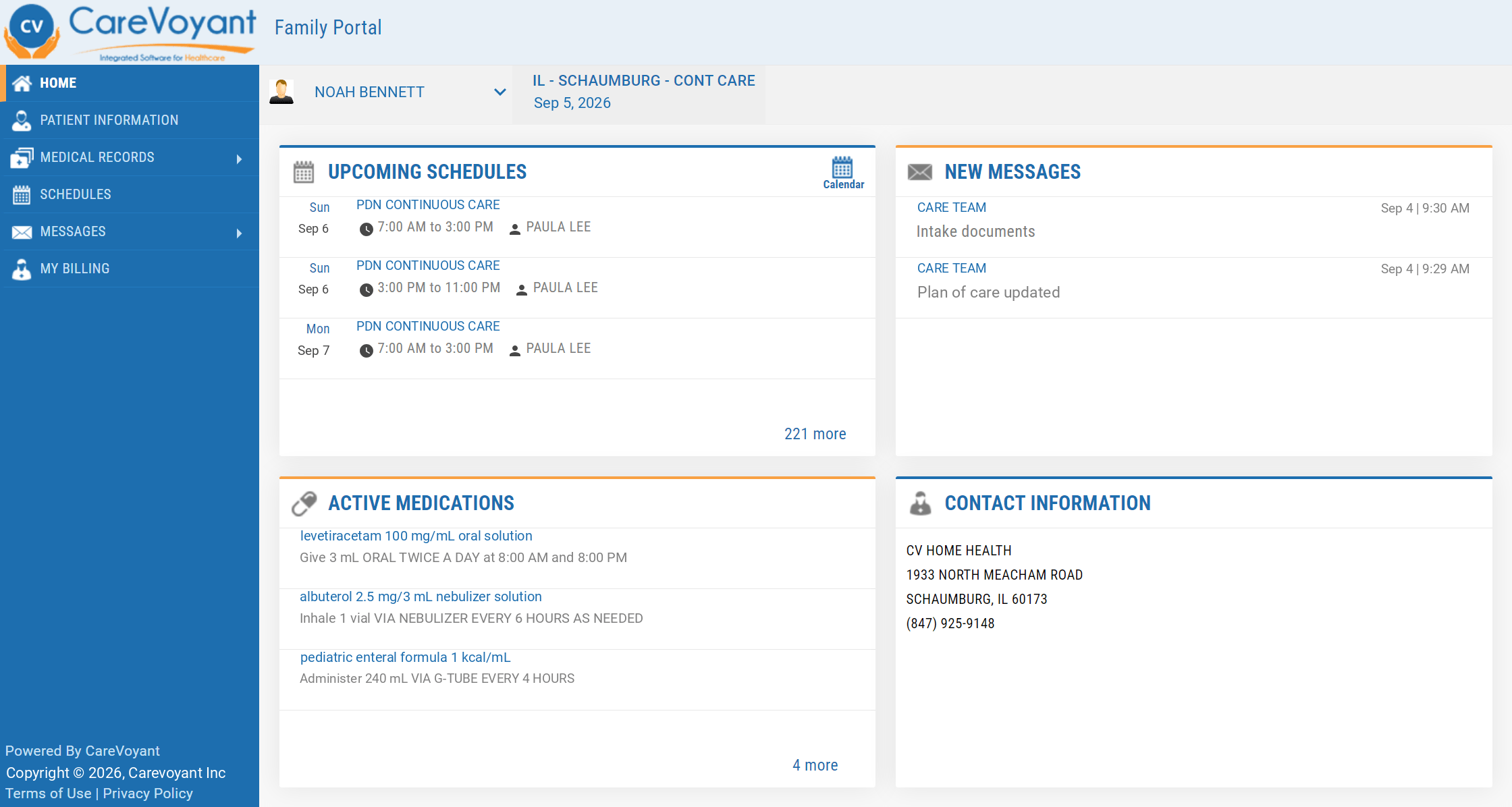
The CareVoyant Family Portal home screen. Upcoming shifts with assigned caregiver, messages from the agency, the active medication list, and agency contact details load in a single view, so families are not assembling their child's status from four places. Screenshot shows representative demo data.
One portal connecting clinical documentation, scheduling, and EVV status removes the silos that force families to piece information together themselves.
Transparency is what converts a transactional relationship into a durable one. Our piece on building trust with family caregivers covers the practices that reinforce it.
3. Mobile apps for point-of-care updates
Caregivers document in the home, at the time of care, rather than reconstructing a shift hours later.
Families receive notifications when a visit starts and ends, which answers the "where is the nurse" question before it becomes a call.
Condition changes, medication responses, and behavior notes reach the office and the family within minutes.
Offline capability matters for rural placements where connectivity is inconsistent.

CV Mobile care plan documentation. The caregiver marks each task complete at the bedside and the entry posts to the patient's record immediately. Screenshot shows representative demo data.
Mobile-first caregiver workflows feed the family portal directly, so what the nurse charts at the bedside is what the parent sees.
CV Mobile handles EVV capture and point-of-care documentation in the same app. See how agencies use it in our overview of CV Mobile for EVV and scheduling.
4. Integrated clinical documentation families can actually read
Visit notes become available to authorized family members shortly after the caregiver completes them.
Pediatric-specific documentation includes electronic medication and treatment administration records, which matter for children on complex medication schedules.
Occupational, physical, and speech therapy notes live in the same chart as nursing documentation rather than in a separate therapy system.
Consistent structure across caregivers reduces the conflicting-report problem described earlier.
All clinical documentation unified across disciplines in ONE platform, so continuity does not depend on who was on shift.
Related reading: choosing the right eMAR and eTAR software for private duty nursing and software features for continuous care documentation in PDN.
5. Scheduling, EVV, and visit verification
Electronic Visit Verification is a compliance requirement first, but it doubles as a communication tool. Under Section 12006 of the 21st Century Cures Act, state Medicaid programs had to require EVV for personal care services by January 1, 2020 and for home health services by January 1, 2023. Every verified visit captures six data elements: service type, the individual receiving care, the date, the location, the individual providing care, and the begin and end times.
Those same six elements are exactly what a parent wants to know, which makes EVV data a natural feed for the family portal.
Published, current schedules tell families who is coming and when, well ahead of the shift.
Automated alerts flag late arrivals, missed visits, and reschedules to office staff and families at the same time.
Requirements differ by state, which our EVV by state reference tracks.
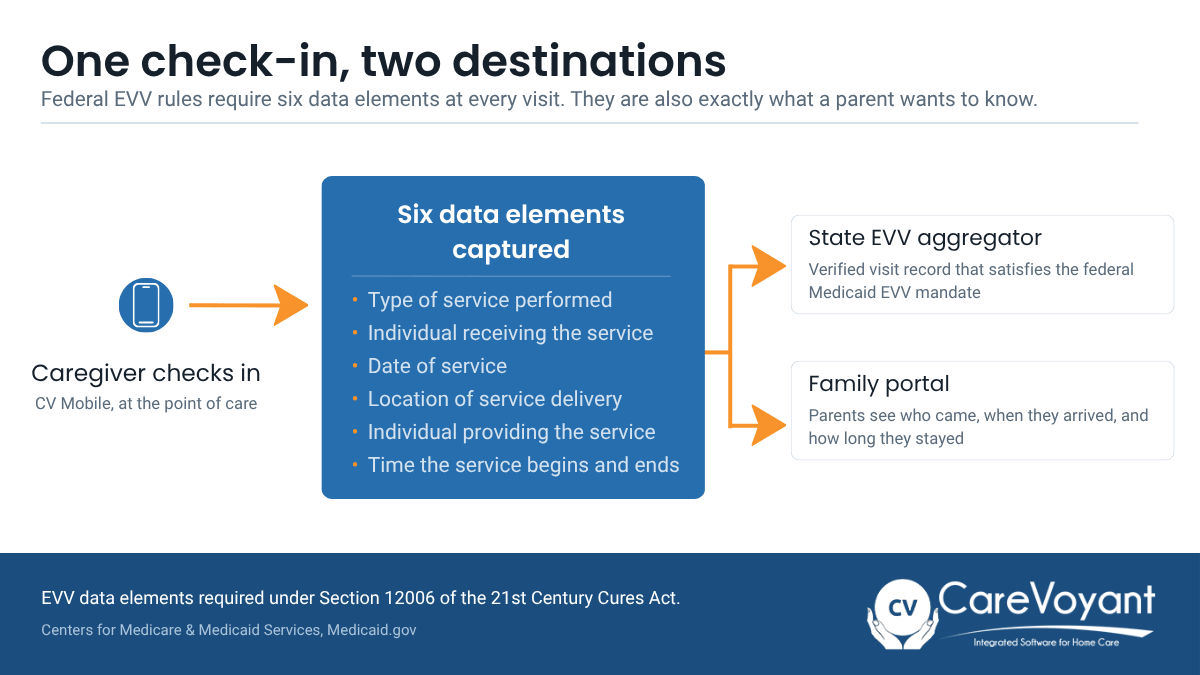
EVV, scheduling, and communication in a single system, with no toggling between an EVV vendor, a scheduling tool, and a messaging app.
More on the scheduling side: private duty nursing shift scheduling software and scheduling functionality in CareVoyant.
6. Incident reporting and escalation pathways
Condition changes and incidents are documented at the point of care rather than reported at the end of a shift.
Defined escalation rules route notifications to the clinical supervisor, the case manager, and the family according to severity.
Escalation records tie back to the clinical chart, so the sequence of who knew what and when is reconstructible during a survey or an investigation.
Clear pathways reduce the ambiguity that produces both delayed clinical response and family mistrust.
Incident workflows tied to clinical records and communication logs make tracking and follow-up part of the same system, not a separate spreadsheet.
What to Evaluate Before You Buy
Most agencies do not have a tool shortage. They have an integration shortage. A messaging app, a separate EVV vendor, a scheduling tool, and a clinical system that do not talk to each other reproduce the exact silos they were bought to eliminate.
When evaluating pediatric private duty nursing software, test four things:
Single patient record. Does messaging, scheduling, EVV, and clinical documentation resolve to one patient chart, or four?
Permission granularity. Can you configure portal access separately for a custodial parent, a non-custodial parent, and a case manager?
Multi-payer handling. Can the system hold concurrent Medicaid waiver, commercial, and school-based authorizations against one child? Our article on care coordination tools covers what this requires.
Data visibility. Can a supervisor see missed visits, overdue documentation, and unread escalations in one dashboard? See integrated home care software and data visibility.
Conclusion
Communication failures in pediatric home care are rarely failures of intent. They are failures of architecture. When the schedule lives in one system, the chart in another, EVV with a third vendor, and family updates in a phone call, information degrades at every handoff, and the family absorbs the cost.
HRSA's finding that only 13.0% of children with special health care needs receive care in a well-functioning system is a coordination statistic before it is a clinical one. Agencies cannot fix the whole system, but they can remove the silos inside their own operation.
Secure messaging, family portals, mobile point-of-care documentation, unified charting, and EVV-linked scheduling do that work, and they do it best when they run on one platform against one patient record.
See how it works in practice. Request a CareVoyant demo to walk through pediatric scheduling, EVV, documentation, and family communication in a single system.
Frequently Asked Questions (FAQs)
-
Through HIPAA-compliant messaging and permission-based family portals built into the agency's clinical system. These keep protected health information inside an auditable environment tied to the patient record, rather than on personal phones or consumer email.
-
Standard SMS is not designed for protected health information. It is unencrypted in transit on many carriers, is not auditable, and leaves PHI on personal devices. In-platform messaging inside a home care system with access controls, audit logging, and a signed business associate agreement is the appropriate channel.
-
A secure web or mobile interface where authorized family members view their child's visit schedule, caregiver assignments, visit status, and clinical documentation. Access is permission-based, so different family members and case managers can be granted different levels of visibility.
-
In an integrated platform, yes. When a caregiver documents at the point of care on a mobile app, that documentation becomes visible to authorized family members shortly after completion rather than after an office data-entry step.
-
EVV records the caregiver, location, and begin and end times of every visit. Surfacing that data in the family portal answers most schedule questions without a phone call and gives families verifiable confirmation that a visit occurred.
-
Usually, but not always. Under HIPAA, a parent is generally the minor's personal representative, with exceptions defined in 45 CFR 164.502(g) that track state laws allowing minors to consent to certain services themselves. Portal permissions need to be configurable enough to reflect that.
About CareVoyant
CareVoyant is a leading provider of cloud-based integrated enterprise-scale home health care software that can support all home-based services under ONE Software, ONE Patient, and ONE Employee, making it a Single System of Record. We support all home based services, including Home Care, Private Duty Nursing, Private Duty Non-Medical, Home and Community Based Services (HCBS), Home Health, Pediatric Home Care, and Outpatient Therapy at Home.
CareVoyant functions – Intake, Authorization Management, Scheduling, Clinical with Mobile options, eMAR/eTAR, Electronic Visit Verification (EVV), Billing/AR, Secure Messaging, Notification, Reporting, and Dashboards – streamline workflow, meet regulatory requirements, improve quality of care, optimize reimbursement, improve operational efficiency and agency bottom line.
For more information, please visit CareVoyant.com or call us at 1-888-463-6797.
Request for Information
To learn more about CareVoyant Software and how we improve the operational efficiency of Home Healthcare Agencies, contact us:
