

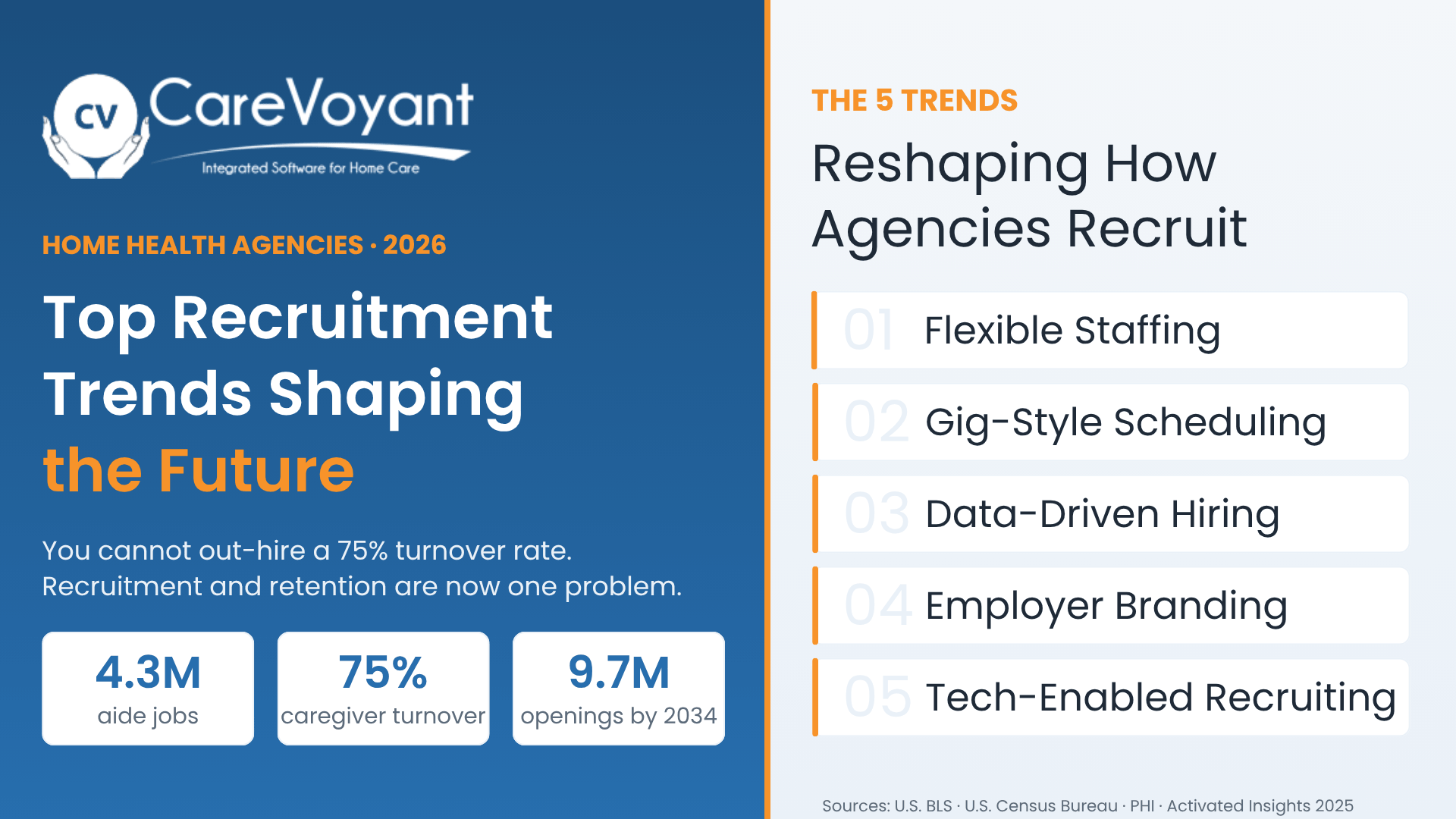
Home health has the largest workforce in the country yet caregiver turnover still runs at 75%, so recruitment is now a retention problem. Flexible staffing, gig-style scheduling, and data-driven hiring are the levers pulling ahead of the shortage. Build your value proposition around the whole caregiver experience, not just the wage.
Introduction
Home health and personal care aides make up the single largest occupation in the U.S. economy, with about 4.3 million jobs in 2024. That same year, the Bureau of Labor Statistics projected the occupation would add more jobs than any other over the next decade. So, home health agencies are hiring into the biggest labor pool in the country and still cannot fill their schedules.
The gap is not about the size of the workforce. It is about how agencies find, hire, and keep people. The old playbook of posting a job, waiting for applications, and running everyone through the same rigid onboarding no longer keeps pace with what caregivers expect or what demand requires. Agencies that rethink recruitment around flexibility, on-demand scheduling, and real hiring data are pulling ahead. The ones that do not are stuck in a hiring cycle they can never quite close.
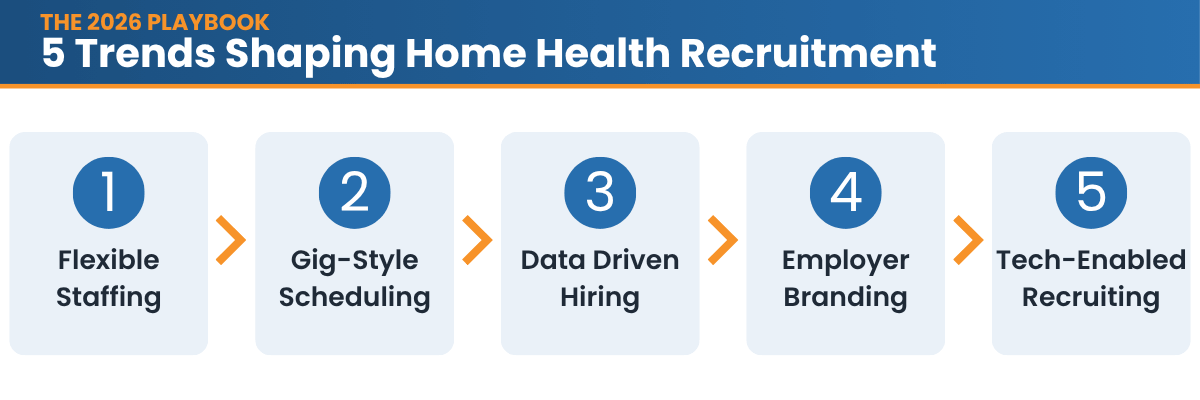
This guide walks through the five trends shaping how home health agencies recruit in 2026, with the market data to back each one and practical steps you can act on.
The State of Home Health Recruitment
Before the trends, it helps to see the numbers agencies are up against. Three forces are colliding: surging demand, a shrinking supply of workers per client, and turnover that eats hiring gains as fast as they come.
Demand keeps climbing
The BLS Occupational Outlook Handbook projects employment of home health and personal care aides to grow 17 percent from 2024 to 2034, far above the average for all occupations. That works out to roughly 765,800 openings each year across the decade, the most of any occupation at its education level.
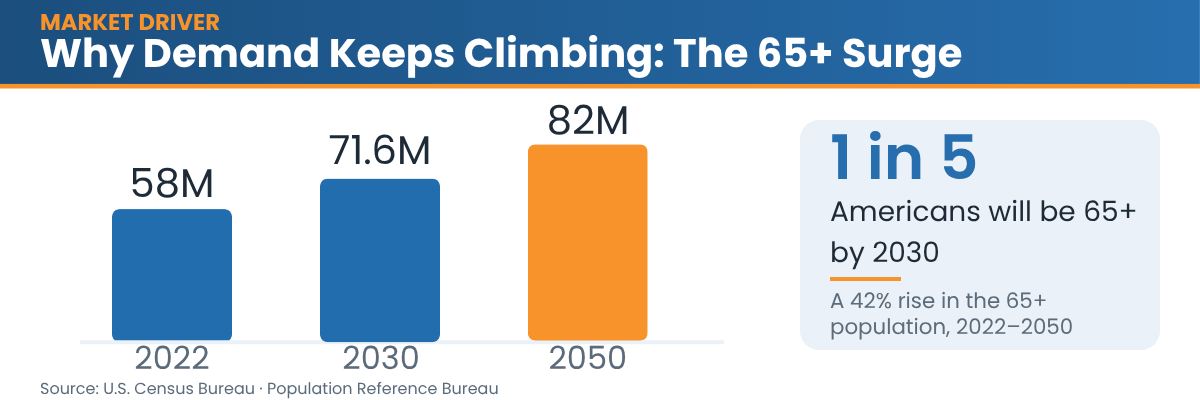
The driver is demographic and it is not slowing down. According to the U.S. Census Bureau, the share of Americans age 65 and older climbed from 12.4 percent in 2004 to 18.0 percent in 2024. By 2030, every baby boomer will have passed 65, putting one in five Americans at retirement age. The Population Reference Bureau, drawing on Census projections, expects the 65-and-older population to grow from 58 million in 2022 to 82 million by 2050, a 42 percent jump. Most of those people want to age at home, which lands the demand squarely on home-based care.
Turnover cancels out hiring
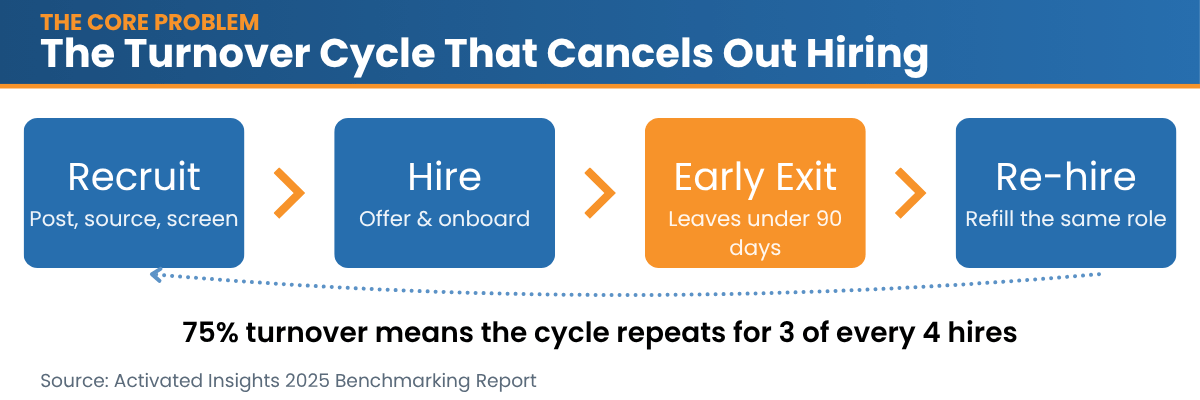
Here is where recruitment quietly becomes a retention problem. Industry benchmarking from Activated Insights (formerly Home Care Pulse) put the median caregiver turnover rate at 75 percent in 2024. That figure is the lowest the industry has seen since 2021, which is genuine progress, but it still means three of every four caregivers left or were let go within the year. Peer-reviewed research backs the scale of the problem: a study published through the National Institutes of Health found direct care worker turnover ranging from about 35 percent for nursing assistants in hospitals to 65 percent for home care workers, and above 90 percent in some settings.
When you factor in occupational transfers and people leaving the labor force entirely, PHI projects 9.7 million total direct care job openings from 2024 to 2034. Most of those openings are not new positions. They are the same jobs being refilled again and again.
Turnover costs real money
Turnover is not just an operational headache. A University of Pittsburgh study estimated each direct care worker who leaves costs a provider about $4,200 once you account for recruiting, onboarding, and lost productivity. The same research linked staffing shortages to a 15 to 20 percent rise in preventable emergency department visits, which pushes cost back onto payers and undercuts the quality story agencies sell to referral partners.
Read the numbers together and the picture is clear. You cannot out-hire a 75 percent turnover rate. The agencies winning on recruitment are the ones changing the job itself, not just the job posting. The five trends below are how they do it.
Trend 1: Flexible Staffing Models
Rigid full-time schedules were built for a workforce that no longer applies in the numbers agencies need. Flexibility is already baked into the role. BLS notes that while most aides work full time, part-time work is common and schedules shift with client needs. Agencies that lean into that reality instead of fighting it hire from a wider pool.
Why flexibility is a lever, not a compromise
Wages in this field are hard to move quickly. Healthcare support occupations had a median annual wage of $37,180 in May 2024, below the median for all occupations, and margins in home care leave little room for across-the-board raises. Flexibility is one of the few benefits an agency can offer that costs less than a wage increase and often matters more to the person deciding whether to take the shift. A caregiver choosing between two agencies at similar pay will pick the one that lets them build a schedule around school pickups, a second job, or their own family caregiving.
Self-scheduling and shift-swapping
Give caregivers control over their availability and you remove a daily point of friction. Self-scheduling tools let workers claim open visits that fit their week and swap shifts without a phone tree of managers approving each change. Agencies that adopt this report fewer call-offs and better retention, because a caregiver who can shape their own week is less likely to walk when life gets complicated.
Float pools and cross-utilization
Internal flexibility protects continuity of care. A trained float pool covers call-offs without scrambling, so a client never loses a visit and a caregiver never feels they are the only line of defense. Cross-utilizing staff across service lines, where licensing and skills allow, gives you slack in the system that a rigid one-caregiver-per-client model never has.
Trend 2: Gig-Style Scheduling and the On-Demand Workforce
The gig economy trained a generation of workers to expect app-based, pick-your-own-shift work. Home care is adapting to that expectation with per-visit, on-demand scheduling models that look more like ride-share than a traditional roster.
Competing for the same workers
This shift matters because home care does not just compete with other care agencies for staff. It competes with every entry-level job that offers flexible hours. Retail, food service, and warehouse work all pull from the same labor pool, and many now offer app-based scheduling and instant pay. If claiming a caregiving shift is harder than picking up a delivery gig, agencies lose people to easier work at similar pay.
The trade-offs are real
On-demand models fill open visits faster and widen the talent pool, but they cut against continuity of care, which is often the thing families value most. A client who sees a different face every visit gets a worse experience than one with a steady caregiver. The agencies doing this well use gig-style scheduling to fill gaps and surge capacity, not to replace the core relationships that keep clients loyal.
Compliance cannot be an afterthought
Gig-style scheduling raises hard questions about worker classification. Treating caregivers as independent contractors when they function as employees invites wage-and-hour liability, and the rules here have shifted more than once in recent years. Layer in Electronic Visit Verification requirements for Medicaid-funded visits and the compliance load grows. Before rolling out any on-demand model, confirm your classification approach against current Department of Labor guidance and your state's EVV rules.
Trend 3: Data-Driven Hiring Practices
Most recruitment problems in home care are not marketing problems. They are process problems. Disorganized, slow, inconsistent hiring drives away good candidates before an agency ever gets to say yes. Data fixes what gut feel misses.
Predictive analytics in screening
Agencies sitting on years of hiring records can use that history to spot the traits that predict who stays. Which sources produce caregivers who last past 90 days? Which shift patterns correlate with early quits? Which screening answers actually track with retention? Predictive screening turns those questions into a repeatable filter instead of a hiring manager's hunch.
Cut the time-to-hire
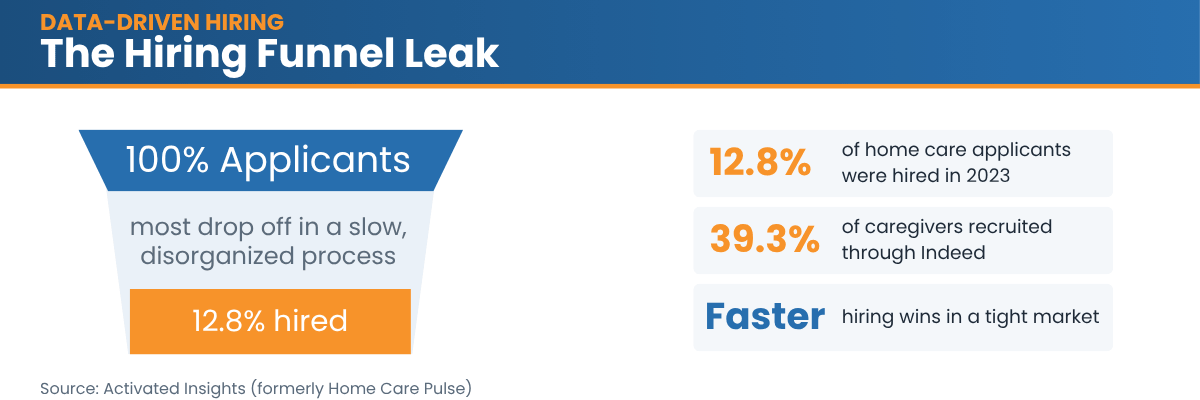
Speed wins candidates in a tight market. The data shows how much room there is to improve: only 12.8 percent of home care applicants were hired in 2023, and hiring rates for home health and hospice nurse applicants fell 25 percent year over year. A slow, clunky funnel is often the reason. Automated screening, faster background checks, and mobile applications move candidates from interest to hire before a competitor grabs them. Since Indeed drives close to 40 percent of caregiver recruiting, optimizing that pipeline alone pays off.
Measure quality of hire, not just volume
Filling seats is not the goal. Filling them with people who stay is. Track quality-of-hire metrics like 90-day and one-year retention by source, early performance scores, and client satisfaction tied to specific caregivers. Once you know which channels and profiles produce keepers, you can spend recruiting dollars where they actually work instead of chasing raw application counts.
Trend 4: Employer Branding and the Caregiver Value Proposition
When wages are hard to raise and every agency competes for the same people, brand and value proposition become the tiebreaker. Caregivers are choosing you as much as you are choosing them.
Build around the whole job, not just the paycheck
The pay reality is sobering. PHI reports a median hourly wage of $16.72 for direct care workers in 2023, and because so much of the work is part time, median annual earnings sit just under $26,000. You will rarely win on wage alone. What you can win on is everything around the wage: predictable scheduling, real training, upskilling paths, recognition, and respect. Career pathing matters especially, because a job that leads somewhere holds people longer than one that does not.
Know who you are recruiting
Effective branding speaks to the actual workforce. PHI's data shows the median direct care worker is 47 years old, 36 percent are 55 or older, and immigrants make up 32 percent of the home care workforce despite being 17 percent of the overall labor force. Recruiting messages, benefits, and onboarding built for a young, single, English-first workforce miss most of the people you are trying to reach. Multilingual materials, flexible hours that suit older workers and second-career caregivers, and benefits that fit real lives do more than any slogan.
Reviews are recruitment now
Caregivers check what current and former staff say before they apply, the same way clients read reviews before they call. A strong presence on Glassdoor and Indeed, plus an active referral program, turns your existing team into your recruiting engine. Referred caregivers tend to arrive with realistic expectations and stay longer, which feeds straight back into lower turnover.
Trend 5: Technology-Enabled Recruitment and Onboarding
The tools that shrink time-to-hire also shape whether a new caregiver stays past their first month. Technology runs through every trend above, but a few applications deserve their own focus.
AI and automation in sourcing
AI-assisted sourcing surfaces qualified candidates faster, screens for red flags, and keeps applicants warm with automated follow-up so nobody falls through the cracks during a slow week. Used well, it frees recruiters to spend time on the human parts of hiring that actually close candidates.
Mobile-first applications
Most caregivers job-hunt on a phone. An application that demands a desktop, a resume upload, and twenty minutes loses people who would have finished a five-minute mobile flow. Meeting candidates where they already are is one of the cheapest recruitment upgrades an agency can make.
Digital onboarding that speeds the ramp
The stretch between offer and first shift is where many new hires quietly disappear. Digital onboarding, e-signatures, mobile training modules, and clear early communication keep momentum alive and get caregivers to their first visit before doubt sets in. Since that first 90 days is where so much turnover happens, a smooth start is retention work disguised as paperwork.
How Agencies Can Adapt
Reading about trends is easy. Acting on them is where results come from. A practical sequence:
First, audit your recruitment funnel end to end. Track how many applicants you get, how many you hire, how long each stage takes, and where candidates drop off. You cannot fix what you have not measured, and the drop-off points usually surprise people.
Second, pilot flexibility before you commit fully. Roll out self-scheduling or a gig-style shift model with one team or region, measure the effect on fill rates and retention, then scale what works.
Third, put your hiring data to work. Even a simple spreadsheet tracking retention by source beats hiring on instinct. Find your best channels and profiles, then double down.
Fourth, sharpen your value proposition around the whole caregiver experience. Look hard at scheduling, training, career paths, and recognition, and ask whether they are built for the workforce you actually recruit.
The Bottom Line
The home health workforce is enormous and growing, but agencies still cannot staff their schedules because the traditional recruitment model was built for a world that no longer exists. Flexibility, gig-style scheduling, and data-driven hiring are not passing fads. They are how caregivers now expect to work and how the strongest agencies keep pace with demand.
The math is unforgiving. Even at a five-year low, a 75 percent turnover rate means you cannot out-hire your way to a stable workforce, so recruitment and retention have to be solved together. The agencies that treat them as one problem in 2026, and that build the job around what caregivers actually want, will have the staff to grow. The ones that keep running the old playbook will keep hiring the same positions over and over.
Frequently Asked Questions (FAQs)
-
Turnover. Median caregiver turnover sat at 75 percent in 2024, so agencies spend most of their recruiting effort refilling the same roles, which makes retention and recruitment two halves of the same problem.
-
It works best for filling open visits and adding surge capacity. Because continuity of care matters so much to clients, most agencies use it alongside steady caregiver relationships rather than as a full replacement, and they watch worker-classification and EVV compliance closely.
-
By showing which recruiting sources and candidate profiles produce caregivers who actually stay. Instead of chasing application volume, agencies use retention data to spend where the keepers come from and to fix the slow steps that lose good candidates.
-
Industry benchmarking put median home care caregiver turnover at 75 percent in 2024, a five-year low, and peer-reviewed research finds direct care turnover ranging from roughly 35 percent to over 90 percent depending on the setting.
About CareVoyant
CareVoyant is a leading provider of cloud-based integrated enterprise-scale home health care software that can support all home-based services under ONE Software, ONE Patient, and ONE Employee, making it a Single System of Record. We support all home based services, including Home Care, Private Duty Nursing, Private Duty Non-Medical, Home and Community Based Services (HCBS), Home Health, Pediatric Home Care, and Outpatient Therapy at Home.
CareVoyant functions – Intake, Authorization Management, Scheduling, Clinical with Mobile options, eMAR/eTAR, Electronic Visit Verification (EVV), Billing/AR, Secure Messaging, Notification, Reporting, and Dashboards – streamline workflow, meet regulatory requirements, improve quality of care, optimize reimbursement, improve operational efficiency and agency bottom line.
For more information, please visit CareVoyant.com or call us at 1-888-463-6797.
Request for Information
To learn more about CareVoyant Software and how we improve the operational efficiency of Home Healthcare Agencies, contact us:
