

A home-based care plan only works when it stays current, includes patient and caregiver input, and lives in the same system as scheduling, documentation, and billing. Most agencies lose value not from writing weak plans, but from letting good plans go stale. Integrated software closes that gap by tying every visit, note, and authorization back to the plan of care.
Introduction
A home-based care plan is the working document that tells everyone involved what care a patient receives, who provides it, how often, and what the care is meant to achieve. It applies across personal care, skilled home health, private duty nursing, and long-term chronic condition support.
Medicare treats this document as a condition of participation, not a formality. Under 42 CFR § 484.60, each patient must receive an individualized written plan of care that specifies the services needed to meet patient-specific needs identified in the comprehensive assessment, names the responsible disciplines, and states the measurable outcomes the agency expects. Medicaid applies a parallel standard to home and community based services through the person-centered planning requirements at 42 CFR § 441.301, where the planning process is directed by the individual and the plan must reflect what matters to them, not what is convenient to schedule.
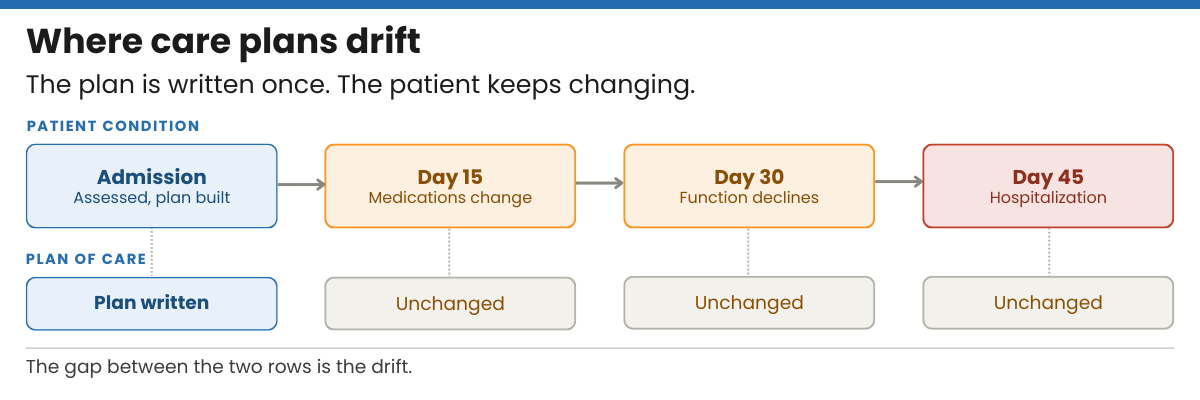
The problem is rarely that agencies fail to produce a plan. The problem is that the plan stops matching reality. It gets written at admission, filed, and never revisited while the patient's condition moves. AHRQ's Care Coordination Measures Atlas identifies information transfer and assessment of needs and goals among the coordination activities that determine whether patients experience connected care or fragmented care. When those activities break down, the cost shows up as avoidable hospital use. MedPAC estimates that potentially preventable hospitalizations occurred during 8.2 percent of fee-for-service home health stays in 2023. Those are admissions a current, well-monitored plan is designed to catch early.
This article covers what a strong home-based care plan contains, where agencies typically lose control of it, and how an integrated home care software keeps the plan usable rather than archived.
The Role and Benefits of Home-Based Care Plans
It sets a measurable standard of care
A care plan converts a clinical assessment into instructions someone can follow at 7 a.m. in a patient's kitchen. CMS is explicit on the standard: the plan must identify patient-specific measurable outcomes and goals, specify the services needed to meet the needs found in the comprehensive assessment, identify which discipline is responsible for each, and cover the education and training the patient and caregiver receive. Without that specificity, a surveyor has no way to judge whether care was delivered as ordered, and neither does the clinical manager.
It protects patients during transitions
Transitions between hospital, facility, and home are where information falls out of the record. AHRQ's care coordination work identifies transitions as the points where patients and families most often experience coordination failures, because responsibility and information flow both shift at once. National utilization data for the sector is published by CDC's National Center for Health Statistics. A structured plan gives the receiving team a definite answer to what the patient takes, what they can do independently, what triggers a call to the physician, and who is responsible for each task. That reduces medication errors and duplicate work.
It gives patients real authority over their care
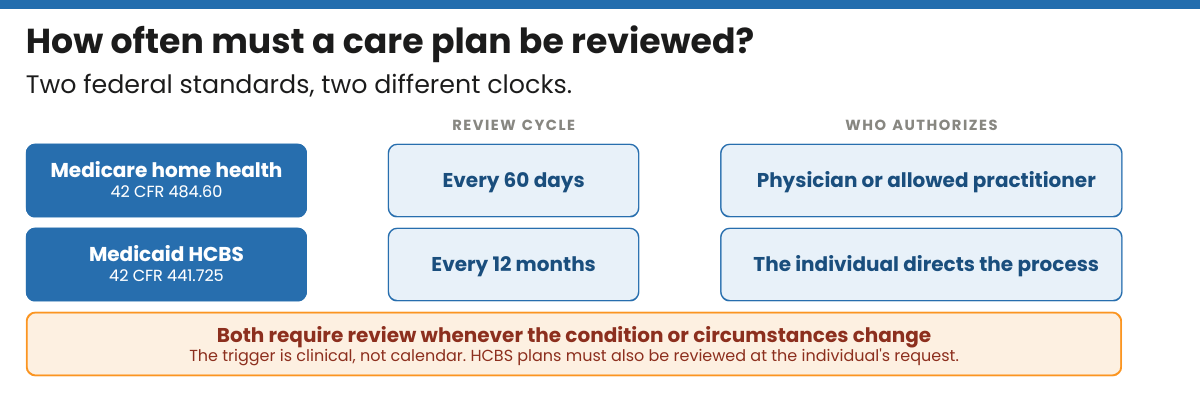
Person-centered planning is not a soft benefit. For Medicaid HCBS, it is a federal requirement. 42 CFR § 441.725 requires the planning process to be driven by the individual, to reflect their preferences for how services are delivered, and to be reviewed and revised at least every 12 months, whenever circumstances or needs change significantly, and at the individual's request. CMS also requires the process to reflect cultural considerations and to be conducted in plain language accessible to people with disabilities and limited English proficiency. Plans built this way get better adherence because the patient recognizes their own priorities in them.
It supports compliance and clean reimbursement
Documentation tied to an authorized plan is the difference between a paid claim and a denied one. HHS Office of Inspector General audits of home health agencies repeatedly find claims that documentation does not support. In one review, OIG found billing errors in 38 of 100 sampled claims at a single agency. In another, an agency was reimbursed for services that documentation did not support, with estimated overpayments above $2.9 million across the audit period. A plan that is current, signed, and linked to the visits actually delivered gives the agency a defensible record when a payer or surveyor asks for one.
Common Pitfalls in Care Plan Utilization
Plans that go stale
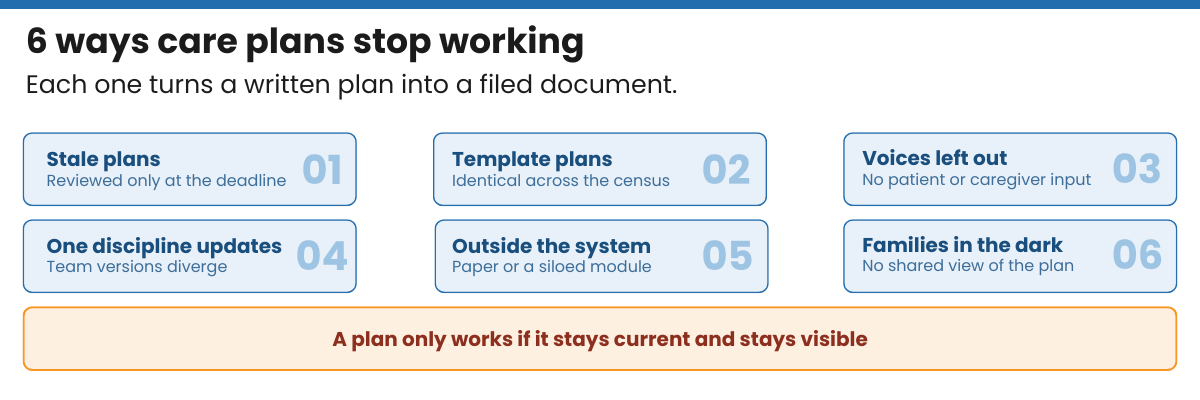
A plan written at admission describes a patient who no longer exists three weeks later. Conditions change, medications change, functional status changes. When review happens only at the recertification deadline, the agency spends most of the episode operating on old information. CMS requires the plan to be reviewed and revised as frequently as the patient's condition warrants, which means the trigger is clinical, not calendar-based.
Template plans that fit no one
Copying a standard plan for every diabetic patient produces documentation that reads identically across the census. Surveyors notice. So do patients, who disengage from goals that clearly were not written about them. Templates are useful as starting structure and harmful as finished output.
Patient and caregiver voices left out
A plan that ignores the patient's routine, cultural expectations, and family arrangements will be quietly ignored in return. Caregiver input is not optional courtesy. CMS guidance on person-centered plans for home and community-based services states that the plan must be developed in consultation with the beneficiary, the treating physician or other appropriate professional, and where appropriate the beneficiary's caregiver, and that it must take into account the extent of and need for any family or other supports. That consultation is easy to skip and hard to defend at audit. It also ignores how much clinical work families already carry: the National Institute on Aging describes family caregivers ordering medicines and equipment, coordinating information across providers, and managing insurance benefits. If the person doing half the work is not in the plan, the plan is incomplete.
Updates made by one discipline only
When the nurse updates the plan but the therapist and the aide do not, the team drifts apart. Each discipline builds its own informal version of the truth. Care becomes inconsistent between visits, and nobody can say which version is authoritative.
Care plans stranded outside the system of record
Plans kept in paper binders, standalone documents, or a clinical module that does not talk to scheduling create a gap between what was ordered and what was scheduled. Staff work from whatever copy they can reach. Authorization limits get exceeded. Visits get delivered that no payer will cover.
Families kept in the dark
Communication failures with family members produce complaints, mistrust, and escalations that could have been prevented with a routine update. During emergencies and care transitions, the absence of a shared plan turns a manageable event into a crisis call.
Integrated Home Care Software to Enhance Utilization of Care Plans
A care plan is only as good as the system holding it. CareVoyant's integrated home care software keeps the plan of care connected to intake, scheduling, clinical documentation, EVV, billing, and payroll under a single patient record, so an update in one place moves everywhere it needs to go.

Keep plans current and patient-specific
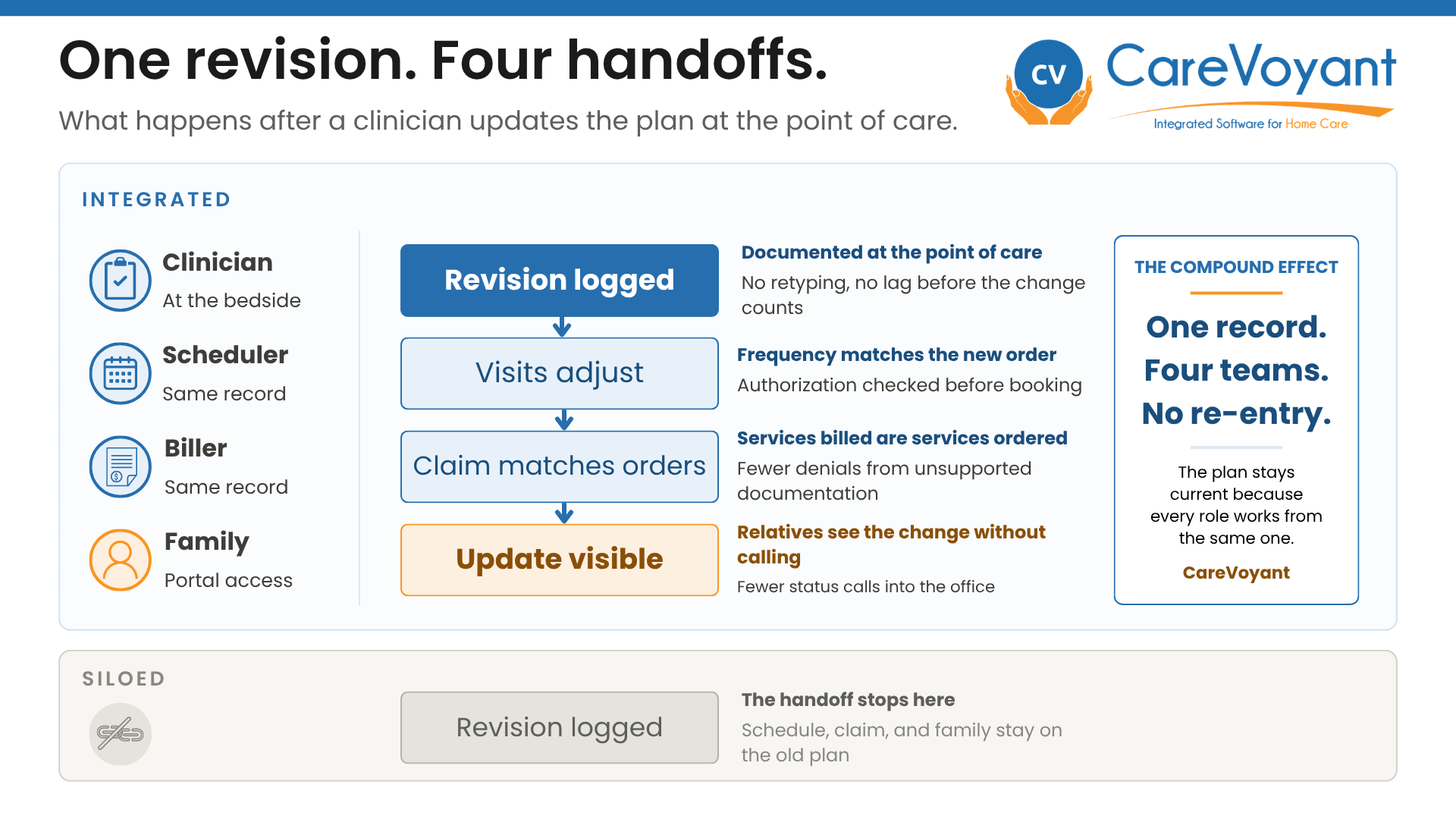
Authorization and Plan of Care Management lets agencies build plans from real assessment data and tie them directly to payer authorizations. Clinicians revise the plan at the point of care rather than after the fact, using clinical and point of care documentation on a mobile device in the patient's home. That removes the lag between a change in condition and a change in the plan. For a deeper look at the mechanics, see home care care planning software.

Bring patients and families into the plan
Care coordination and communication tools capture patient and caregiver preferences during assessment and carry them into the plan itself rather than leaving them in a note.
Families need a way in after that. CareVoyant includes secure messaging and a patient-facing family portal, so relatives can follow progress and care updates without calling the office for a status check. That matters most during transitions and emergencies, when the absence of a shared view turns a manageable event into an escalation. Keeping families informed is a retention issue as much as a clinical one, covered further in building trust with family caregivers and how to improve care team communication in home care.

Keep every discipline on the same version
In private duty nursing, where shifts run long and conditions shift quickly, continuous documentation matters more than periodic summaries. CareVoyant supports continuous care documentation for private duty home care, so RNs, therapists, and aides all work from the current plan instead of separate copies. Avoiding the common failure modes here is covered in PDN documentation mistakes.

Connect the plan to scheduling, EVV, and billing
Plan changes that do not reach the schedule create unauthorized visits. CareVoyant links the plan of care to scheduling, EVV and CV Mobile, and billing and revenue cycle management on one record, so authorized services, scheduled visits, verified visits, and billed claims stay in agreement. Agencies losing revenue to authorization drift will recognize the pattern described in home care authorization management and revenue loss.

Support survey readiness and clean claims
Documentation prompts, required-field validation, and audit-ready reporting help agencies meet payer and regulatory expectations across home health, personal care, and HCBS lines of service, each with its own documentation rules. Related reading: home health documentation and Medicare compliance and survey preparedness for home care agencies.
Conclusion
Care plans fail quietly. Nobody announces that the document has drifted from the patient's actual condition; the gap just widens until a hospitalization or a denied claim makes it visible. Keeping the plan accurate is less about writing a better document at admission and more about having a system where every visit, note, and authorization feeds back into it.
CareVoyant all-in-one home care software platform supports that with one patient record across every line of service. Request a demo to see how plan of care management connects to scheduling, documentation, and billing in a single platform.
Frequently Asked Questions (FAQs)
-
Under 42 CFR § 484.60, each patient must receive services written in an individualized plan of care that identifies patient-specific measurable outcomes and goals. The plan must specify the care and services needed to meet the needs identified in the comprehensive assessment, name the responsible discipline or disciplines, and cover patient and caregiver education and training. Services must be furnished in accordance with accepted standards of practice. Review the full section for the complete list of required elements before building agency templates.
-
Under 42 CFR § 484.60, the Medicare home health plan of care is reviewed and revised by the physician or allowed practitioner as frequently as the patient's condition requires, and no less often than once every 60 days. Medicaid HCBS person-centered service plans must be reviewed at least every 12 months under 42 CFR § 441.725, whenever the individual's circumstances or needs change significantly, and at the individual's request.
-
The certifying physician or allowed practitioner authorizes the plan, but every discipline delivering care contributes to it. Nurses, therapists, and aides all document findings that should trigger a revision. In practice, the agency's clinical manager is accountable for making sure those findings actually reach the plan.
-
The terms are often used interchangeably. In Medicare home health, "plan of care" refers to the physician-certified document required under the Conditions of Participation. "Care plan" is used more broadly across personal care, private duty, and HCBS, where the governing requirements differ by payer and state.
-
Integrated software keeps the plan tied to the authorization, the schedule, and the visit documentation, so services delivered match services ordered and services authorized. It also enforces required fields at the point of documentation and produces audit-ready reports, which reduces the volume of denials tied to unsupported or incomplete documentation.
-
Yes. CMS guidance on person-centered plans for home and community-based services states the plan must be developed in consultation with the beneficiary, the treating physician or other appropriate professional, and where appropriate the beneficiary's caregiver, and that it must account for the extent of and need for family or other supports. For Medicaid HCBS the individual directs the planning process and may include family and other chosen participants. Documenting the caregiver's role, availability, and responsibilities prevents gaps when agency staff are not present. Software helps here too: CareVoyant's secure messaging and family portal give relatives visibility into progress and care updates without routing every question through the office.
About CareVoyant
CareVoyant is a leading provider of cloud-based integrated enterprise-scale home health care software that can support all home-based services under ONE Software, ONE Patient, and ONE Employee, making it a Single System of Record. We support all home based services, including Home Care, Private Duty Nursing, Private Duty Non-Medical, Home and Community Based Services (HCBS), Home Health, Pediatric Home Care, and Outpatient Therapy at Home.
CareVoyant functions – Intake, Authorization Management, Scheduling, Clinical with Mobile options, eMAR/eTAR, Electronic Visit Verification (EVV), Billing/AR, Secure Messaging, Notification, Reporting, and Dashboards – streamline workflow, meet regulatory requirements, improve quality of care, optimize reimbursement, improve operational efficiency and agency bottom line.
For more information, please visit CareVoyant.com or call us at 1-888-463-6797.
Request for Information
To learn more about CareVoyant Software and how we improve the operational efficiency of Home Healthcare Agencies, contact us:
