

EVV is more than a compliance checkbox. It helps to prevent fraud, streamline operations, and improve care quality. Understanding myths vs. realities empowers home care providers, agencies, and caregivers to adopt EVV with confidence.
Introduction
Electronic Visit Verification (EVV) has become a critical requirement in homecare, driven by rising costs, fraud concerns, and heightened regulatory scrutiny. Yet, confusion and misconceptions continue to cloud its purpose and impact. Some see EVV as intrusive or burdensome, while others worry about compliance risks and operational hurdles. In reality, EVV, an electronic system that verifies when and where care is delivered, can streamline processes, protect agencies, and improve outcomes when implemented effectively.
This article goes beyond myths to uncover practical insights, guiding providers, compliance officers, state agencies, and vendor leaders toward smarter, more confident EVV adoption.

EVV in Context: Origins, Purpose & Policy
Electronic Visit Verification (EVV) is not just a technological trend; it is a federal mandate that reshaped how homecare services are delivered and monitored. The foundation was laid by the 21st Century Cures Act of 2016, which required states to implement EVV for Medicaid-funded personal care services by 2020 and home health care services by 2023. This legislation, along with subsequent federal guidance, aimed to improve accountability and reduce improper billing while ensuring patients receive the care they are authorized to receive.
At its core, EVV is an electronic system that verifies key details of a homecare visit, including the type of service provided, the individual receiving care, the date and time of service, the location, and the caregiver delivering it. These data points create a digital “proof of care” that can be audited and analyzed.
The overarching goals of EVV are clear: prevent fraud, waste, and abuse; improve oversight and compliance; and enable more data-driven decisions for care delivery and reimbursement. While primarily applied to personal care and home health services, some states have extended EVV requirements to additional programs. By grounding operations in verified data, EVV supports integrity, efficiency, and trust in the homecare ecosystem.
EVV Models & State Flexibility
When it comes to implementing EVV, states have flexibility in choosing the model that best fits their Medicaid program. The three most common approaches - Closed, Open, and Hybrid, each come with unique benefits and challenges.
Closed Model
In a closed model, the state mandates a single EVV vendor for all providers. This ensures consistency and centralized oversight but often limits provider choice and innovation. Agencies may face challenges integrating the mandated system with their existing workflows.

Open Model
The open model allows providers to select their preferred EVV vendor, as long as the system can interface with the state’s aggregator. This promotes competition, flexibility, and better integration with agency software. However, states must invest in interoperability standards and monitoring, which can be complex and costly.

Hybrid Model
A hybrid approach combines both: the state offers an “official” EVV solution but permits providers to use alternative vendors if they meet compliance requirements. While this balances control and flexibility, it can create uneven adoption and additional oversight needs.
Why States Vary & Transition Challenges
States choose models based on regulatory mandates, budget constraints, political considerations, and technical readiness. Transitioning from one model to another such as closed to open can be disruptive, requiring retraining, data migration, and adjustments in compliance monitoring.
Common Myths (“Fiction”) vs. Reality (“Fact”)
Despite being a federal mandate, Electronic Visit Verification (EVV) is often misunderstood in the homecare industry. Misconceptions about cost, compliance, and caregiver impact create unnecessary resistance. Below, we break down common myths, clarify realities, and show how CareVoyant EVV Software address these concerns.
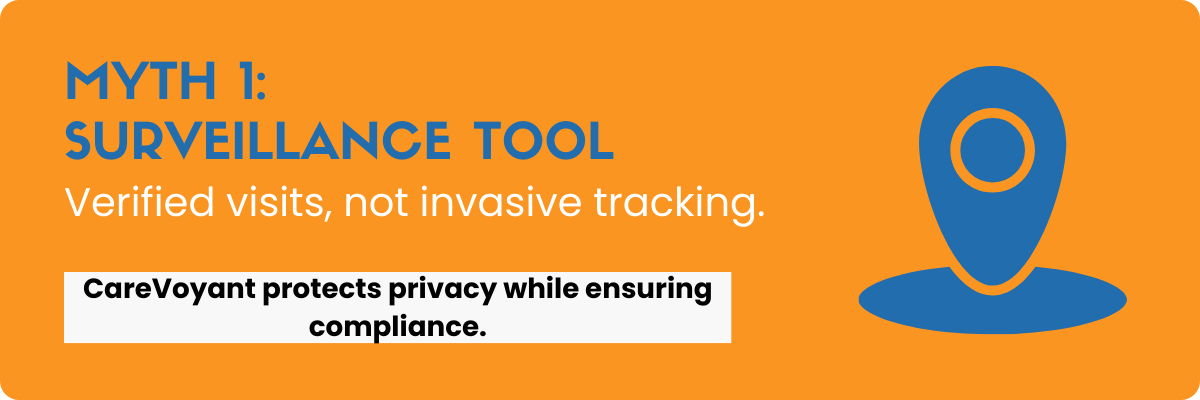
Myth 1: EVV is Just a Surveillance Tool
Reality: EVV verifies visits, not monitor caregivers continuously. It captures check-in and check-out data time, location, service type, and caregiver identity.
Nuances & Caveats: Some worry about “big brother” tracking. In truth, EVV is designed for compliance, not constant monitoring. States typically prohibit continuous GPS tracking.
CareVoyant Advantage: With CV Mobile, caregivers clock in/out securely, even in offline mode, without invasive tracking. The system validates visits while respecting privacy, supporting compliance with the 21st Century Cures Act. Learn more about integrated EVV software solutions.
Myth 2: EVV Increases Administrative Burden
Reality: When integrated properly, EVV reduces paperwork and manual oversight. Automated validation of visits cuts errors and improves claim accuracy.
Nuances & Caveats: Transitioning can feel burdensome at first, especially if providers juggle multiple systems. The key is choosing software that integrates EVV with scheduling, billing, and payroll.
CareVoyant Advantage: CareVoyant integrates scheduling, authorization & plan of care management, billing/AR, payroll, and accounting into ONE platform. This unified workflow ensures visits verified in EVV flow seamlessly to claims, payroll, and compliance reports eliminating redundant data entry.

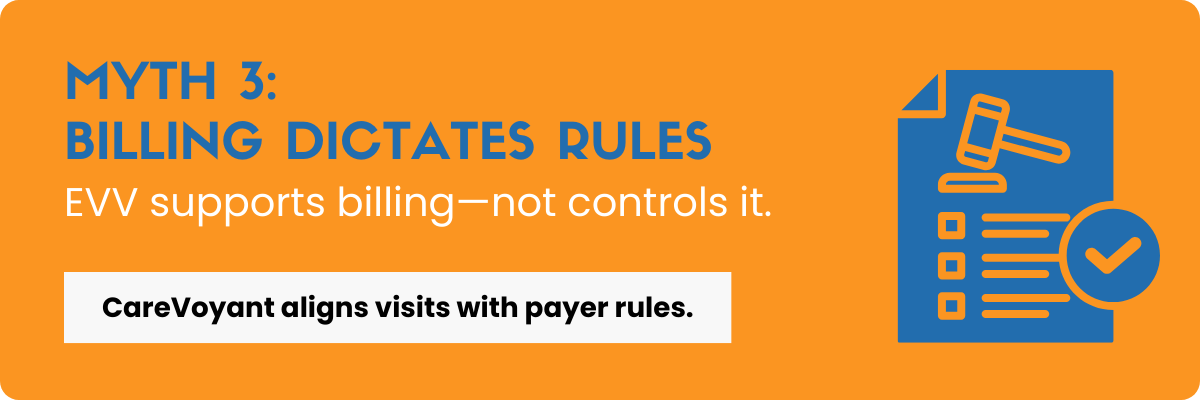
Myth 3: EVV Systems Dictate Billing Rules
Reality: Billing policies are set by states and payers, not EVV vendors. EVV simply provides the verified data needed to support billing.
Nuances & Caveats: Delays may occur if systems are poorly integrated or cannot adapt to policy changes. Providers should look for configurable, agile solutions.
CareVoyant Advantage: CareVoyant’s billing and revenue cycle management tools align EVV data with payer rules. Automatic validation reduces denials and speeds reimbursement. When state rules shift, CareVoyant adapts quickly, keeping agencies compliant.
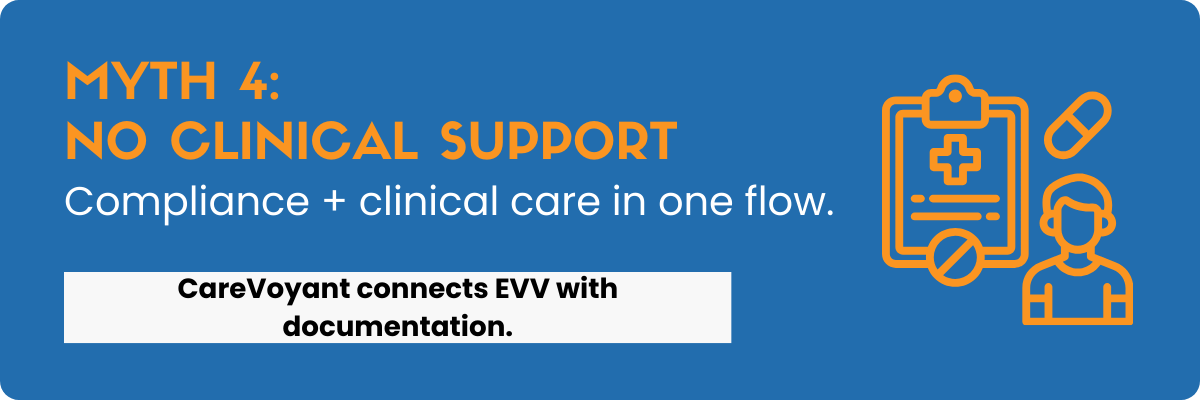
Myth 4: EVV Doesn’t Support Clinical Workflows
Reality: While EVV focuses on visit verification, advanced platforms extend functionality to clinical documentation and care management.
Nuances & Caveats: Some basic EVV vendors only track visits, leaving providers with gaps in care coordination. Agencies need systems that bridge compliance and clinical quality.
CareVoyant Advantage: CareVoyant integrates clinical point-of-care documentation, eMAR/eTAR, care coordination, and communication tools into the EVV workflow. Caregivers can complete care notes, record vitals, and update treatment tasks during verified visits linking compliance to quality outcomes.
Myth 5: EVV Works the Same in Every State
Reality: States differ widely in EVV models (Closed, Open, Hybrid), approved vendors, and reporting requirements.
Nuances & Caveats: A one-size-fits-all approach can fail. Agencies operating across states need flexible, multi-model support.
CareVoyant Advantage: CareVoyant EVV is state-compliant and adaptable, supporting open integrations and aggregator reporting. Whether a state mandates a single vendor or allows flexibility, CareVoyant aligns with requirements while giving providers control of their workflows.

Myth 6: EVV Offers Limited Value Beyond Compliance
Reality: While compliance is the mandate, EVV data can drive operational efficiency and business insights.
Nuances & Caveats: Agencies that treat EVV as a “check-the-box” tool miss its strategic value. Leveraging verified data improves resource allocation, staffing, and financial performance.
CareVoyant Advantage: CareVoyant transforms EVV into a strategic asset through reports, dashboards, and operational analytics. Agencies can track caregiver performance, reduce no-shows, optimize scheduling, and strengthen decision-making.
Myth 7: Caregivers Will Resist EVV Adoption
Reality: Caregiver pushback often stems from poor system design or lack of training. User-friendly tools reduce frustration.
Nuances & Caveats: Involving caregivers early and ensuring mobile accessibility are critical for adoption. Agencies that ignore workforce concerns risk turnover.
CareVoyant Advantage: CareVoyant’s mobile-friendly design, offline access, and integrated scheduling simplify the caregiver’s workflow. Instead of juggling multiple apps, staff manage timekeeping, clinical notes, and communication in one system making adoption smoother and reducing resistance.
Myth 8: EVV Implementation is Too Costly for Small Agencies
Reality: EVV adoption involves upfront investment, but long-term savings in reduced fraud, faster billing, and operational efficiency outweigh costs.
Nuances & Caveats: Smaller agencies must be strategic, choosing platforms that deliver value beyond compliance.
CareVoyant Advantage: By unifying EVV with billing, payroll, scheduling, and care management, CareVoyant all-in-one home care software eliminates the need for multiple vendors and redundant systems. This lowers total cost of ownership while maximizing compliance and efficiency.

Conclusion
EVV is more than a regulatory requirement; it is an opportunity to improve compliance, streamline operations, and enhance care delivery. Misconceptions can create fear, but with the right technology, agencies can transform EVV into a driver of efficiency and growth. CareVoyant EVV Software stands out by integrating compliance, clinical workflows, scheduling, and financials into one seamless solution helping providers move beyond myths toward measurable value.
Frequently Asked Questions
-
Electronic Visit Verification (EVV) is a system that confirms homecare visits occur as scheduled by verifying the caregiver, patient, location, date, time, and service provided. EVV helps ensure compliance, reduces fraud, and improves accountability in homecare delivery.
-
EVV is required due to the 21st Century Cures Act, which mandates EVV for Medicaid-funded personal care and home health services. The goal is to prevent improper billing, reduce fraud, and ensure patients receive authorized care.
-
No. EVV does not continuously monitor caregivers. It only verifies key visit details such as clock-in, clock-out, location at visit start/end, and caregiver identity. Most states prohibit invasive or ongoing GPS tracking.
-
EVV verifies essential visit data, including:
Type of service performed
Individual receiving care
Date and time of service
Visit location
Caregiver providing care
These data points create a secure digital record for compliance and billing.
-
EVV may feel challenging during implementation, but integrated EVV software reduces paperwork, eliminates manual visit tracking, and improves claim accuracy. Agencies benefit most when EVV connects directly with scheduling, billing, and payroll workflows.
-
EVV provides verified proof that care was delivered as authorized. This reduces missed visits, unauthorized billing, and documentation gaps. When EVV data aligns with payer rules, agencies experience fewer denials and faster reimbursement.
-
Yes. EVV rules differ widely by state, including:
Approved vendors
Reporting formats
Aggregator systems
Implementation models (closed, open, hybrid)
Multi-state agencies need EVV software that adapts to varying compliance standards.
-
States implement EVV using different approaches:
Closed model: One state-mandated vendor
Open model: Providers choose their EVV vendor
Hybrid model: State offers a solution but allows alternatives
Each model affects provider flexibility and integration options.
-
Yes. Advanced EVV platforms integrate visit verification with clinical tools such as point-of-care documentation, eMAR/eTAR, care notes, and treatment tasks. This improves care coordination while maintaining compliance.
-
While EVV requires upfront investment, long-term ROI is significant. Integrated EVV software reduces fraud, speeds billing, improves scheduling efficiency, and eliminates the need for multiple disconnected systems lowering overall costs for smaller agencies.
About CareVoyant
CareVoyant is a leading provider of cloud-based integrated enterprise-scale home health care software that can support all home-based services under ONE Software, ONE Patient, and ONE Employee, making it a Single System of Record. We support all home based services, including Home Care, Private Duty Nursing, Private Duty Non-Medical, Home and Community Based Services (HCBS), Home Health, Pediatric Home Care, and Outpatient Therapy at Home.
CareVoyant functions – Intake, Authorization Management, Scheduling, Clinical with Mobile options, eMAR/eTAR, Electronic Visit Verification (EVV), Billing/AR, Secure Messaging, Notification, Reporting, and Dashboards – streamline workflow, meet regulatory requirements, improve quality of care, optimize reimbursement, improve operational efficiency and agency bottom line.
For more information, please visit CareVoyant.com or call us at 1-888-463-6797.
Request for Information
To learn more about CareVoyant Software and how we improve the operational efficiency of Home Healthcare Agencies, contact us:
