

The Staffing Tightrope Every Private Duty Agency Walks
Every private duty agency owner knows the tension. Add another RN to a shift and margins shrink. Pull a shift too thin and a family calls asking why their child’s nurse showed up an hour late again. The instinct is to treat this as a hiring problem: find cheaper staff, or find more of them. It rarely is. This is a matching problem, and the match has four parts: the right caregiver, at the right skill level, in the right place, at a cost the payer source actually supports.
The private duty nursing workforce is not getting easier to staff around. The Bureau of Labor Statistics projects home health and personal care aide employment to grow 18 percent from 2025 to 2035, adding roughly 847,300 jobs, much faster than the average for all occupations. It also projects about 760,500 openings a year across that decade. Most of those openings exist because someone left, not because an agency grew. Demand isn’t the problem. Retention is.
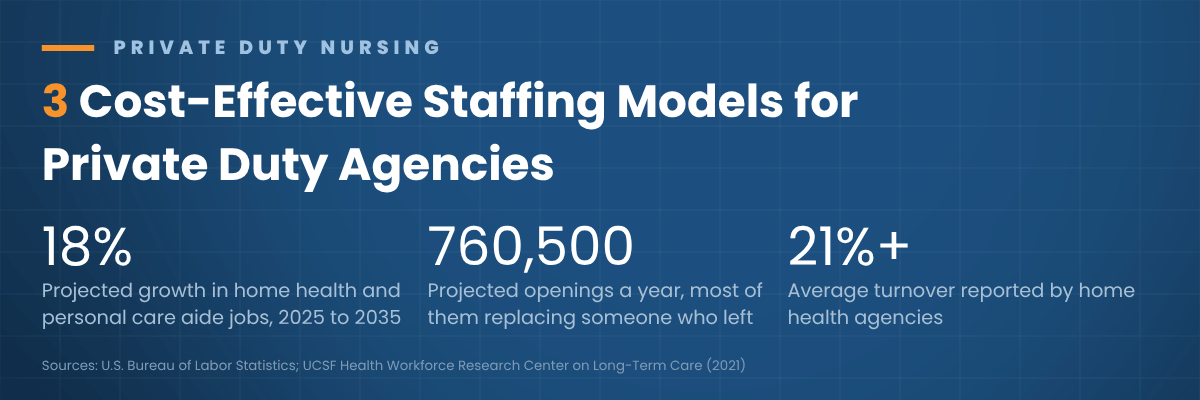
A 2021 study from UCSF’s Health Workforce Research Center on Long-Term Care found home health agencies reporting turnover above 21 percent on average, with the cost of a single nurse turnover often exceeding $100,000 once recruiting, onboarding, and lost productivity are counted. That six-figure number reflects licensed nursing staff rather than every caregiver departure, but the pattern holds at every level: each exit forces a scramble, and the scramble almost always ends in overtime. Much of that churn is more predictable than agencies assume, and the reasons caregivers quit home care jobs are well documented.
Cost-effective staffing is not the cheapest staffing. It is the model that keeps a shift filled with the right person the first time, so the agency never pays twice for the same coverage.
Why Private Duty Staffing Is Uniquely Hard to Budget
Private duty nursing runs on hours, not visits. A home health episode gets paid in units regardless of how long a clinician actually stays. A private duty shift gets paid, or billed to Medicaid, by the hour. Every minute of overtime, every mile of drive time, and every shift differential lands directly on the bottom line.
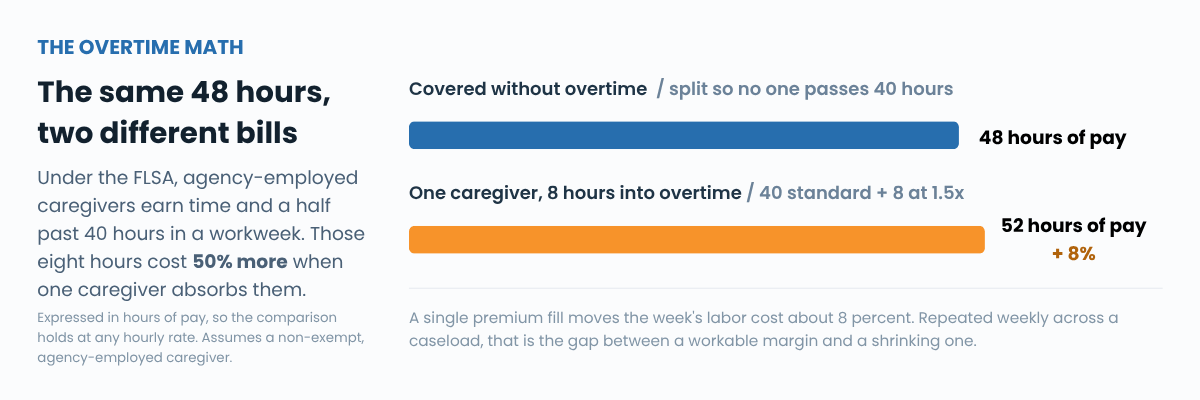
The arithmetic is less forgiving than it looks. Under the Fair Labor Standards Act, agency-employed direct care workers earn time and a half beyond 40 hours in a workweek. Covering eight hours at that premium rather than at standard rate costs 50 percent more for those eight hours and raises the total labor cost of a 48-hour week by roughly 8 percent. Repeat that across a caseload every week and it becomes the difference between a workable margin and a shrinking one.
A few things make this harder than staffing almost any other care setting:
Acuity narrows the pool. A ventilator-dependent or trach-and-suction patient needs a specific skill set. An agency cannot fill that shift with whoever is available. It has to be whoever is qualified, which shrinks the staffing pool exactly when flexibility matters most.
Authorization sets a hard ceiling. Payers approve a fixed number of hours per week. Staff beyond it and the agency eats the cost. Staff under it and the family goes without care they are entitled to.
The labor market is tight and getting tighter. With turnover in home-based care sitting well above other healthcare settings, agencies are constantly recruiting just to stay level, not to grow.
None of this means agencies are stuck choosing between overspending and understaffing. It means the fix has to happen upstream of hiring, in how shifts get built, filled, and tracked.
The Three Models at a Glance
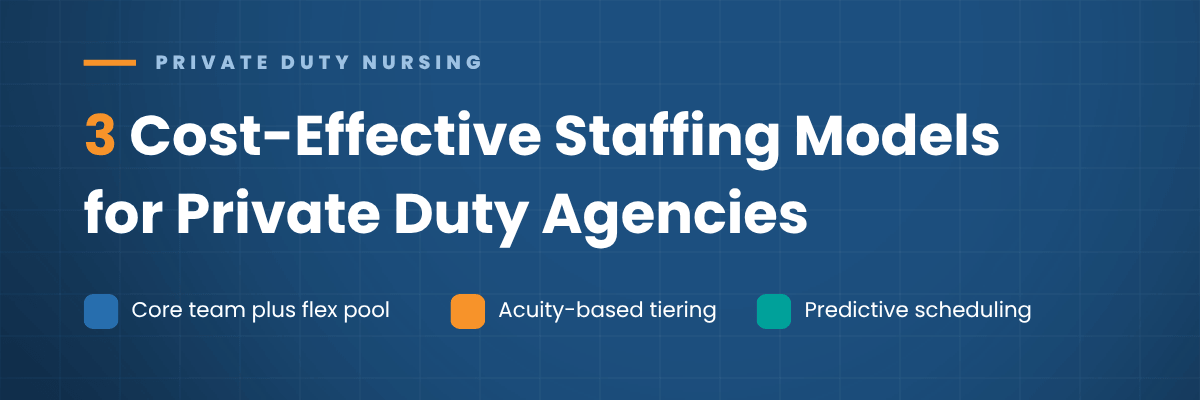
| 1. Core team plus flex pool Employed, cross-trained staff cover predictable census. A smaller PRN pool absorbs surges and call-offs. | 2. Acuity-based tiering Each case is matched to the lowest-cost license that can safely and legally deliver the care. | 3. Predictive scheduling Historical call-off, census, and availability data forecast staffing gaps weeks ahead. | |
|---|---|---|---|
| What it controls | Headcount cost during census swings | The rate paid per hour of care | When a staffing gap gets discovered |
| Best when | Census is volatile month to month | Case mix spans stable and complex patients | Call-offs drive most of your overtime |
| Main cost lever | Avoiding permanent headcount you do not need | Not paying RN rates for LPN-appropriate shifts | Filling at standard rate instead of premium |
| Biggest risk | An untracked PRN pool costs as much as full-time staff | Scope-of-practice or authorization violation | The forecast is only as good as the data |
| What it requires | Credential and authorization tracking for every PRN | Enforced scope and authorization rules, by state | Historical call-off, census, and availability data |
None of the three survive on a spreadsheet. All of them need scheduling, authorization, and payroll reading from the same data.
Core team plus flex pool staffs predictable census with employed, cross-trained caregivers and covers surges, call-offs, and short-notice cases with a smaller flex or PRN pool.
This works because it separates two very different cost problems. The core team gives the agency predictable payroll and lower onboarding overhead. The flex pool absorbs the spikes: seasonal pediatric cases during the school year, or a family needing temporary overnight coverage. Neither forces the agency to carry permanent headcount it does not need in a slow month.
The catch is that a flex pool nobody tracks closely becomes its own cost center. Every PRN caregiver still needs credential verification, orientation, and authorization matching before a shift. Agencies that manage this on paper or across disconnected spreadsheets often find the flex pool costs nearly as much as full-time staff once onboarding and compliance rework are counted.
Model 2: Acuity-Based Tiering
Acuity-based tiering matches each patient’s clinical complexity to the lowest-cost license that can safely and legally deliver the care, keeping complex or unstable cases with an RN.
Private duty nursing is skilled care by definition, so the tiering happens between RN and LPN (or LVN, depending on the state), not down to an aide level. Ventilator management, trach and suction, IV therapy, and complex wound care stay with a licensed nurse. What tiering changes is the default: an LPN covering a stable, well-managed case, instead of every shift defaulting to RN coverage.
Done well, this stops agencies from paying RN rates for shifts an LPN could safely and legally cover, without ever placing a patient with an under-licensed caregiver. Done poorly, it creates real compliance risk: a shift assigned outside a nurse’s scope of practice, or outside what the payer authorized for that level of care.
Before you change how shifts are assigned: Scope of practice for LPNs and LVNs varies by state, and so does what each payer will authorize at each license level. Confirm both against your state's nurse practice act and your payer contracts.
Where a home health aide fits into this picture is a separate question, and a common one for agencies that run private duty nursing alongside a non-medical or personal care line of service. An HHA does not perform clinical tasks and is not a substitute tier within PDN. But the same patient may have authorized RN or LPN hours for skilled care and separate HHA hours for ADL support like bathing, dressing, or meal prep. Agencies managing both service lines under one roof can staff that patient’s full week, skilled and non-medical, as a single case. That is where the real efficiency shows up: one care plan, one schedule, one authorization picture, instead of two systems that do not talk to each other.
Model 3: Predictive Scheduling
Predictive scheduling uses historical call-off patterns, census trends, and caregiver availability to forecast staffing gaps weeks ahead, so open shifts get filled at standard rate instead of premium rate.
This model is less about who staffs a shift than about when the agency finds out a shift needs filling. Most agencies still operate reactively. A call-off happens, someone starts working the phones, and whoever picks up gets paid overtime or a shift differential because there was no time to plan otherwise.
Predictive scheduling flips that. With enough history behind it, an agency can forecast gaps two to four weeks out instead of two hours out. That lead time is the difference between offering an open shift at standard rate and paying a premium to fill it same-day.
This is the model most agencies underuse. Not because it fails, but because it requires visibility most legacy systems do not provide. It also carries the clearest return: fewer emergency fills, less registry staffing, and fewer overtime hours arriving as a surprise on the next payroll run.
The Hidden Costs Most Agencies Miss
Ask most owners what drives their labor costs and they will say wages. Wages matter. But the costs that quietly erode margin usually sit somewhere else:
Travel time and mileage calculated by hand, or not consistently at all. That either underpays caregivers, which drives turnover, or overpays them, which drives cost, depending on which way the errors break.
Overtime that stays invisible until payroll runs. By the time a scheduler sees total hours, the shift has already happened and the cost is locked in.
Authorization and billing mismatches that force retroactive fixes when a documented shift does not match what was approved.
Turnover driven by uneven shift distribution. This is a fairness problem more than a pay problem. Caregivers who feel they always draw the least desirable shifts leave, and the agency pays the replacement cost again.
Every one of these is a visibility gap before it becomes a staffing gap.
Choosing the Right Model for Your Agency
Most mature agencies do not run one of these models exclusively. They blend core team plus flex pool with acuity-based tiering, then layer predictive scheduling on top to decide when and how far ahead to activate the flex pool.
The question worth asking internally is not “which model is cheapest.” It is this: is our staffing cost problem a people problem, or a visibility problem? For most private duty agencies, especially ones still coordinating scheduling, authorization, and payroll across separate tools, it is the second one.
The Technology Layer That Makes Any of This Work
None of the three models survive at scale on a whiteboard, a shared spreadsheet, or three disconnected point solutions. To execute cost-effective staffing, software needs to:
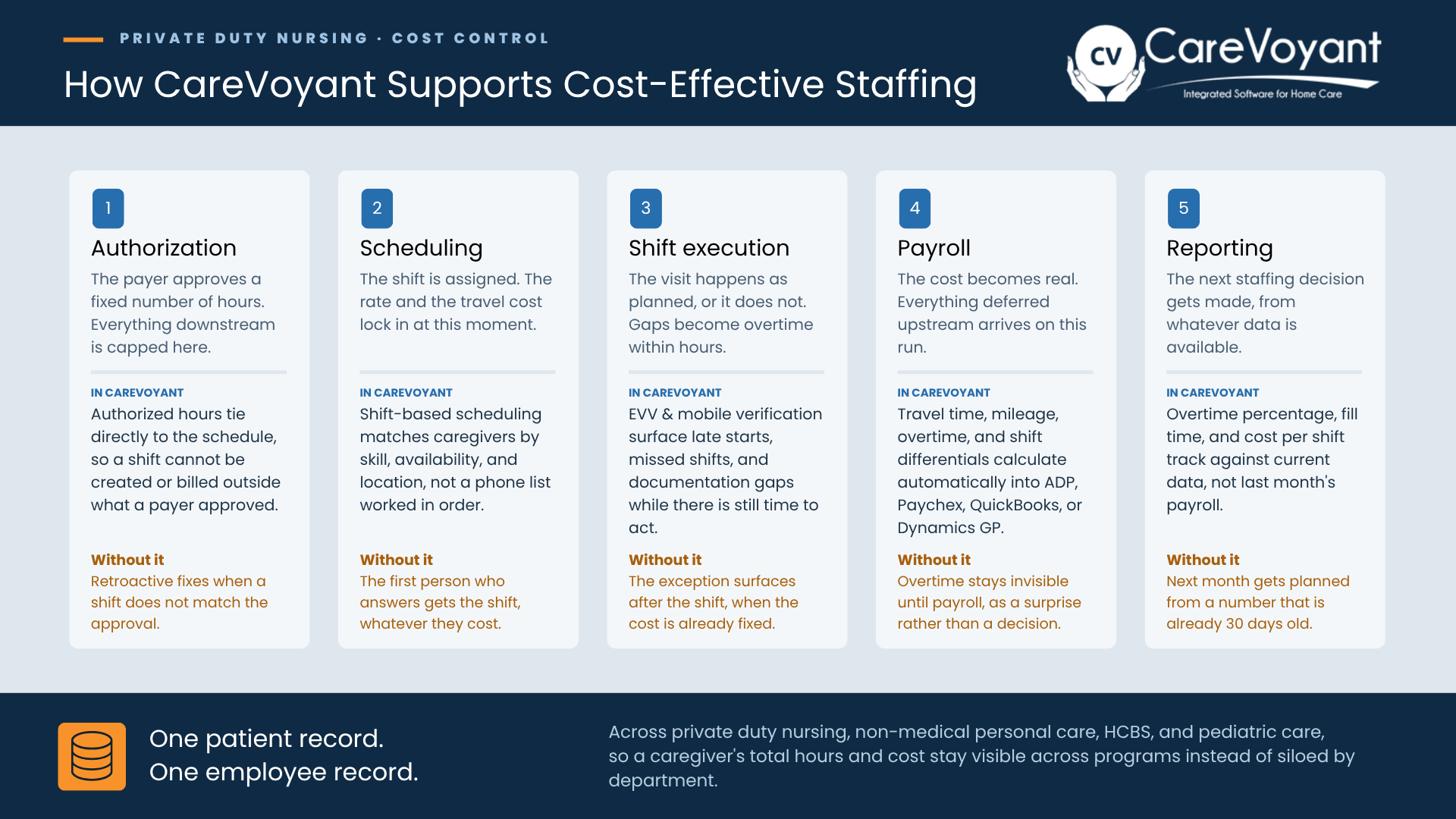
Tie authorized hours directly to scheduling, so a shift cannot be created outside what has been approved
Match caregivers to shifts by skill, distance, and availability automatically, instead of a scheduler working a phone list in order
Flag schedule exceptions such as late starts, missed visits, and GPS mismatches, before they turn into an overtime shift or a care gap
Calculate travel time, mileage, and overtime automatically as part of payroll processing, not after the fact
Keep one patient record and one employee record across every line of service, so a caregiver’s total hours and cost stay visible across programs rather than siloed by department
How CareVoyant Supports Cost-Effective Staffing
CareVoyant’s Private Duty Nursing Software was built around the shift-based cost structure of private duty care, not adapted from a visit-based home health platform. A few ways it supports the models above:
Shift-based scheduling built for PDN’s hour-by-hour cost structure, with intelligent caregiver-to-patient matching by skill, availability, and location
Authorization tied to scheduling and billing, so shifts cannot be created or billed outside what a payer has approved
Real-time schedule monitoring, backed by EVV and mobile visit verification, surfacing late starts, missed shifts, and documentation gaps while there is still time to act
Payroll integration with automatic calculation of travel time, mileage, overtime, and shift differentials, connecting directly with ADP, Paychex, QuickBooks, and Dynamics GP
One record across service lines covering PDN, non-medical, HCBS, and pediatric care, so agencies running an acuity-tiered model can move staff across programs without duplicate data entry
Reports and dashboards tracking overtime percentage, fill time, and cost per shift, so staffing decisions get made from current data rather than last month’s payroll surprise
Agencies with the clearest picture of where their staffing dollars go are usually the ones already tracking a defined set of private duty nursing KPIs against live data rather than month-end reports.
The Bottom Line
Cost-effective staffing is a matching problem, not a hiring problem. The goal is filling a shift correctly the first time.
Core team plus flex pool controls headcount cost. Acuity-based tiering controls the rate paid per hour. Predictive scheduling controls when a gap gets discovered.
Most mature agencies blend all three rather than picking one.
Every model depends on scheduling, authorization, and payroll reading from the same data. On disconnected systems, each one adds administrative cost instead of removing it.
Acuity tiering is the model with real compliance exposure. Verify scope of practice and payer authorization by state before changing assignment rules.
Agencies that control labor costs well are not the ones paying caregivers the least. They are the ones with no blind spots between authorization, scheduling, and payroll, so every staffing decision gets made with full visibility into cost and coverage at the same time. Talk to CareVoyant about what that looks like for your agency.
Frequently Asked Questions
-
There is no single ratio that works across agencies. The right mix depends on patient acuity, authorized hours, and caregiver availability in a given market. The more useful question is whether the agency has real-time visibility into all three at once.
-
Predictive scheduling is the most direct lever. Filling shifts two to four weeks ahead based on historical call-off and census patterns, instead of same-day, sharply reduces the need for overtime or premium-rate fills.
-
Usually less expensive, since it prevents paying higher-credential rates for care a lower-credentialed, still-authorized caregiver could safely perform. It only works if scope-of-practice rules and authorization limits are enforced automatically rather than checked by hand.
-
By tying authorization directly to scheduling, automating travel time and overtime calculations, and flagging exceptions before they turn into unplanned costs, rather than agencies finding out during payroll.
-
Cost-effective staffing matches the right caregiver to the right need at the lowest cost that still meets the plan of care. Understaffing cuts hours regardless of need. The first protects margin. The second creates risk: missed care, unhappy families, and eventually more overtime to fix the gaps it created.
About CareVoyant
CareVoyant is a leading provider of cloud-based integrated enterprise-scale home health care software that can support all home-based services under ONE Software, ONE Patient, and ONE Employee, making it a Single System of Record. We support all home based services, including Home Care, Private Duty Nursing, Private Duty Non-Medical, Home and Community Based Services (HCBS), Home Health, Pediatric Home Care, and Outpatient Therapy at Home.
CareVoyant functions – Intake, Authorization Management, Scheduling, Clinical with Mobile options, eMAR/eTAR, Electronic Visit Verification (EVV), Billing/AR, Secure Messaging, Notification, Reporting, and Dashboards – streamline workflow, meet regulatory requirements, improve quality of care, optimize reimbursement, improve operational efficiency and agency bottom line.
For more information, please visit CareVoyant.com or call us at 1-888-463-6797.
Request for Information
To learn more about CareVoyant Software and how we improve the operational efficiency of Home Healthcare Agencies, contact us:
