

Introduction
Home care leaders watch billable hours, census growth, and star ratings closely. Travel gets far less attention. It shows up in payroll every week, yet many agencies only see its full cost at the end of the year.
That cost went up in 2026. The IRS set the 2026 business standard mileage rate at 72.5 cents per mile in January. Then, because of higher fuel prices, it raised the rate to 76 cents per mile for July 1 through December 31. It was the first midyear change since 2022. For agencies that reimburse at the IRS rate, every mile now costs more than it did six months ago.
If you budgeted at the January rate, update it: The IRS business mileage rate rose from 72.5 cents to 76 cents per mile on July 1, 2026, its first midyear change since 2022.
Home care mileage tracking is how you get that cost under control. If your agency still depends on paper logs or a separate mileage app instead of integrated home care software, you are paying for miles and drive time you cannot fully see. This article shows where that money goes and how CareVoyant's CV Miles helps you keep more of it.
Why Drive Time Is a Hidden Payroll Cost
Many agencies treat travel as a fixed cost of doing business. U.S. data suggests it deserves a closer look. Researchers from The University of Texas at Austin and the Technical University of Munich analyzed 166,641 visits by 807 caregivers at a U.S. home healthcare agency with eight branches in four states. Average travel time between patient locations ranged from about 20 minutes in the most compact branches to about 61 minutes in the most spread-out one.
Do the math on a typical day. A caregiver with five visits makes four trips between clients. At 20 to 60 minutes per trip, that is roughly 1.3 to 4 hours on the road in a single shift.
That time is also paid time. The U.S. Department of Labor states that travel from one client to another during the workday counts as hours worked. Each extra mile costs you twice: once in reimbursement and once in wages. For a deeper look at the wage side, read our guide to how caregiver travel time affects payroll and your bottom line.
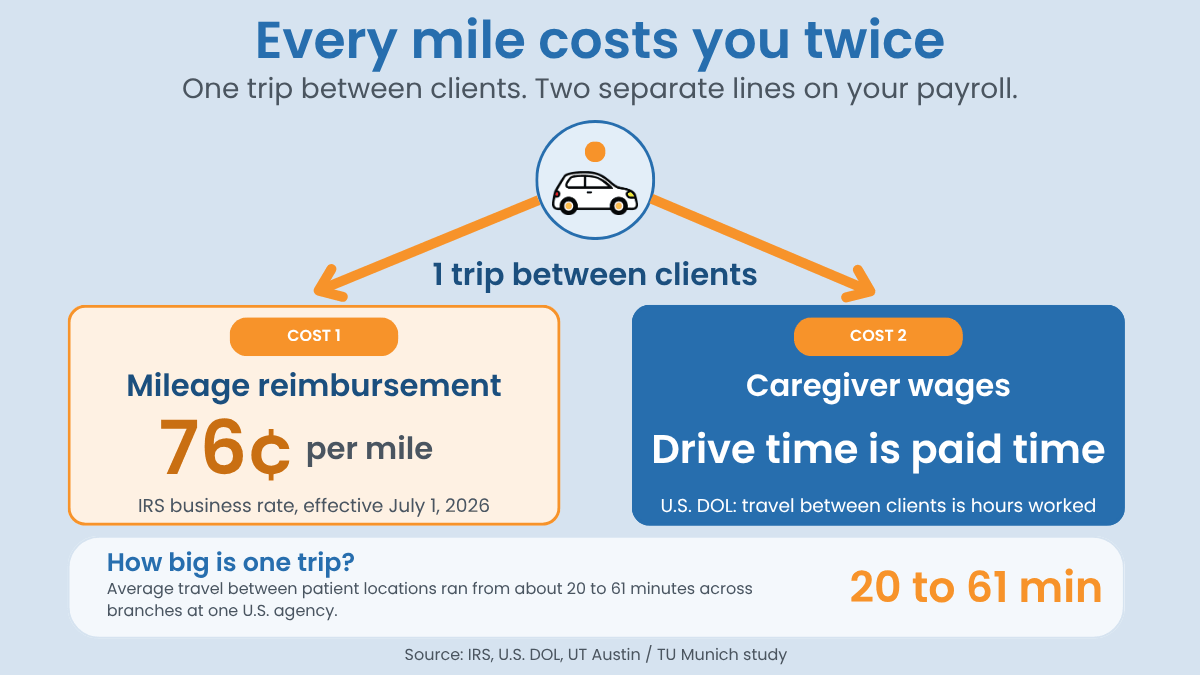
One trip between clients generates two separate payroll costs. At 76 cents per mile and 20 to 61 minutes of average travel, neither one is small.
Most caregivers are not reimbursed at all: In a National Employment Law Project survey, only 18% of home care workers said their employer paid for on-the-job transportation costs such as mileage or gas.
Manual logs make the problem harder to manage. When caregivers estimate or round their miles, small differences add up across hundreds of visits a month. Office staff then spend hours checking logs against schedules before every payroll run, which is why accurate time tracking for home care payroll matters so much.
What Mileage Reimbursement Rules Mean for Your Agency
Three rules shape how home care agencies handle caregiver travel:
Travel time between clients is paid time. Under the Fair Labor Standards Act (FLSA), time spent driving between clients during the workday must be paid. It also counts toward the 40-hour threshold, so drive time can push caregivers into overtime pay.
The IRS rate is a benchmark, not a mandate. Employers can reimburse at a different rate. The IRS rate is the common reference point because it is widely used for tax-free reimbursement when mileage is properly documented.
Unreimbursed vehicle costs can create minimum wage problems. Under the FLSA, wages must be paid free and clear. If a caregiver's vehicle costs push their effective pay below minimum wage, the agency may owe the difference. Some states, including California and Illinois, go further and require employers to reimburse necessary business expenses.
Rules vary by state, so review your travel pay and reimbursement policy with your employment counsel.
Before you set your travel pay policy: Under the FLSA, driving between clients during the workday is paid time, and it counts toward the 40-hour overtime threshold. State expense reimbursement rules vary, so confirm both against DOL guidance on travel time and your state's own requirements.
How CV Miles Works Inside CareVoyant
CareVoyant is built on a "ONE Software, ONE Patient" approach. CV Miles is not a separate plugin or add-on. It works inside CareVoyant's scheduling and payroll integration workflow.
CV Miles works hand in hand with EVV and the CV Mobile app. When a caregiver clocks in and out through EVV, the system captures GPS location for the visit. CV Miles then calculates travel time and distance between visits automatically for each shift, using map data to find the most efficient route between locations. Caregivers do not have to submit a separate mileage claim, and the results flow directly into payroll.
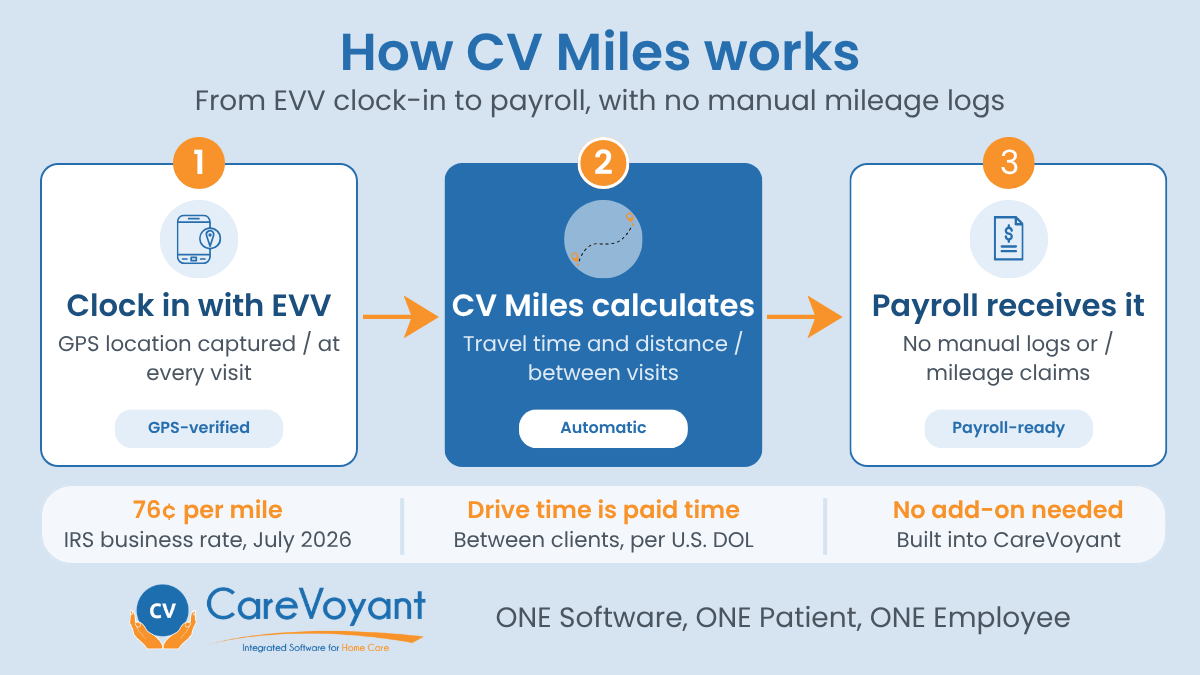
EVV captures the GPS location at clock-in and clock-out. CV Miles handles the rest.
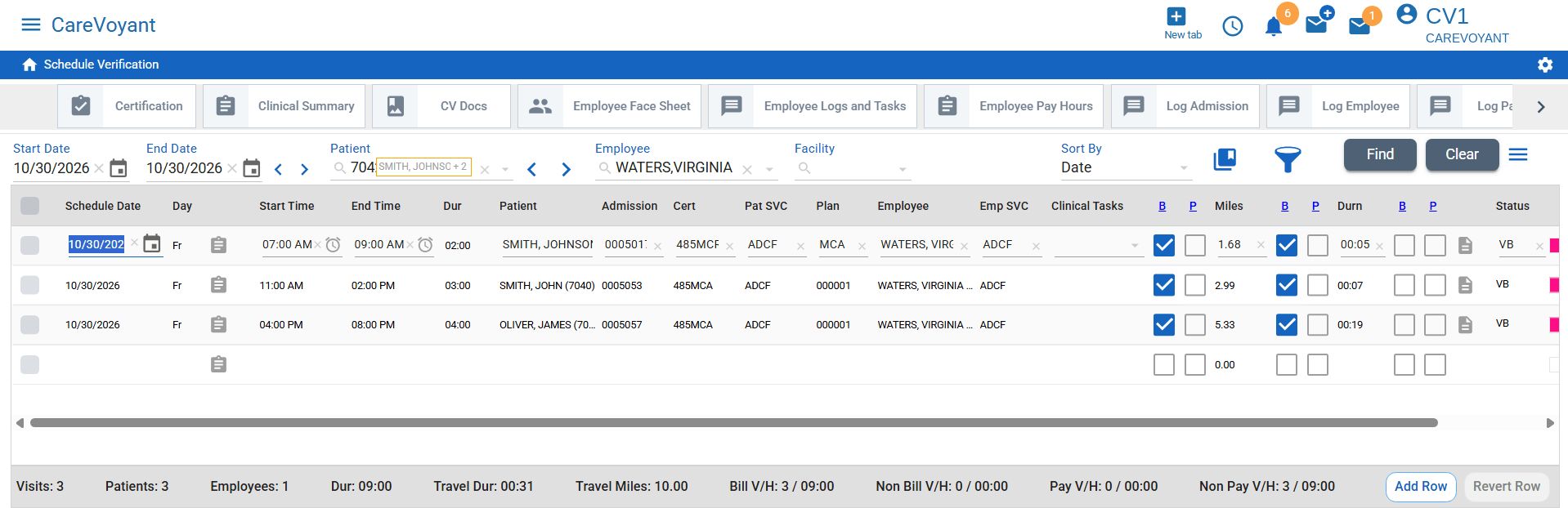
Travel miles and travel time calculated for each scheduled visit, with daily totals. This caregiver's three visits total 10 miles and 31 minutes of travel.
Three Ways Automated Mileage Tracking Pays Off
1. Less Administrative Work
Office staff no longer need to check each mileage log against the schedule. Travel miles and time are already calculated, so payroll review takes less time. If your agency pays for a separate mileage app, you can also drop that subscription and the extra data silo that comes with it. Learn more about how to streamline payroll processing with integrated home care software.
2. Better Use of Caregiver Time
The U.S. Bureau of Labor Statistics projects that employment of home health and personal care aides will grow 18% from 2025 to 2035, much faster than the average for all occupations. Hiring will not get easier. Every hour a caregiver spends driving is an hour not spent with a client.
Clear travel data helps schedulers group visits by location. That can raise billable capacity without adding staff. See how to optimize home care staff utilization with intelligent scheduling.
3. Stronger Audit Documentation
Travel records based on caregiver memory are hard to defend in a state audit or a DOL inquiry. CV Miles gives you a digital breadcrumb trail: GPS-verified visit records captured through EVV, with each calculated mile and minute tied to a scheduled, authorized visit. That consistent record supports travel time pay, mileage reimbursement, and your state EVV requirements. Read more on how mobile EVV with GPS saves time and money.
What the Savings Look Like: A Sample ROI Calculation
| Assumption or result | Value |
|---|---|
| Caregivers | 50 |
| Miles driven per caregiver per day | 30 |
| Working days per year | 250 |
| Annual miles | 375,000 |
| Annual reimbursement at 76 cents per mile | $285,000 |
| Savings from 5% fewer miles | $14,250 |
| Drive time per caregiver per day | 1.5 hours |
| Annual drive hours | 18,750 |
| Wages for drive time at $17.21 per hour* | $322,688 |
| Savings from 5% less drive time | $16,134 |
| Total estimated annual savings | $30,384 |
*Based on the May 2025 BLS median annual wage of $35,800 for home health and personal care aides, divided by 2,080 hours.
That is just over $30,000 a year from a 5% improvement, before counting the office hours saved on mileage log review. You can track these gains over time with scheduling and employee utilization KPIs.
Shorter Routes Support Caregiver Retention
Turnover is still the biggest workforce challenge in home care. Median turnover for professional caregivers reached 79.2% in 2023, according to the 2024 Activated Insights Benchmarking Report.
Scattered schedules and long drives add stress to an already demanding job. Unpaid or underpaid travel adds more. Accurate travel pay and tighter routes will not solve turnover on their own, but they remove two common frustrations. When caregivers see that every mile and minute is counted, they have one less reason to leave. For more ideas, explore these strategies to improve employee retention in home care.
Stop Paying for Miles You Cannot See
Growing your margin is not only about adding new clients. It also means keeping more of the revenue you already earn. CV Miles turns travel into a tracked, managed cost: fewer hours spent on payroll review, fewer wasted miles, and GPS-backed travel records you can rely on. It is one part of CareVoyant's broader focus on operational efficiency for private duty home care, HCBS, and private duty nursing agencies.
With the IRS rate now at 76 cents per mile, that visibility matters more than ever.
Ready to see CV Miles in action? Request a live demo or call us at 888-463-6797.
Frequently Asked Questions
-
Yes. Under the Fair Labor Standards Act, the U.S. Department of Labor treats travel from one client to another during the workday as hours worked. Agencies must pay caregivers for that time, and it counts toward overtime.
-
The IRS business standard mileage rate was 72.5 cents per mile from January 1 through June 30, 2026. It rose to 76 cents per mile for July 1 through December 31, 2026.
-
Federal law does not set a required reimbursement rate. However, unreimbursed vehicle costs cannot reduce a caregiver's pay below minimum wage. Some states, including California and Illinois, require employers to reimburse necessary business expenses. Check the rules in each state where you operate.
-
EVV captures GPS location when a caregiver clocks in and out of each visit. The software then calculates the distance and travel time between those visits using map data and sends the results to payroll, so caregivers do not need to keep manual logs. CV Miles does this inside CareVoyant.
-
Savings depend on agency size, geography, and routing. In a sample calculation, a 50-caregiver agency that cuts miles and drive time by 5% saves just over $30,000 a year, before counting office time saved on log review.
About CareVoyant
CareVoyant is a leading provider of cloud-based integrated enterprise-scale home health care software that can support all home-based services under ONE Software, ONE Patient, and ONE Employee, making it a Single System of Record. We support all home based services, including Home Care, Private Duty Nursing, Private Duty Non-Medical, Home and Community Based Services (HCBS), Home Health, Pediatric Home Care, and Outpatient Therapy at Home.
CareVoyant functions – Intake, Authorization Management, Scheduling, Clinical with Mobile options, eMAR/eTAR, Electronic Visit Verification (EVV), Billing/AR, Secure Messaging, Notification, Reporting, and Dashboards – streamline workflow, meet regulatory requirements, improve quality of care, optimize reimbursement, improve operational efficiency and agency bottom line.
For more information, please visit CareVoyant.com or call us at 1-888-463-6797.
Request for Information
To learn more about CareVoyant Software and how we improve the operational efficiency of Home Healthcare Agencies, contact us:
