

CareVoyant's eMAR and eTAR keep medication and treatment records intact from the point of care through to the claim, including in homes with no cellular signal. EVV and billing run off the same record rather than a separate export, so clinical accuracy and reimbursement accuracy stop being separate problems.
Why Nursing Documentation Breaks Down in Home-Based Care?
Nursing documentation in private duty nursing and post-acute care has grown harder to manage as clinicians take on higher-acuity patients, more frequent medication passes, and longer lists of required clinical observations. The time cost is measurable. In a 36-hospital time and motion study of 767 nurses, documentation consumed 35.3 percent of nursing practice time, roughly 147.5 minutes per shift, with another 17.2 percent going to medication administration.
Home-based care adds a problem hospital nurse do not face: the record travels. When medication and treatment activity lives on paper logs, faxed order updates, and disconnected systems, gaps open at exactly the points where risk concentrates. An AHRQ-indexed systematic review of medication errors in the home care setting identified three leading causes: transition documentation, medication reconciliation, and communication across the multidisciplinary team. All three are documentation failures before they become clinical ones. They are also the failures behind the documentation mistakes that cost PDN agencies most.
The reconciliation gap is well quantified. In an AHRQ study of patients transitioning from hospital to home care, 89 percent of the 212 patients reviewed had at least one medication discrepancy, producing 1,389 discrepancies in total, and 40.7 percent of those were judged capable of contributing to an adverse drug event.
CareVoyant's eMAR and eTAR software replaces static forms and disconnected records with real-time electronic medication and treatment administration tied directly to assessments, physician orders, and care plans. This article covers what happens to that record after the nurse finishes charting: in a home with no signal, in a state EVV audit, and on the claim that funds the next shift.
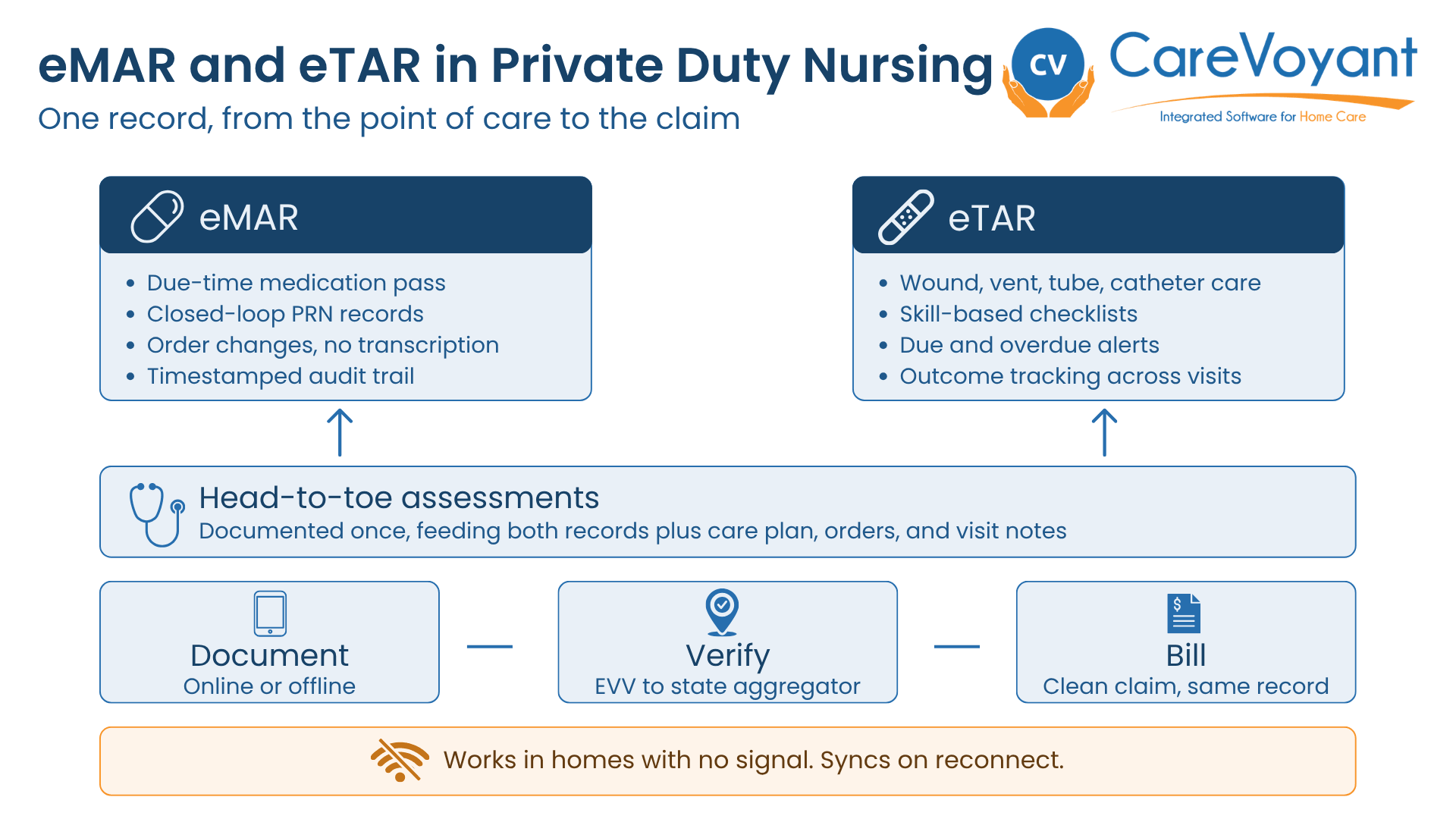
Medication, treatment, and assessment records move through EVV verification to the claim without leaving the platform.
eMAR and eTAR at a Glance
| eMAR | eTAR | |
|---|---|---|
| Records | Medications administered | Treatments and skilled interventions performed |
| Typical entries | Scheduled doses, PRN medications, missed or late doses | Wound care, ventilator and respiratory tasks, tube feeding, catheter care, glucose checks |
| Each entry captures | Time, dose, route, administering nurse | Time, procedure, patient response, administering nurse |
| Replaces | Paper MAR or static PDF form | Paper TAR or handwritten treatment log |
Both are legal records as well as clinical ones. In private duty nursing they carry more weight than in visit-based home health, because a single 12-hour shift can involve a dozen or more scheduled administrations against a physician-ordered plan of care. For a fuller explanation of how eMAR replaced the paper MAR, see electronic medication administration records explained.
Documentation That Holds Up Outside the Chart
Accurate medication and treatment records matter most when they hold up beyond the clinical chart: in a home with no signal, in a state EVV audit, and on the claim that funds the next shift. Three parts of the CareVoyant platform carry that documentation forward.
Documenting in Homes With Poor or No Connectivity
Private duty nursing happens wherever the patient lives, which often means rural routes and houses where cellular service drops to nothing. A documentation system that requires a live connection pushes nurses back to paper notes and end-of-shift re-entry, and re-entry from memory is where clinical detail gets lost.
CV Mobile includes an offline mode built for exactly these areas. Medication and treatment administration records work the same way offline as they do online. A scheduled dose given in a basement bedroom with no signal is documented in the eMAR at the time it happens, not reconstructed in the car afterward, and the record syncs to CareVoyant automatically once the device reconnects.
That distinction matters more for eMAR and eTAR than for any other part of the chart. Medication timing is the whole point of a medication administration record, and a time stamp entered three hours late is a different clinical fact than the one it claims to represent.
For agencies whose workforce is not fully covered by smartphones, Fixed Visit Verification and manual verification remain available, so a connectivity gap never becomes a compliance gap. The same principle applies across the mobile app built for private duty nursing.
EVV and Clinical Documentation in One Visit Workflow
For Medicaid-funded private duty nursing, the visit is verified and the care is documented in the same hour by the same nurse. Splitting those into two systems means two logins, two chances to mistype, and reconciliation work for the office afterward.
CareVoyant captures both in one workflow. The nurse clocks in with GPS verification, documents medications and treatments, and clocks out, and CareVoyant's unified EVV interface sends the visit data to whichever aggregator the state has designated. Agencies operating across state lines meet different EVV rules through one standard interface instead of one vendor per state. Requirements vary considerably, so it is worth checking EVV rules by state for the markets you serve.
The integration also works as a guardrail. CV Mobile is connected to authorization and scheduling, so services delivered outside an active authorization are caught at the point of care rather than at the point of denial.
From Point-of-Care Documentation to a Clean Claim
Most home care platforms treat clinical documentation and billing as separate systems joined by an export. Every export is a place where a treatment documented by the nurse and a service line on the claim can drift apart, and that drift is what auditors find.
CareVoyant runs both on one record. The eTAR entry that documents a wound care treatment and the EVV data that verifies the visit are the same data the claim is built from, with no re-keying and no month-end reconciliation between clinical and billing. A configurable claim scrubber checks claims before submission, and billing and revenue cycle management draws directly from the clinical record.
The practical effect is that documentation quality and revenue integrity stop being separate projects. A nurse who charts completely at the point of care is also producing a claim that survives review, which is the most direct way to reduce unbilled claims and improve cash flow.
CareVoyant's eMAR: Accuracy at Every Administration
The Medication Pass in Due-Time Order
The eMAR lists scheduled, PRN, and overdue medications in the order they come due, so a nurse working a 12-hour shift is not scanning a flow sheet to work out what is next. Allergy alerts and contraindication flags fire before administration, and validation rules require dose, route, and frequency before an entry will save.
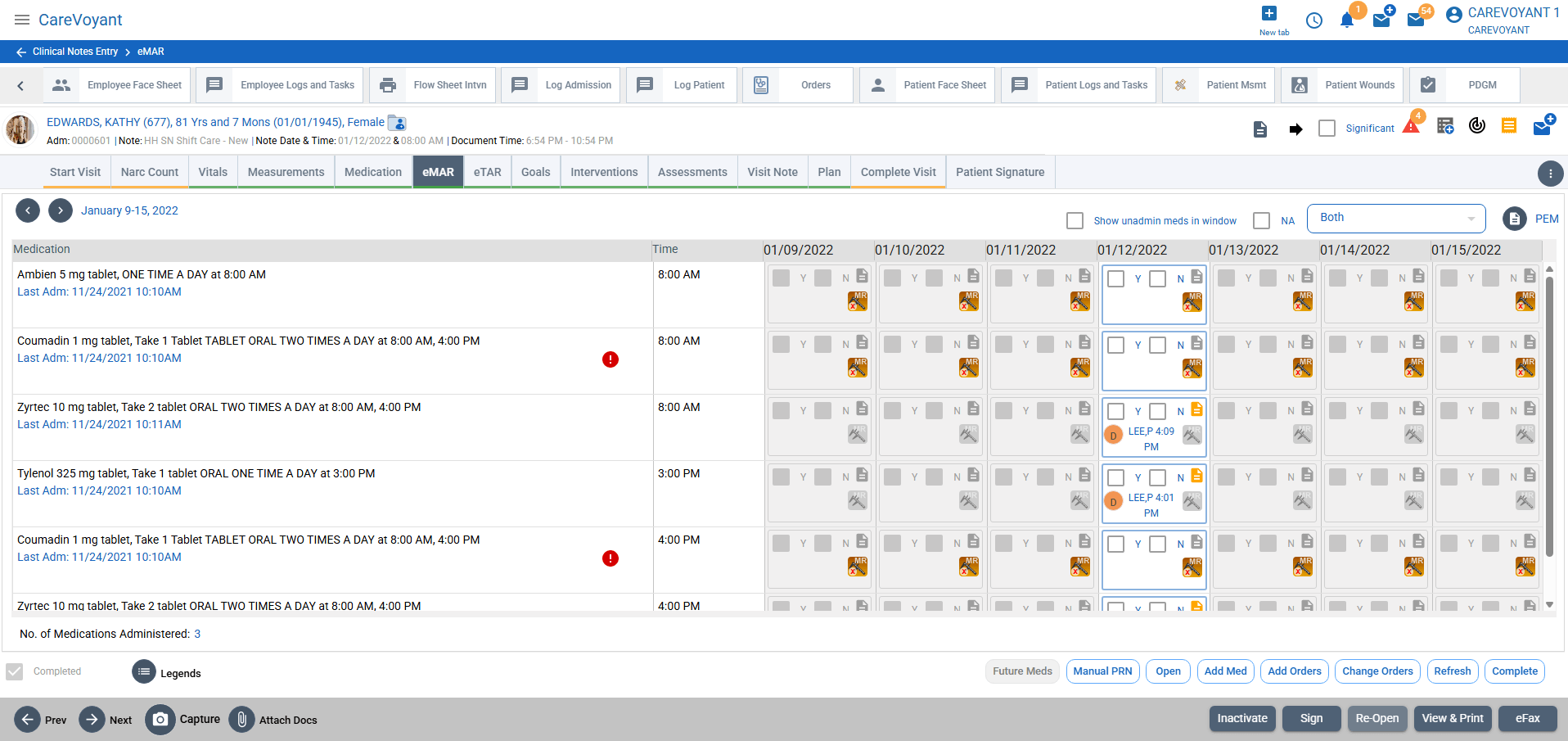
Scheduled, PRN, and overdue medications in one view, ordered by when they are due.
Closed-Loop PRN Documentation
PRN medications are where paper records break down most often. CareVoyant requires a documented reason for administration and a follow-up effectiveness entry, so the record shows not only that a dose was given but why and whether it worked. That closes a loop static forms leave open, and it gives supervisors something reviewable rather than a checkmark.
Order Changes Without Manual Transcription
When a physician changes an order or a supervisor updates the care plan, the change reaches the eMAR directly. No one retypes it onto a flow sheet, and no nurse works from a list that went stale that afternoon. The medication list a nurse sees at 2am reflects the most recent order.
Audit Trails and Controlled Substance Accountability
Every entry is time-stamped and attributed to the administering nurse. Missed and late administrations surface to supervisors rather than waiting for a chart review, and administration history is available as a report without reconstructing it from paper. For agencies handling controlled substances, that traceability is what a count discrepancy investigation depends on, alongside narcotics count tracking and disciplined survey preparedness.
These four capabilities are the baseline for private duty nursing. If you are comparing vendors rather than reading how the records work, four criteria for evaluating eMAR and eTAR platforms covers the selection criteria.
““CareVoyant eMAR allows us to update the patient’s medication profile and administration record in real time. This has allowed us to reduce medication errors and increase documentation accuracy.””
CareVoyant's eTAR: Treatment and Skilled Care Documentation
End-to-End Treatment Administration Capture
CareVoyant's Electronic Treatment Administration Record documents skilled nursing treatments end to end for private duty nursing and post-acute care. Nurses capture wound care protocols, ventilator and respiratory therapy tasks, tube feeding, catheter care, diabetic management, injections, vital signs, and specialized nursing routines. Each treatment ties directly to physician orders and care plans, so interventions are performed as prescribed and documented consistently at the point of care. This is the same structure that underpins continuous care documentation in PDN.
Skill-Based Checklists and Nursing Protocols
CareVoyant's eTAR uses skill-based checklists and standardized nursing protocols. Step-by-step documentation guides nurses through each treatment, reducing variability and reinforcing best practices. Standardized treatment templates help ensure required clinical elements are never missed, while still allowing flexibility for agency-specific workflows. This structured approach improves documentation quality, supports training and onboarding, and strengthens compliance across all levels of skilled care. It matters most in high-detail work such as wound care documentation.
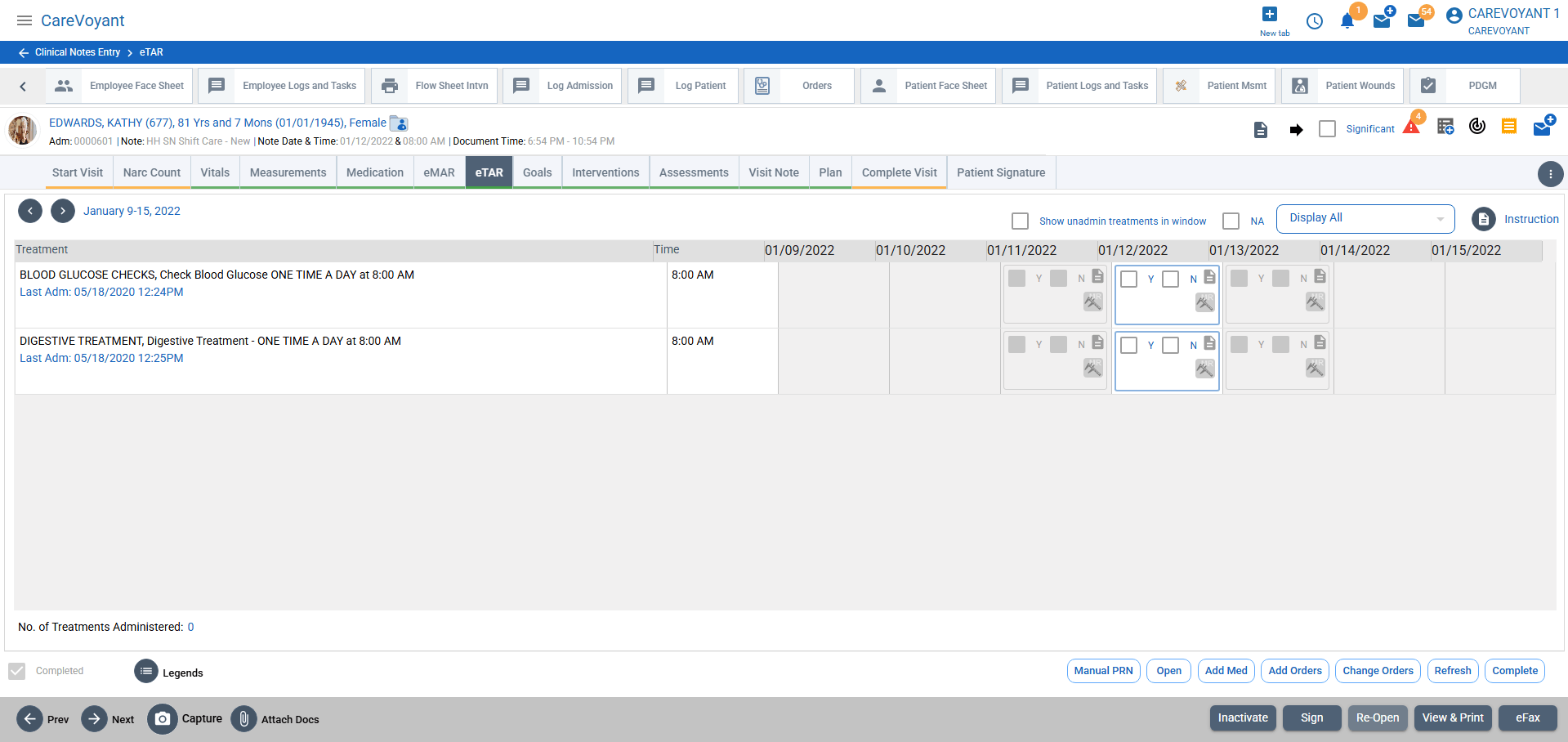
Step-by-step checklists guide the nurse through each treatment and tie back to the physician order.
Real-Time Alerts for Scheduled and Overdue Treatments
CareVoyant's eTAR includes real-time alerts that notify clinicians when treatments are due, upcoming, or overdue. These alerts help ensure no care task is missed, even in complex schedules or high-acuity cases. Supervisors gain visibility into treatment completion, enabling faster intervention when care is delayed. This proactive alerting improves clinical accountability and helps agencies maintain consistent care delivery.
Treatment Outcomes and Follow-Up Tracking
Beyond task completion, CareVoyant's eTAR supports treatment outcome tracking over time. Nurses monitor progress, document patient responses, and identify changes in condition across visits. This longitudinal view strengthens care team communication, enabling nurses, supervisors, therapists, and providers to collaborate more effectively and make informed clinical decisions.
Integrated Head-to-Toe Assessments
Unified Assessment Workflow
CareVoyant's head-to-toe assessment is built into the clinical workflow, linking assessment findings to medication and treatment records automatically. Nurses document once, and the information carries across eMAR and eTAR, removing duplicate documentation and reducing the risk of inconsistencies. This lets clinicians focus on patient care instead of repetitive charting.
Structured Data That Improves Clinical Insights
CareVoyant captures assessments using structured, standardized data, making clinical information easier to track and analyze over time. Vital signs, system-by-system findings, and changes from baseline are clearly documented, while built-in logic auto-flags abnormal findings for timely follow-up. This helps nurses identify emerging issues earlier and supports more informed clinical decision-making.
Integration with Care Plan, Orders, and Visit Notes
All assessment data feeds directly into the care plan, physician orders, and visit notes, creating a single source of truth for the entire care team. Relevant interventions populate related sections automatically, supporting documentation accuracy, continuity of care, and stronger compliance across every visit. That connection runs through authorization and plan of care management.
Bringing Medication, Treatment, and Assessment Records Together
The three leading causes of medication errors in home care are documentation problems before they are clinical ones: incomplete transition records, missed reconciliation, and gaps in communication across the care team. Each one traces back to information sitting in a place the next clinician cannot reach.
CareVoyant closes those gaps by keeping medication administration, treatment administration, head-to-toe assessments, care plans, and physician orders on one record rather than in systems that have to be reconciled later. A nurse documents once, at the point of care, with or without a connection. That same record verifies the visit for state EVV reporting and supports the service line on the claim, so clinical accuracy and reimbursement accuracy stop being separate problems handled by separate teams.
For private duty nursing agencies managing high-acuity patients across multiple states and payers, that consolidation is what makes survey readiness a byproduct of daily work instead of a scramble before an audit.
See how CareVoyant handles eMAR and eTAR for your service lines. Request a demo and we will walk through medication documentation, treatment records, and EVV using your own workflow.
Frequently Asked Questions (FAQs)
-
Yes. CV Mobile includes an offline mode, and medication and treatment administration records work the same way offline as they do online. A nurse documents a dose at the time it is given, and the record syncs to CareVoyant automatically once the device reconnects. Fixed Visit Verification and manual verification are available as additional options for caregivers without smartphone coverage.
-
They answer different questions about the same visit. EVV verifies that a visit happened: who provided care, for whom, where, and when, reported to the state Medicaid aggregator. eMAR documents what clinical care was delivered during that visit, specifically which medications were administered and when. Both are required for Medicaid-funded private duty nursing, and in CareVoyant both are captured in one workflow rather than two systems.
-
The eTAR entry that documents a treatment is the same record the claim draws from. There is no export step between clinical and billing, so a service line on the claim cannot drift from what the nurse documented. That removes the reconciliation work most agencies do at month end and reduces the mismatches that cause denials.
-
An eTAR records non-medication clinical interventions. In private duty nursing that typically means wound care, ventilator and respiratory treatments, tube feeding, catheter care, diabetic management including glucose monitoring, injections, vital signs, and other skilled nursing procedures ordered in the plan of care.
-
Assessment findings link to medication and treatment records automatically. A nurse documents vital signs or a system-by-system finding once, and it is available in the eMAR and eTAR context rather than being entered twice. Abnormal findings are auto-flagged for follow-up, and the data feeds into the care plan, physician orders, and visit notes.
-
Federal rules do not mandate an electronic MAR specifically, though EVV is federally required for Medicaid personal care and home health services under Section 12006 of the 21st Century Cures Act. Documentation requirements for medication administration are set by state Medicaid programs and by accreditation bodies, and they vary. Check the requirements for the states your agency operates in.
About CareVoyant
CareVoyant is a leading provider of cloud-based integrated enterprise-scale home health care software that can support all home-based services under ONE Software, ONE Patient, and ONE Employee, making it a Single System of Record. We support all home based services, including Home Care, Private Duty Nursing, Private Duty Non-Medical, Home and Community Based Services (HCBS), Home Health, Pediatric Home Care, and Outpatient Therapy at Home.
CareVoyant functions – Intake, Authorization Management, Scheduling, Clinical with Mobile options, eMAR/eTAR, Electronic Visit Verification (EVV), Billing/AR, Secure Messaging, Notification, Reporting, and Dashboards – streamline workflow, meet regulatory requirements, improve quality of care, optimize reimbursement, improve operational efficiency and agency bottom line.
For more information, please visit CareVoyant.com or call us at 1-888-463-6797.
Request for Information
To learn more about CareVoyant Software and how we improve the operational efficiency of Home Healthcare Agencies, contact us:
