

Introduction
Nearly 1 in 4 U.S. adults is a family caregiver. That is 63 million people, up 20 million in a decade, according to AARP and the National Alliance for Caregiving. On average they give 27 hours of care a week, and nearly a quarter give 40 hours or more. Most do it on top of a job, children and their own health.
Many of these families already work beside a home care agency, and many more soon will. They cover the nights, the weekends and the hours between visits. They give medications, manage equipment and are often the first to notice that something has changed.
November is National Family Caregivers Month. It is a good time to say thank you, but family caregivers need more than thanks. This guide covers what the month is, what the latest data says about family caregivers, and eight practical ways home care agencies can support them, in November and all year.
What Is National Family Caregivers Month?
National Family Caregivers Month is a national observance each November that recognizes the people who care for a family member or friend with a chronic condition, disability or the needs of aging. It raises awareness of what caregivers do, educates communities about the support they need, and connects caregivers with trusted resources.
When Is National Family Caregivers Month?
It runs for the whole month of November. In 2026, that is Sunday, November 1 through Monday, November 30.
Who Leads It?
Caregiver Action Network (CAN), founded as the National Family Caregivers Association, has led the observance since 1997. Presidents have marked it with proclamations, and the federal Administration for Community Living observes it each year.
This Year's Theme: Care Connects Us
Each year CAN picks a theme that spotlights one part of the caregiving experience. The 2026 theme is Care Connects Us: across every condition and every stage, care connects caregivers to their loved ones, to vital information and to one another.
For home care agencies, the theme describes work you already do. Your staff connect families to the care team at every shift change, your nurses connect them to information about the condition, and your agency can connect them to other caregivers who understand. CAN's Care Connects Us hub supports all three, with guides for about 40 health conditions, caregiver stories and a November webinar series.
| Year | CAN theme |
|---|---|
| 2026 | Care Connects Us |
| 2025 | Plug-in To Care |
| 2024 | iCare |
| 2023 | #CaregiversConnect |
Each November, CAN also runs a webinar series for family caregivers, on topics such as working while caregiving and long-term care. Share the schedule with your client families, along with CAN's Caregiver Help Desk at (855) 227-3640 for anyone who needs one-on-one help.
November is also National Home Care and Hospice Month, when agencies celebrate their own staff (see our post on Home Care Heroes Month), and National Alzheimer's Disease Awareness Month.
Family Caregivers by the Numbers
The most complete picture of family caregiving in the U.S. comes from Caregiving in the U.S. 2025, published by AARP and the National Alliance for Caregiving, and AARP's Valuing the Invaluable series. Here is what they show.
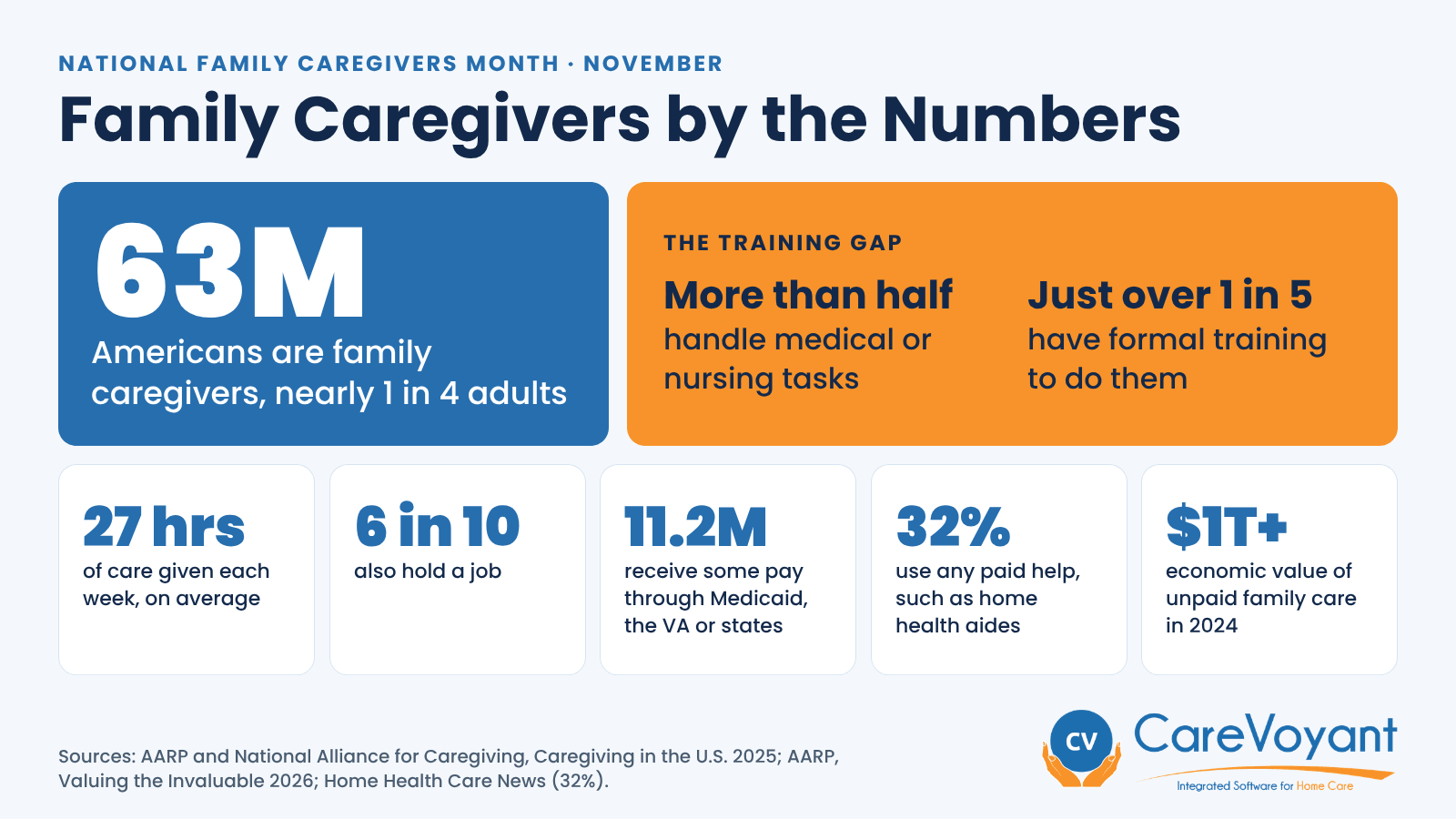
Family caregiving in the U.S. at a glance. Sources: AARP and NAC, Caregiving in the U.S. 2025; AARP, Valuing the Invaluable 2026.
| Figure | What it measures |
|---|---|
| 63 million | Americans who gave ongoing care to an adult or child with a complex condition or disability in the past year, nearly 1 in 4 adults |
| +20 million | Growth in family caregivers from 2015 to 2025 |
| 27 hours | Average care given per week |
| Nearly 1 in 4 | Caregivers giving 40 or more hours a week |
| More than half | Caregivers handling complex medical or nursing tasks such as injections, wound care or medication management |
| Just over 1 in 5 | Caregivers with formal training in those medical and nursing tasks |
| 11% | Caregivers trained to help with activities of daily living |
| 6 in 10 | Caregivers who also hold a job; half of them report work disruptions |
| Nearly half | Caregivers who have faced a major financial impact, such as debt |
| 11.2 million | Family caregivers who receive some pay through Medicaid, the VA or state programs |
| Over $1 trillion | Economic value of unpaid family care in 2024 |
For home care agencies, one more figure stands out. Only 32% of family caregivers use paid help such as home health aides, as Home Health Care News reported from the same AARP and NAC study. About two-thirds carry the load with no paid support at all, even as the work becomes more medical and takes more hours.
Where Family Caregivers Show Up in a Home Care Agency
Family caregivers are not a separate audience from your clients. They appear in your agency in four distinct roles, and each one needs something different from you.
The Family Member Between Visits
When your aide clocks out, someone else takes over. A spouse, an adult child or a neighbor covers the evenings, weekends and overnight hours your authorization does not. What happens in those hours shapes how the next visit goes, so this person is part of the care team whether or not your records say so.
Parents of Medically Complex Children
In pediatric private duty nursing, parents are often the most skilled caregivers in the home. They manage trachs, ventilators and feeding tubes between nurse shifts, and they notice small changes before anyone else. Our post on communication tools for pediatric home care covers how to keep them in the loop.
The Paid Family Caregiver
About 11.2 million family caregivers now receive some pay through Medicaid, the VA or state programs. Many are employed through agencies under self-directed or consumer-directed programs, which brings EVV, timesheet and payroll requirements. If your agency is new to this model, start with our Consumer Directed Services primer and our overview of HCBS software.
Compliance check: Family members your agency employs under self-directed programs still need EVV, approved timesheets and services that match the authorization. Audit them the same way you audit the rest of your staff.
The Working Caregiver
Six in 10 family caregivers also hold a job, and half of them report disruptions such as arriving late or leaving early. For these families, a predictable visit schedule matters as much as the care itself. A late aide or a last-minute substitution can cost them a shift at work.
Three Gaps Home Care Agencies Are Built to Close
Family caregivers carry three gaps that a home care agency is unusually well placed to close: training, respite and coordination.
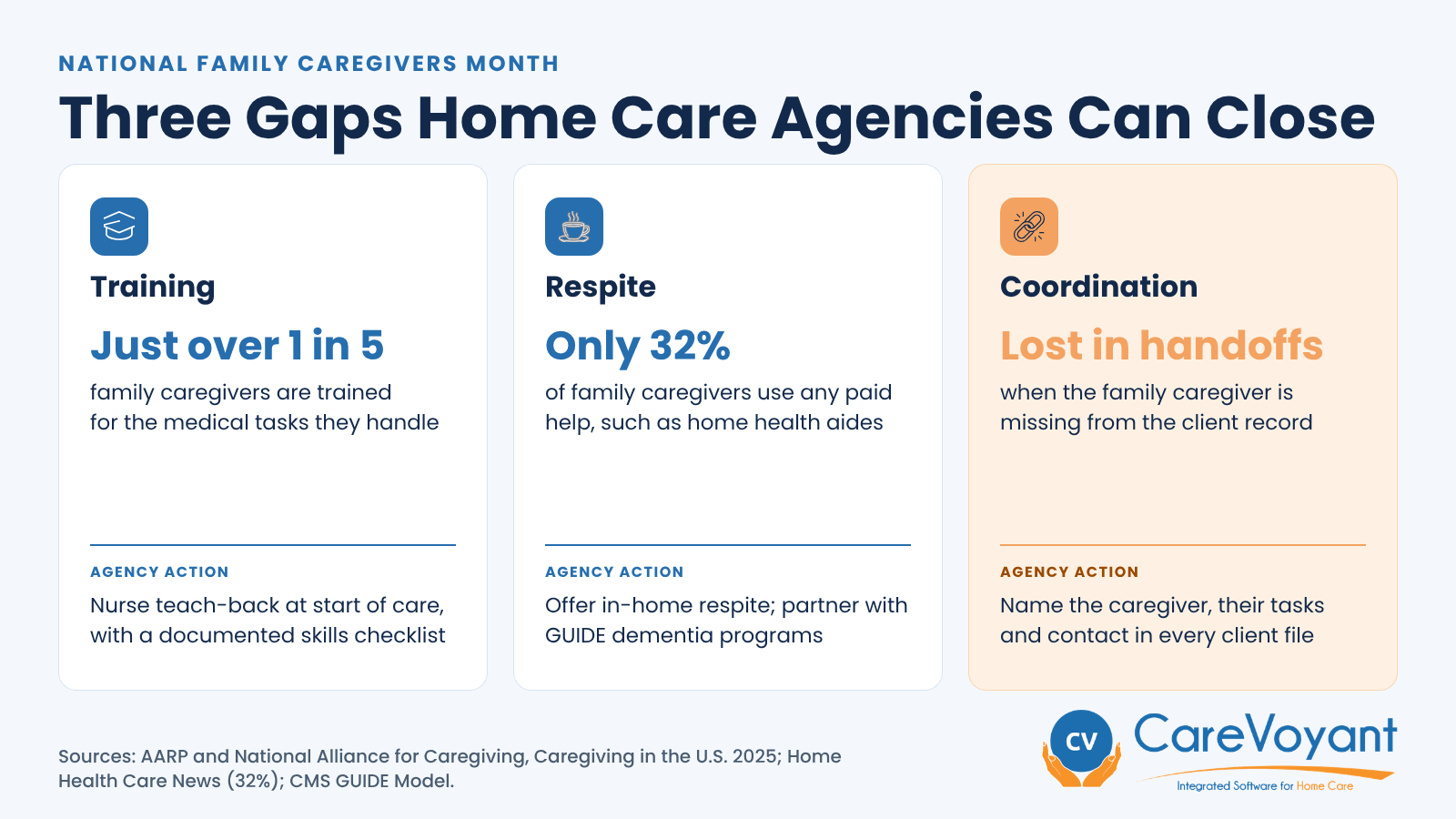
Three gaps family caregivers face, and what home care agencies can do about each.
The Training Gap
More than half of family caregivers handle medical or nursing tasks, but only about 1 in 5 has had formal training to do them. Only 11% have been trained to help with bathing, dressing, transfers and other daily activities. That leaves millions of people learning wound care or medication management by trial and error.
Your nurses already teach these skills. The difference is making it deliberate: a teach-back session at the start of care, a written checklist of the tasks the family will handle, and a recheck whenever orders change. Document what was taught and how the caregiver did, so the next clinician knows where things stand.
Medicare has also started paying for this work. Since January 1, 2024, caregiver training services (CPT 97550, 97551 and 97552, with more codes added in 2025) can be billed under the Physician Fee Schedule by physicians, certain non-physician practitioners and physical, occupational and speech therapists, with the patient's consent. For most agencies, the opportunity lies in partnering with the therapy and physician practices that use these codes.
Did you know? Medicare has paid for caregiver training since January 1, 2024. Physicians, certain non-physician practitioners and therapists bill it under the Physician Fee Schedule, so the practices you already refer with may welcome a partner.
The Respite Gap
Only about a third of family caregivers use any paid help, and almost 40% say respite would help them. Respite is the short break that keeps a caregiver from burning out, and in-home respite is work a home care agency already does every day.
Funding is growing. The CMS GUIDE Model, which began July 1, 2024 and runs for eight years, pays for respite of up to $2,500 a year per eligible patient living with dementia, in the home, at adult day programs or in facilities. GUIDE programs can contract with partner organizations to deliver services, so agencies that offer in-home respite should introduce themselves to GUIDE participants nearby. Many state Medicaid waiver programs also cover respite. For more on dementia care at home, see how caregivers often see the early signs of dementia first.
GUIDE at a glance: The CMS GUIDE Model pays for up to $2,500 a year in respite per eligible patient living with dementia, at home, at adult day programs or in facilities. The model runs for eight years from July 2024.
The Coordination Gap
When the family caregiver is missing from the client record, what they know and what they do gets lost between shifts. This year's theme, Care Connects Us, is about closing exactly this gap. Invite the primary family caregiver to a care plan review, send them the CAN condition guide that matches their loved one's diagnosis, and point them to peer support groups. For day-to-day communication habits, see our guide to building trust with family caregivers.
8 Ways Home Care Agencies Can Observe National Family Caregivers Month
These steps take an afternoon or a staff meeting each, and every one of them keeps paying off after November ends.
Start this week: Pick one step, give it an owner and a date. Steps 1 and 2 need only your client list and one staff meeting.
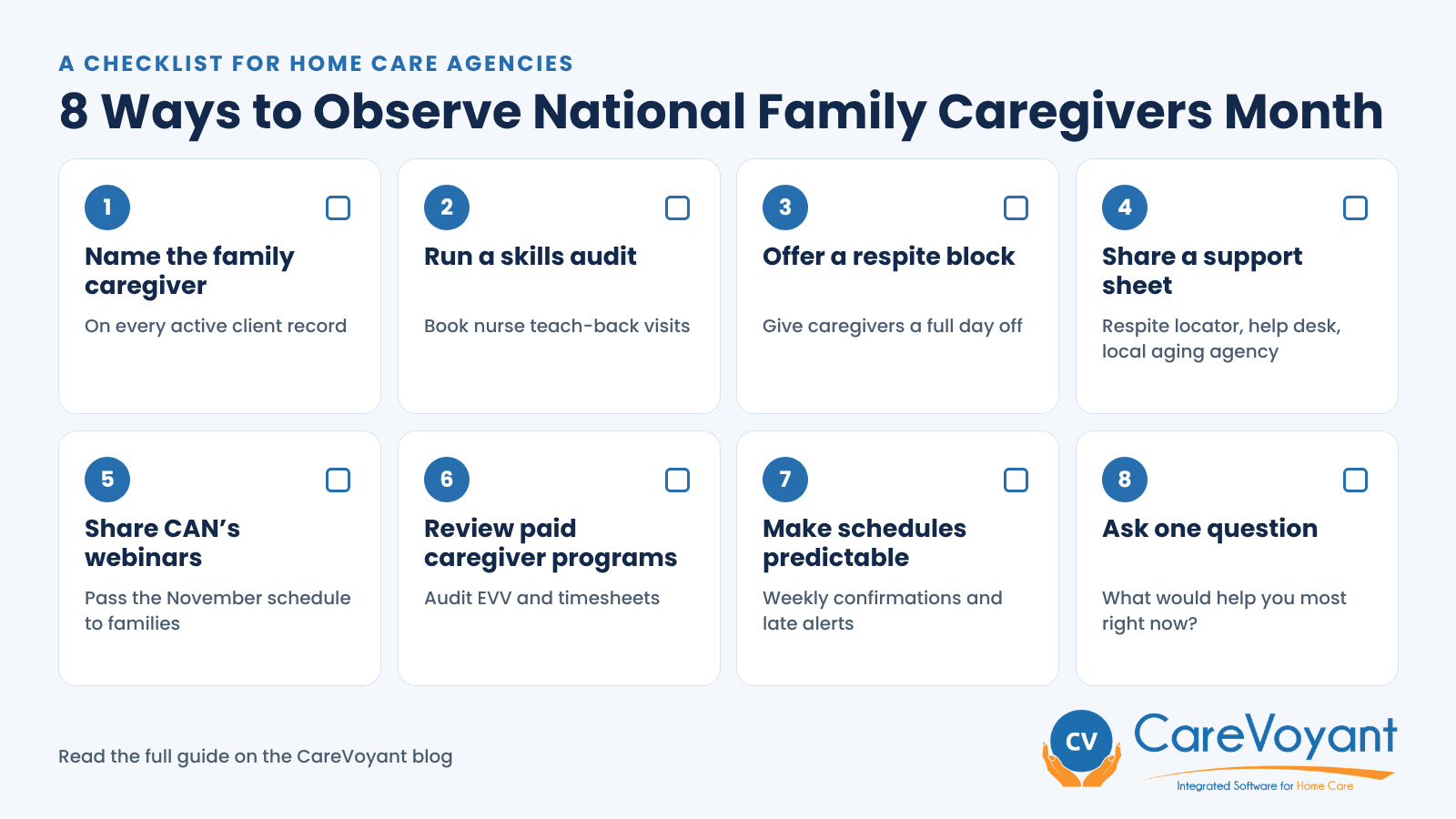
Save or print this checklist to plan your agency's November.
1. Name the Family Caregiver on Every Client Record
For each active client, record who the primary family caregiver is, how they are related, how to reach them, which tasks they handle and the best time to call. Many caregivers do not think of themselves as caregivers, so ask directly.
2. Run a Family Skills Audit
Ask field staff which medical tasks families perform between visits: medications, wound care, transfers, feeding tubes. Where a family is doing a task without training, schedule a nurse teach-back visit.
3. Offer a November Respite Block
Package a set of respite hours for private-pay families this month, so a caregiver can take a full day off. Set the pricing to fit your agency, and use it to introduce families to respite before a crisis forces it.
4. Give Families a Local Support Sheet
One page with the resources they will need: the ARCH National Respite Locator, CAN's Caregiver Help Desk at (855) 227-3640, your local Area Agency on Aging and your agency's own after-hours number.
5. Share CAN's November Webinars
Caregiver Action Network runs a webinar series during the month. Send CAN's schedule, linked in the theme section above, to the families most likely to benefit, along with the Caregiver Help Desk number.
6. Review Your Paid Family Caregiver Programs
Check which self-directed and paid family caregiver programs operate in your states, and whether you are set up to take part. If you already employ family members, audit their EVV and timesheets; our post on common CDS audit issues lists what reviewers flag most.
7. Make Schedules Predictable for Working Caregivers
Confirm visit times each week, and alert families right away when an aide is running late or a substitute is coming. For a caregiver with a job, that one text can save a shift.
8. Ask One Question
Ask every family caregiver, "What would help you most right now?" Fold the answers into care plan updates; our guide to keeping home-based care plans current shows how.
How Integrated Home Care Software Supports Family Caregivers Year-Round
Every step above depends on information that has to live somewhere other than a staff member's memory. CareVoyant Home Care Software keeps it in one place, under one patient record, across every line of service.
One record for the whole care team. Family caregiver details, the care plan and visit notes sit together, so every nurse and aide sees who covers what between visits.
Care plans that show the split. Tasks the family handles and tasks your staff handle are both visible, which makes skills audits and teach-back visits easy to plan and document.
Respite that stays inside the authorization. Scheduling tied to authorization management keeps respite hours within approved units, so they get paid.
EVV and payroll for paid family caregivers. One platform handles EVV, timesheets and payroll for family members employed under PCA, CDS and PDN programs.
Communication that reaches families. Care coordination tools, including secure messaging and a family portal, keep caregivers informed without extra phone calls.
For agencies serving children, CareVoyant Pediatric Home Care Software brings the same tools to PDN families.
Support Family Caregivers All Year
National Family Caregivers Month lasts 30 days, but the work it recognizes does not stop on December 1. The agencies that do the most for family caregivers treat them as part of the care team: named in the record, trained for the tasks they handle, given real breaks and kept informed.
Start with one of the eight steps this November, then build it into how your agency works the rest of the year.
To see how CareVoyant helps home care agencies keep families, staff and care plans connected, schedule a demo.
Frequently Asked Questions
-
National Family Caregivers Month takes place every November. In 2026 it runs from Sunday, November 1 through Monday, November 30. Caregiver Action Network leads the national observance, and organizations, employers and agencies share resources and hold events throughout the month.
-
The 2026 theme is Care Connects Us, chosen by Caregiver Action Network. It highlights how care connects family caregivers to their loved ones, to vital information and to one another, across every condition and every stage of caregiving.
-
Caregiver Action Network, founded as the National Family Caregivers Association, has led National Family Caregivers Month since 1997. Presidents have marked the month with proclamations, and the federal Administration for Community Living observes it each year.
-
About 63 million Americans, nearly 1 in 4 adults, gave ongoing care to an adult or child with a complex medical condition or disability in the past year, according to Caregiving in the U.S. 2025 by AARP and the National Alliance for Caregiving. That is 20 million more than in 2015.
-
Yes, in some programs. About 11.2 million family caregivers receive some pay through Medicaid, the VA or state programs. Many are employed through home care agencies under self-directed or consumer-directed programs, which come with EVV, timesheet and payroll requirements.
-
Respite care is short-term relief that lets a family caregiver rest while someone else provides care, at home or in another setting. It may be covered by state Medicaid waiver programs, by the Medicare GUIDE Model for eligible people living with dementia (up to $2,500 a year), or paid privately.
-
Yes. Since January 1, 2024, Medicare has paid for caregiver training services under the Physician Fee Schedule. Physicians, certain non-physician practitioners and physical, occupational and speech therapists can bill these codes when they train a patient's caregiver, with the patient's consent.
-
Start with practical steps: record the family caregiver on every client file, check which medical tasks families handle without training, offer respite, share local and national resources, and make visit schedules predictable for caregivers who work. Each step keeps helping after November ends.
About CareVoyant
CareVoyant is a leading provider of cloud-based integrated enterprise-scale home health care software that can support all home-based services under ONE Software, ONE Patient, and ONE Employee, making it a Single System of Record. We support all home based services, including Home Care, Private Duty Nursing, Private Duty Non-Medical, Home and Community Based Services (HCBS), Home Health, Pediatric Home Care, and Outpatient Therapy at Home.
CareVoyant functions – Intake, Authorization Management, Scheduling, Clinical with Mobile options, eMAR/eTAR, Electronic Visit Verification (EVV), Billing/AR, Secure Messaging, Notification, Reporting, and Dashboards – streamline workflow, meet regulatory requirements, improve quality of care, optimize reimbursement, improve operational efficiency and agency bottom line.
For more information, please visit CareVoyant.com or call us at 1-888-463-6797.
Request for Information
To learn more about CareVoyant Software and how we improve the operational efficiency of Home Healthcare Agencies, contact us:
