
RSV Season Planning Starts in October
A cold that keeps a healthy toddler home for two days can send a child with a tracheostomy to the pediatric ICU. When RSV reaches medically fragile children in home care, the margin for error is small, and every person who walks through the door, including the private duty nurse, can bring a virus in. That is why respiratory season planning for a PDN agency starts in October.
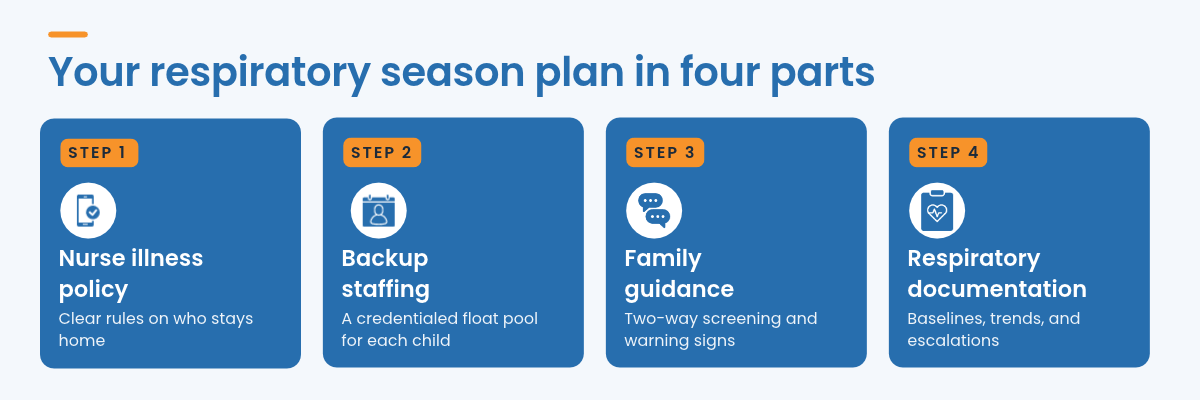
This guide covers four parts of a season plan: nurse illness policies, backup staffing during outbreaks, family guidance, and documenting respiratory status changes.
Why RSV Hits Medically Fragile Children in Home Care Harder
Medically fragile children in private duty nursing (PDN) usually live with at least one condition that raises the risk of severe respiratory illness: a tracheostomy, ventilator dependence, chronic lung disease from prematurity, congenital heart disease, a neuromuscular disorder that weakens the cough, or a weakened immune system. CDC lists these among the conditions that put children at highest risk of severe RSV.
Before RSV immunizations were introduced, an estimated 58,000 to 80,000 U.S. children younger than 5 were hospitalized with RSV each year, according to CDC. Influenza adds a second wave. CDC surveillance counted 298 influenza-associated pediatric deaths in the 2024-25 season, and at least 198 more had been reported for 2025-26 as of early October 2026.
The home setting changes the risk as well. A PDN nurse may spend 8 to 24 hours a day in one home. Siblings bring viruses home from school and daycare, and holiday visitors arrive near the peak of the season. A hospital has infection prevention staff and visitor rules. In the home, the agency's policies have to do that job. Agencies that use pediatric home care software to keep diagnoses, devices, and care plans in one record can quickly see which children need the most protection.
Season timing: RSV typically peaks between December and January in most of the U.S., according to CDC. Agencies should have policies, backup nurses, and family guidance in place by early November.
Build a Pre-Season Readiness Plan Before November
Update each child's plan of care
Work with the ordering physician to confirm respiratory parameters and escalation thresholds: the lowest acceptable oxygen saturation, the respiratory rate that triggers a call, oxygen titration limits, and when to call 911. Write these as physician orders rather than general guidance, so every nurse in the home works from the same thresholds.
The steps in our guide on how to improve home-based care plans apply here. Agencies using plan of care management tools can keep the respiratory orders in front of nurses at every visit.
Confirm immunization conversations, without prescribing
The agency does not decide which immunizations a child receives, but it can make sure the conversation happens. At intake and recertification, ask whether the family has discussed RSV antibody and flu vaccine eligibility with the child's physician, and record the answer.
The guidance changed this year. In September 2026, the American Academy of Pediatrics expanded the list of high-risk children aged 8 to 19 months who should receive an RSV antibody (nirsevimab) in their second RSV season. The list now includes children born before 32 weeks, children with anatomic pulmonary abnormalities or neuromuscular disorders, and children with Down syndrome or other chromosomal differences that raise risk. These join existing groups such as chronic lung disease, significant congenital heart disease, and severe immunocompromise. Many PDN patients qualify, so a quick prompt can help families raise it with their physician.
New this season: Review every PDN patient aged 8 to 19 months against the expanded AAP list, and prompt families to ask their physician before the season starts.
Check supplies and staff skills
Confirm stock of suction catheters, tracheostomy supplies, pulse oximeter probes, nebulizer kits, masks, and gloves for each home. Check backup power and spare equipment for ventilator-dependent children.
Run a short refresher on tracheostomy care, suctioning, PPE donning and doffing, and early warning signs of respiratory decline. Include every nurse who might cover a high-acuity child, not only the primary nurses.
Write a Nurse Illness Policy Nurses Will Actually Follow
Most nurse illness policies already say "stay home when sick." The gap is between that rule and what happens at 5 a.m., when a nurse wakes with a scratchy throat and knows the family has no other coverage.
Set clear exclusion criteria
Base the policy on CDC's prevention strategies for seasonal influenza in healthcare settings, which apply to home healthcare personnel. CDC advises that staff with fever and respiratory symptoms stay out of work until at least 24 hours after the fever ends without fever-reducing medicine. Staff with respiratory symptoms but no fever should be evaluated before they care for patients.
For staff caring for patients who need a protective environment, such as stem cell transplant recipients, CDC suggests considering reassignment or exclusion for 7 days from symptom onset, or until symptoms resolve if that takes longer. Agencies may choose to apply this stricter standard to their most fragile patients. Check your state health department too.
Remove the pressure to work sick
Why policies alone fall short: A CDC NIOSH study found that 41% of healthcare personnel with influenza-like illness during the 2014-15 season kept working, for a median of 3 days.
PDN nurses often work sick out of loyalty to the family or worry about lost pay. Policies that reduce that pressure include no-penalty sick call-outs, a clear call-out deadline (for example, three hours before the shift), and a visible backup plan so the nurse knows the child will be covered. The strategies to reduce stress for home care workers help nurses feel safe making the call.
Add a pre-shift symptom check
Ask nurses to complete a short symptom check before each shift: fever, cough, sore throat, runny nose, and sick household members. With a mobile EVV and scheduling app, nurses already confirm each visit from their phones, which makes the check a natural part of starting the shift.
Set vaccination expectations
CDC calls annual vaccination the most important measure to prevent seasonal influenza and recommends it for healthcare personnel. The American Academy of Family Physicians' 2026 guidance also advises healthcare personnel to receive an RSV vaccine based on their own age and health eligibility. Rules on requiring vaccines vary by state, so state the agency's expectation clearly, make vaccines easy to get, and track status for each nurse.
Define return-to-work criteria
Spell out who clears a nurse to return, what gets documented, and whether a mask is required for a set number of days after returning to a high-risk home.
Backup Staffing During Respiratory Outbreaks
A strict illness policy only works when a qualified nurse can take the shift. For a child on a ventilator, "any available nurse" is not a backup plan.
Build a credentialed float pool for each child
List the nurses who hold the competencies each high-acuity child needs, such as tracheostomy and ventilator care, and who have completed an orientation in that specific home. The approaches in cost-effective staffing models for private duty agencies help balance the cost of a float pool against overtime and missed hours.
Cross-orient two or three backups per child in October, so the family meets each nurse before a call-out. Tools that match nurses to patients by skill, location, and family preference make it easier to choose backups who fit the home as well as the chart.
Follow a same-day call-out workflow
The nurse reports illness before the call-out deadline, by phone rather than text alone.
The scheduler filters available nurses by competency and completed orientation for that child.
The scheduler confirms the backup and tells the family who is coming and when.
If no qualified nurse is available, the clinical manager calls the family, confirms they can safely provide care, and documents the missed shift and the reason.
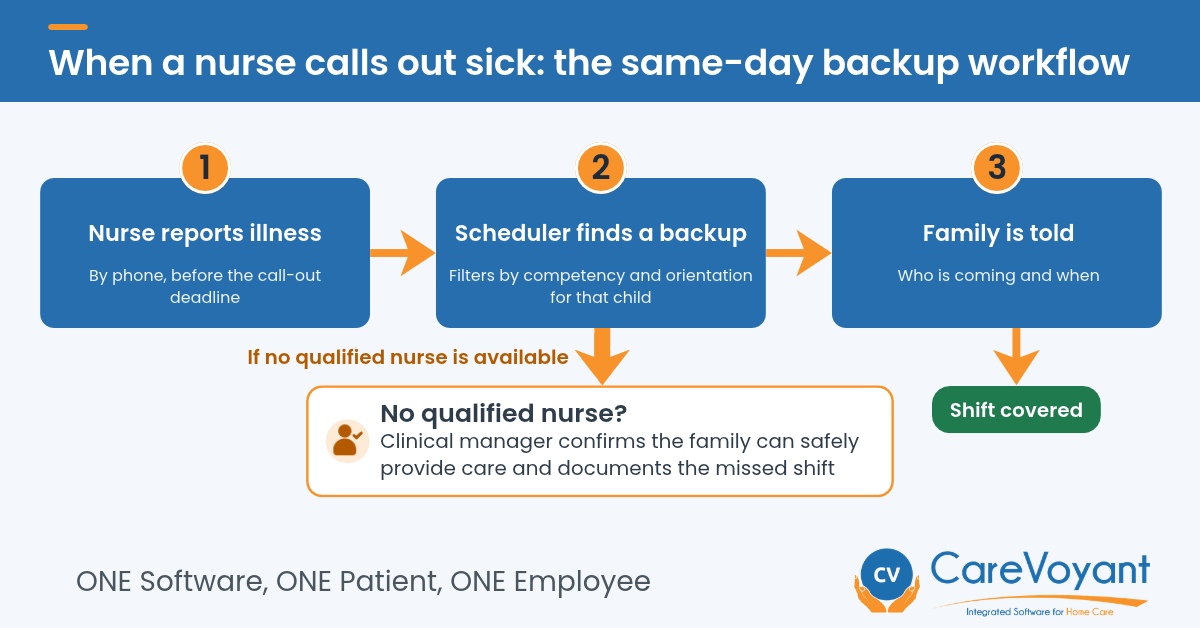
PDN shift scheduling software that filters by credential and orientation turns step 2 from a phone tree into a short list.
Track outbreak-week metrics
Watch call-out rate, shift fill rate, and missed authorized hours week by week from October through March. A rising call-out rate is often the first sign of an outbreak among staff. These numbers sit alongside the broader private duty nursing KPIs most agencies already report.
Document the reason each shift went unfilled so the record supports the agency during audits and reauthorization.
Family Guidance: Make Parents Partners in Infection Control
During respiratory season, families also become the agency's partner in keeping viruses out of the home.
Make illness screening two-way
Ask families to tell the agency before a shift when a parent, sibling, or visitor is sick, just as nurses screen themselves. The nurse can then arrive with the right PPE, and the clinical manager can decide whether the shift continues. Families share this more readily when the relationship is strong, so it helps to build trust with family caregivers long before flu season.
Agree on household rules for the season
Set a few simple rules with the family: hand hygiene at the door for everyone, limits on sick visitors, masks for symptomatic household members near the child, and regular cleaning of shared surfaces and equipment. Encourage parents and older siblings to ask their own physicians about flu and RSV vaccines.
Teach the warning signs
Families should know the changes that need a call to the nurse or physician: faster breathing, retractions (skin pulling in between the ribs), rising oxygen needs, thicker or more frequent secretions, fever, fewer wet diapers, and pauses in breathing. Write down who to call and when to call 911 in plain language. Attention to health literacy matters here, because a tired parent at 2 a.m. needs short, clear instructions.
Give families a one-page season checklist: Household rules, warning signs, and phone numbers on one sheet they can post on the refrigerator.
Documenting Respiratory Status Changes in PDN
Respiratory decline in a medically fragile child is often gradual: a few more suction passes per shift, slightly higher oxygen flow, secretions that change color. No single entry looks alarming. The trend does.
Record a seasonal baseline
For each child, document the usual respiratory rate, SpO2 range, heart rate, work of breathing, secretion color and amount, suction frequency, oxygen flow, and ventilator settings. Record it in October, while the child is well, so every nurse has the same reference point.
Chart trends, not snapshots
Each shift's notes should let the next nurse compare against the baseline at a glance.
| What to record each shift | Why it matters |
|---|---|
| Respiratory rate and SpO2 at set intervals | Shows gradual change against baseline |
| Work of breathing (retractions, nasal flaring, accessory muscle use) | Often changes before SpO2 drops |
| Secretion color, thickness, and amount | A change can signal infection |
| Suction frequency | Rising counts flag increasing secretions |
| Oxygen flow or ventilator setting changes | Shows rising support needs |
| Temperature | Gives the physician the fever pattern |
| Feeding tolerance and output | Flags dehydration risk during illness |
Structured clinical and point-of-care documentation keeps these fields consistent from one nurse to the next. Log nebulizer treatments, fever reducers, and oxygen changes on the eMAR or eTAR as well.
Document escalations completely
Every escalation note needs five things: The time, the findings, who was notified, the orders received, and the child's response.
Vague notes such as "MD aware" are among the common PDN documentation mistakes that cause problems in reviews.
Hand off to substitute nurses
A backup nurse needs the child's baseline and the last 72 hours of trends before the shift starts. Good handoffs protect continuity of care in pediatric home care even when the primary nurse is out sick.
How PDN Software Supports Respiratory Season Operations
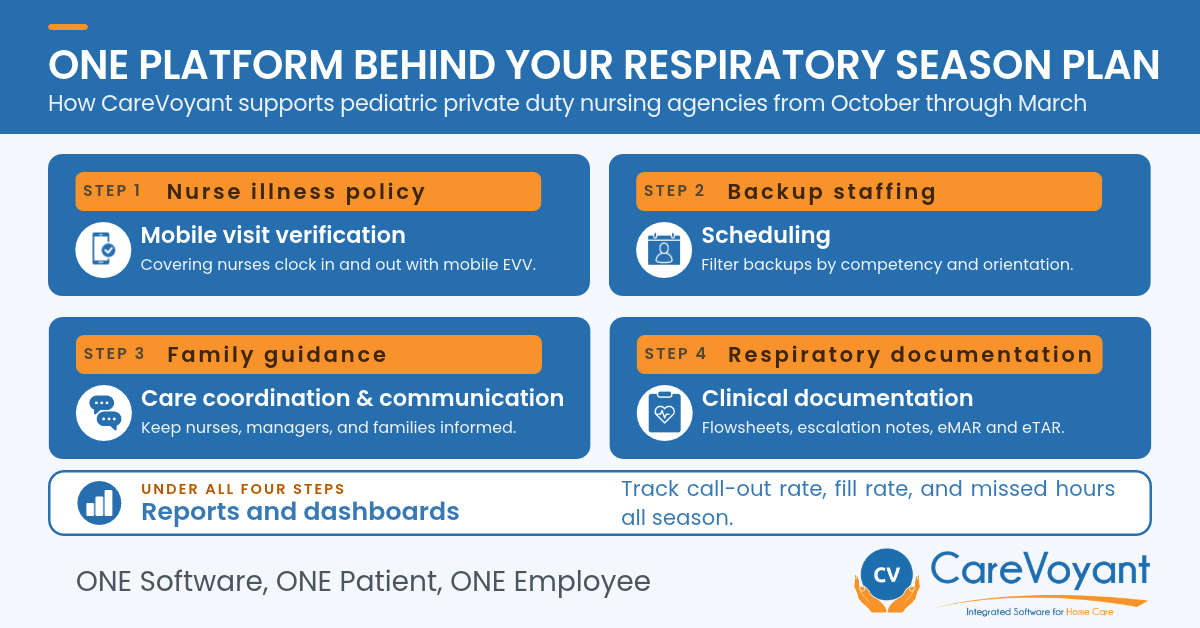
Private duty nursing software built for continuous shift care brings the pieces together:
Scheduling: filter backup nurses by competency and patient orientation.
Mobile visit verification: EVV at clock-in and clock-out for every covering nurse.
Clinical documentation: respiratory flowsheets, escalation notes, and eMAR and eTAR in one record.
Communication: care coordination and communication tools that keep nurses, schedulers, clinical managers, and families informed.
Reporting: reports and dashboards that track call-out rates, fill rates, and missed hours.
Prepare Now, Before the Peak
A clear nurse illness policy, a credentialed backup pool, informed families, and consistent respiratory documentation work best together. Put all four in place in October and November, before RSV and flu reach their peak.
See how CareVoyant helps pediatric private duty nursing agencies staff, document, and coordinate care through respiratory season. Request a demo today.
Frequently Asked Questions
-
Agencies should start in October. RSV typically peaks between December and January in most of the U.S., and CDC recommends infant RSV antibodies from October through March. Starting early leaves time to update plans of care, orient backup nurses, and give families season guidance before cases rise.
-
CDC advises that healthcare personnel with fever and respiratory symptoms stay home until at least 24 hours after the fever ends without fever-reducing medicine. Nurses with respiratory symptoms but no fever should be evaluated before patient contact, and agencies may set stricter rules for their most fragile patients.
-
Build a credentialed float pool for each high-acuity child, with two or three backup nurses who have completed a patient-specific orientation before the season. Pair it with a same-day call-out workflow, a clear call-out deadline, and scheduling tools that filter nurses by competency.
-
Nurses should document changes from the child's baseline in respiratory rate, SpO2, work of breathing, secretions, suction frequency, temperature, and oxygen or ventilator settings. When they escalate, they should record the time, findings, who was notified, orders received, and the child's response.
-
Under AAP guidance updated in September 2026, high-risk children aged 8 to 19 months should receive nirsevimab before their second RSV season. This includes children born before 32 weeks and those with chronic lung disease, significant heart disease, neuromuscular disorders, or severe immunocompromise. Families should confirm eligibility with their physician.
-
Families can tell the agency about sick household members before each shift, keep sick visitors away, use hand hygiene at the door, and keep symptomatic household members masked near the child. They should also know the warning signs, such as faster breathing or rising oxygen needs, that call for an urgent call.
About CareVoyant
CareVoyant is a leading provider of cloud-based integrated enterprise-scale home health care software that can support all home-based services under ONE Software, ONE Patient, and ONE Employee, making it a Single System of Record. We support all home based services, including Home Care, Private Duty Nursing, Private Duty Non-Medical, Home and Community Based Services (HCBS), Home Health, Pediatric Home Care, and Outpatient Therapy at Home.
CareVoyant functions – Intake, Authorization Management, Scheduling, Clinical with Mobile options, eMAR/eTAR, Electronic Visit Verification (EVV), Billing/AR, Secure Messaging, Notification, Reporting, and Dashboards – streamline workflow, meet regulatory requirements, improve quality of care, optimize reimbursement, improve operational efficiency and agency bottom line.
For more information, please visit CareVoyant.com or call us at 1-888-463-6797.
Request for Information
To learn more about CareVoyant Software and how we improve the operational efficiency of Home Healthcare Agencies, contact us:
