

Introduction
About one in three direct care workers in the U.S. relies on Medicaid for their own health coverage, according to PHI. Starting January 1, 2027, many of them will need to show 80 hours a month of work, school, or community service to keep it. That makes Medicaid work requirements a home care issue, just not in the way most agencies expect.
The federal rule calls this the "community engagement requirement." Most people call it Medicaid work requirements. The rule applies to individual Medicaid enrollees, not to agencies, but it reaches your census and your workforce.
Most HCBS and personal care agencies will check their client list first. That check matters, but it is rarely where the biggest risk sits. Older adults, people with disabilities, and people on Medicare make up most HCBS caseloads, and the rule largely passes them by. The aides who care for them are a different story.
Agencies running HCBS software that ties eligibility, authorizations, scheduling, and payroll together will spot both risks sooner. This guide covers who the rule applies to, who is exempt, and why caregivers face more exposure than clients. It also explains how six-month renewals drive coverage churn and what to check in intake and staffing before January.
What the Medicaid Community Engagement Requirement Is
On June 1, 2026, the Centers for Medicare & Medicaid Services (CMS) issued an interim final rule putting the work requirement in the 2025 budget law (HR 1) into practice. States must start no later than January 1, 2027. For a wider look at the law, see our overview of how HR1 changes Medicaid for home care agencies.
The 80-Hour or $580 Monthly Test
An adult who is subject to the rule meets it for a month in any of these ways:
Working, doing community service, or joining a work program for at least 80 hours
Enrolling in an educational program at least half-time
Combining those activities to reach 80 hours
Earning at least 80 times the federal minimum wage, which is $580 a month in 2026
Applicants must show they met the test for one to three consecutive months before they apply, depending on the state. Current enrollees must show it for one or more months between renewals. States choose how many months they check.
Key Dates for Home Care Agencies
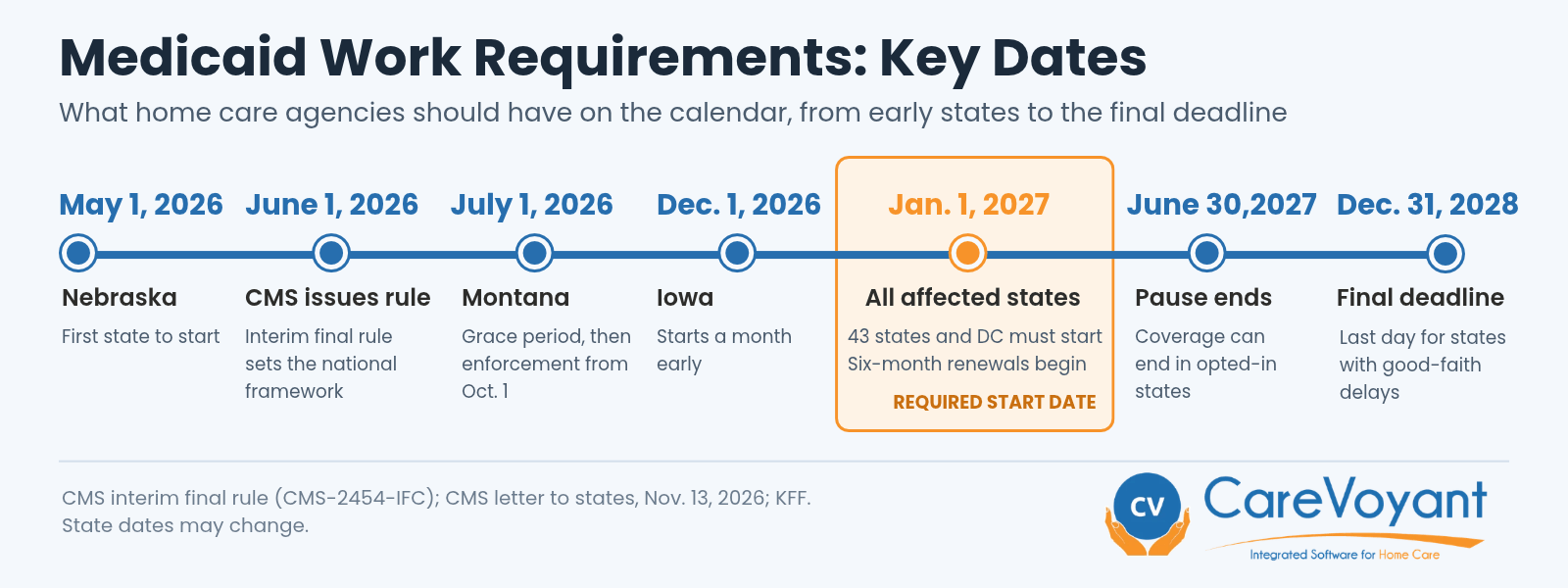
May 1, 2026: Nebraska becomes the first state to implement
June 1, 2026: CMS issues the interim final rule
July 1, 2026: Montana begins, with a grace period until October 1; Arkansas plans a soft launch with no disenrollments before 2027
December 1, 2026: Iowa implements
December 11, 2026: Deadline for states to opt into CMS's hold-harmless period
January 1, 2027: Required start date for every affected state
June 30, 2027: Optional pause on coverage losses ends
December 31, 2028: Last day for states granted good-faith implementation extensions
Which States Are Affected
The rule applies in 43 states and the District of Columbia, the places that cover the Medicaid adult group. U.S. territories are not subject to it. Before reading further, confirm your state's status on the KFF Medicaid work requirements tracker. Agencies that operate only in states without the adult group will see little direct effect.
Who the Rule Covers, Excludes, and Exempts
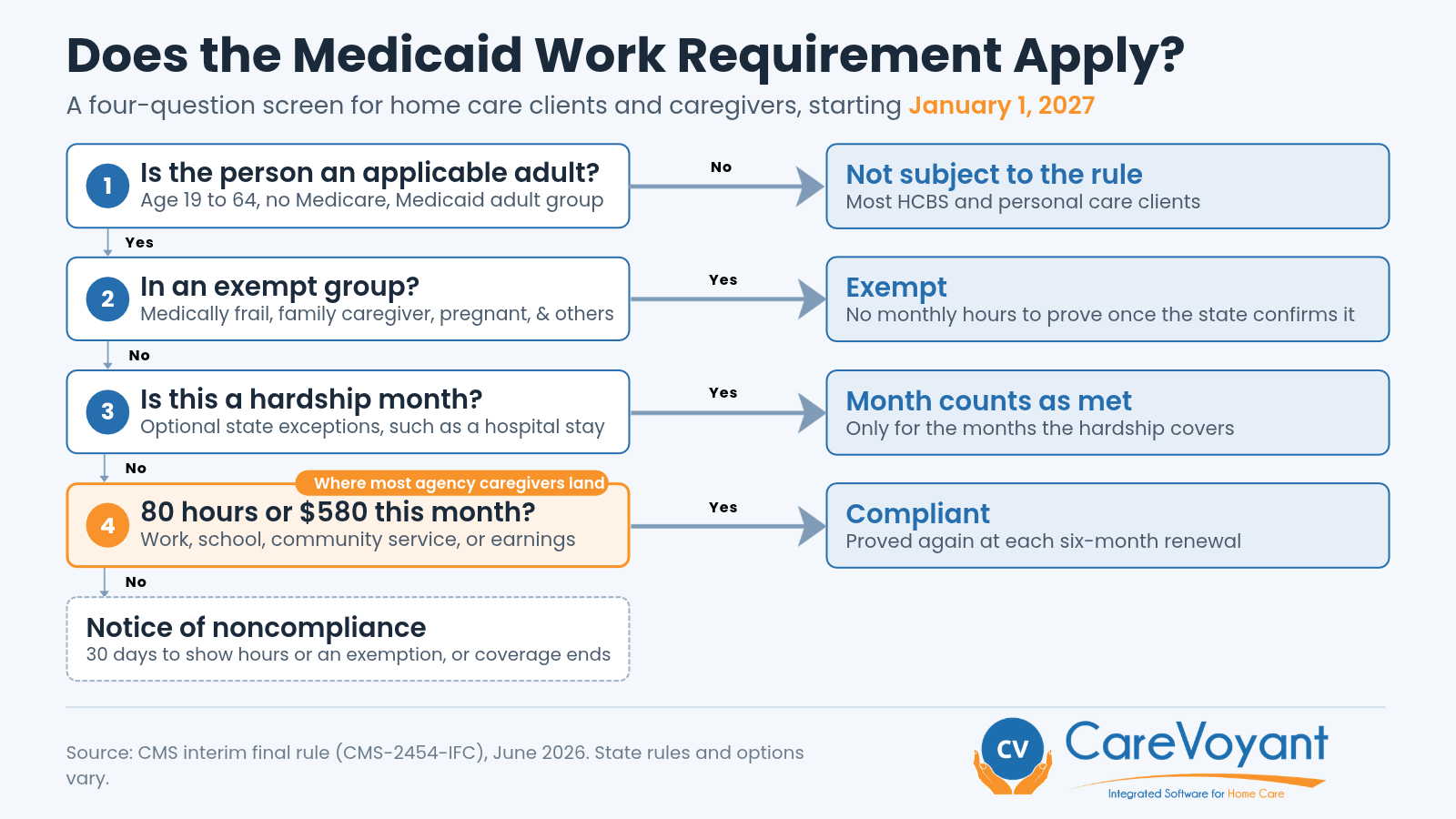
The rule applies to "applicable individuals." These are non-pregnant adults ages 19 to 64 who are not entitled to or enrolled in Medicare and who qualify through the Medicaid adult (expansion) group or certain Section 1115 demonstrations.
Mandatory Exemptions
Even within that group, many adults do not have to meet the requirement. CMS lists these exemptions:
| Exempt group | Why it matters for home care |
|---|---|
| Parents, guardians, caretaker relatives, or family caregivers of a child 13 or younger or of a disabled individual | Covers many unpaid family caregivers of your clients |
| Medically frail adults, including people who are blind or disabled or whose disability significantly impairs activities of daily living | Covers many working-age clients who receive personal care |
| Veterans with a total disability rating | May apply to some clients and some staff |
| Pregnant or postpartum individuals | May apply to staff for a set period |
| People meeting TANF work rules, or in a SNAP household and not exempt from SNAP work rules | May apply to staff who receive SNAP |
| American Indians and Alaska Natives | Applies to clients and staff alike |
| Former foster care youth | Rare in HCBS caseloads |
| People in drug or alcohol treatment | Applies while in a treatment program |
| Inmates of a public institution | Not typical for home care clients |
Update, November 2026: CMS now lets states pause coverage losses until June 30, 2027. States that opt in by December 11 must still start checking compliance on January 1, but can't deny or end coverage for missing the requirement until July. Separately, on October 29 a federal judge struck the extra test CMS added to the medical frailty exemption, so a qualifying condition documented within the past 12 months can now be enough. CMS has said it will appeal. Check your state's latest guidance.
Optional Short-Term Hardship Exceptions
States may also choose to count a month as met during a short-term hardship. The options include an inpatient hospital or nursing facility stay, a declared disaster in the person's county, a county with high unemployment, and extended travel for serious medical care. Hardship exceptions cover only the months they apply to, so the requirement returns once the hardship ends.
How Medicaid Work Requirements Affect Home Care Clients
For most HCBS and personal care clients, the answer is "not much." Most qualify for Medicaid through age, Medicare, or a disability-based eligibility group, so they are not applicable individuals at all. HCAOA estimates that about 10% of Medicaid home care recipients are enrolled through the ACA expansion group. Enrolling in a 1915(c) waiver changes how a person receives services, not which eligibility group they belong to.
Where Client Exposure Still Exists
The rule can still reach part of your census:
Working-age expansion adults. Clients ages 19 to 64 who qualify through the adult group and receive personal care or other home and community-based services are applicable individuals.
Clients who must prove medical frailty. The frailty exemption covers a disability that significantly impairs one or more activities of daily living. That is exactly what a personal care assessment documents. States set which data and which practitioners can confirm it, so the exemption works best when the record is clear.
Family caregivers on Medicaid. Many unpaid family caregivers of your clients are working-age adults with Medicaid. Most will qualify for the caregiver exemption, but only if the state can confirm it.
The short version: The client who needs help bathing and dressing is likely exempt. The aide who helps them may not be.
What This Means for Your Agency Type
| Agency type | Client impact | Caregiver impact | What to do first |
|---|---|---|---|
| Personal care (Medicaid-funded) | Low to moderate; some clients are expansion adults under 65 | High; aides are often working-age, part-time, and on Medicaid | Flag clients ages 19 to 64 without Medicare; make employment proof easy |
| HCBS waiver | Low; about 10% of Medicaid home care recipients come through expansion | High | Confirm each client's eligibility group at intake |
| Consumer-directed or self-direction | Low | High; treatment of paid family caregivers varies by state | Check your state's rules for paid family caregivers |
| Non-medical home care (mostly private pay) | Minimal | Moderate; low-wage aides may be on Medicaid | Focus on the staffing checks below |
| Medicare home health | Minimal; Medicare clients are out of scope | Moderate for aides | Focus on the staffing checks below |
Why Agency Caregivers on Medicaid Face More Exposure Than Clients
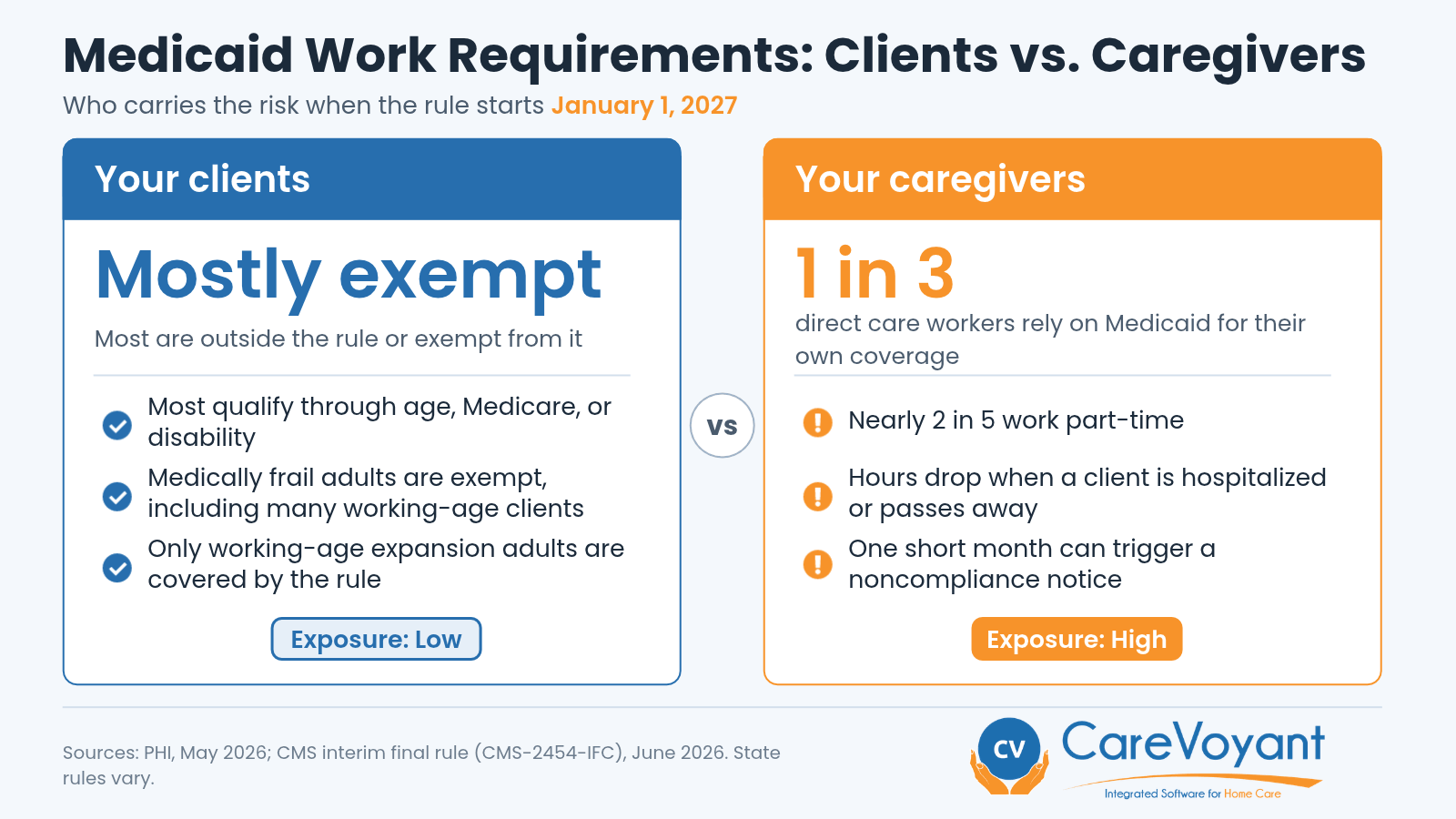
The clients are mostly exempt. The workforce is not. This is where HCBS and personal care agencies carry the most risk.
One in Three Direct Care Workers Relies on Medicaid
PHI estimates that about one-third of the nation's 5.4 million direct care workers rely on Medicaid for their own coverage. A 2025 Center on Budget and Policy Priorities analysis, summarized by ANCOR, ranked personal care aides as the second most likely occupation to be affected by work requirements. Home health aides ranked 15th.
Variable Hours and Sudden Gaps
Home care schedules move with client needs. Nearly two in five direct care workers work part-time, according to PHI's May 2026 brief. Hours can also drop overnight when a client is hospitalized or passes away. One short month can be enough to trigger a noncompliance notice.
Run the numbers: An aide paid $15 an hour passes the $580 income test with about 39 paid hours in a month. For most working aides, the risk is not total hours. It is the gap month and the missing proof.
Multiple Employers and Thin Paper Trails
Many aides split their week across two agencies or add private clients. Turnover is high, and the work happens in clients' homes, not one worksite. States check data sources such as payroll records before asking a person for documents, so timely, accurate agency payroll helps your staff pass without paperwork.
Paid Family Caregivers in Consumer-Directed Programs
Paid caregiving hours count as work. Some paid family caregivers may also fit the family caregiver exemption. States handle this differently, so agencies running consumer-directed services should confirm how their state treats paid family caregivers before January.
The Workforce Ripple
Coverage loss among aides can turn into missed shifts, resignations, and unstaffed visits. The clients feel it too. The Medicaid Home Care Chartbook 2026, from the National Alliance for Care at Home and the Research Institute for Home Care, projects that HR 1 will cut the number of Medicaid enrollees receiving home care by 311,879. That estimate includes the work requirements, as reported by Home Health Care News. With home health recruitment trends for 2026 already tight, few agencies can absorb more turnover. Our guide to managing the home care labor shortage covers longer-term staffing steps.
Eligibility Churn at Renewal and the Six-Month Clock
Starting with renewals scheduled on or after January 1, 2027, HR 1 moves almost all expansion adults from yearly to six-month renewals. Each renewal is another point where coverage can lapse, often over paperwork rather than eligibility. Some states, including Indiana and New Hampshire, also plan to check compliance between renewals, according to KFF.
Here is how the process works under the CMS rule:
The state checks its own data first, such as payroll, claims, and other agency records.
If it cannot confirm compliance or an exemption, it sends a notice of noncompliance.
The person has 30 calendar days to show they met the requirement or that it does not apply.
If they do not respond in time, the application is denied or coverage ends.
People who lose coverage can reapply at any time. There is no waiting period.
Watch the mailbox: A state notice starts a 30-day clock. If a client's address or phone number is out of date, that window can close before anyone sees the letter.
CMS projects a 15% disenrollment rate in the adult group. That assumes about 9% of enrollees lose coverage for not meeting the requirement and another 6% lose it to administrative or paperwork barriers, according to a Holland & Knight summary of the rule. People who lose or are denied Medicaid this way also cannot get premium tax credits for Marketplace coverage, so a missed notice can leave them uninsured.
What Churn Costs an Agency
When a client's Medicaid lapses, the authorization behind their care is at risk. Visits delivered during the gap may not be billable, and denied claims pile up in AR. Agencies that already track authorization mistakes that cause revenue loss and avoid scheduling against expired authorizations will catch these gaps faster. The same discipline helps with eligibility verification in home care billing and keeps accounts receivable over 90 days from growing.
What to Check in Intake
Add these checks to your intake process now, and repeat them at each reassessment:
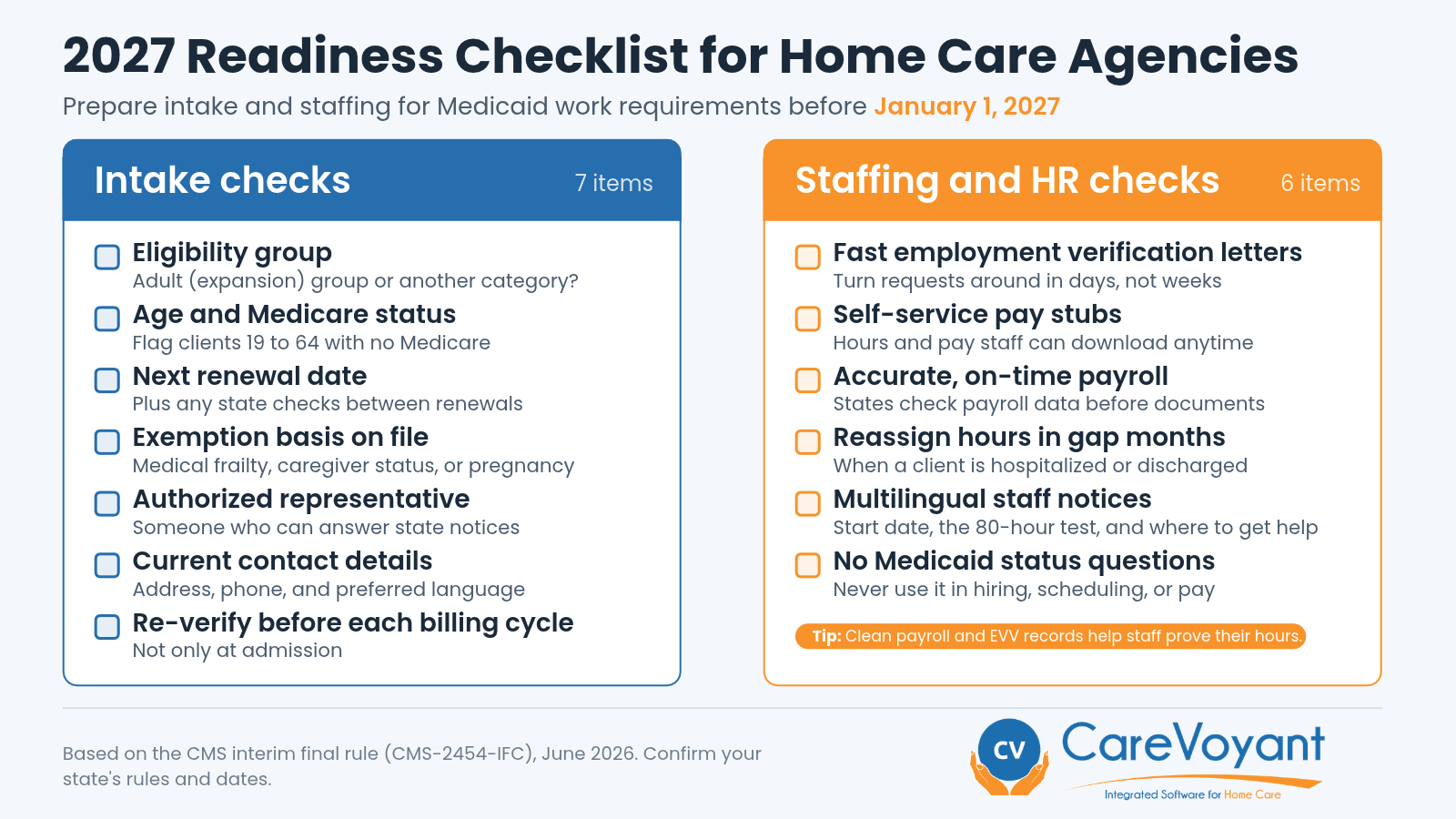
Eligibility group. Does the client qualify through the adult (expansion) group or another category?
Age and Medicare status. Is the client 19 to 64 with no Medicare? If yes, flag them as potentially subject to the rule.
Renewal date. When is the next renewal, and does the state check compliance between renewals?
Exemption basis. Is there a likely exemption, such as medical frailty, caregiver status, or pregnancy, and is it documented?
Authorized representative. Who can respond to state notices if the client cannot?
Contact details. Are the mailing address, phone number, and preferred language current? A notice sent to an old address is a missed 30-day window.
Billing re-check. Is eligibility verified before each billing cycle, not only at admission?
One more step happens outside your intake form. Ask your state Medicaid agency whether it will use home care claims to identify and exempt eligible clients automatically, as HCAOA recommends. It spares clients the paperwork that causes most coverage loss.
These checks build on habits many agencies already have. Our guides on how to speed up Medicaid eligibility verification and common home care intake bottlenecks cover the mechanics. Centralized intake for patient access and electronic intake forms make the new fields easier to capture consistently.
What to Check in Staffing and HR
Your caregivers carry the larger risk, and small HR changes can lower it.
Make Proof Easy to Get
Turn around employment verification letters within days, not weeks. Give staff self-service access to pay stubs and hours worked. Report payroll accurately and on time, since states pull payroll data before asking workers for documents. PHI has urged states to use electronic visit verification (EVV) and payroll data for this purpose, so clean EVV records may help your staff too.
Protect Hours in Gap Months
When a client is hospitalized, moves to a facility, or passes away, reassign that caregiver's hours quickly. A few extra shifts in a short month can keep an aide above the 80-hour or $580 line. Intelligent scheduling for staff utilization makes those reassignments faster, and accurate time tracking for home care payroll keeps the record clean.
Share the Rule, Not the Burden
Send plain-language, multilingual notices that explain your state's start date, the 80-hour test, and where to get help, such as the state Medicaid agency. Staff who understand the rule are more likely to answer a notice on time.
Set Guardrails
Do not require staff to disclose whether they have Medicaid, and do not base hiring, scheduling, or pay decisions on it. Confirm your approach with employment counsel. Handled well, this support also strengthens retention, a theme in our posts on why home care employees quit and caregiver retention strategies.
Support, not screening: Help staff keep their coverage, but never ask whether they have Medicaid or use it in hiring, scheduling, or pay decisions.
How Home Care Software Helps Agencies Prepare
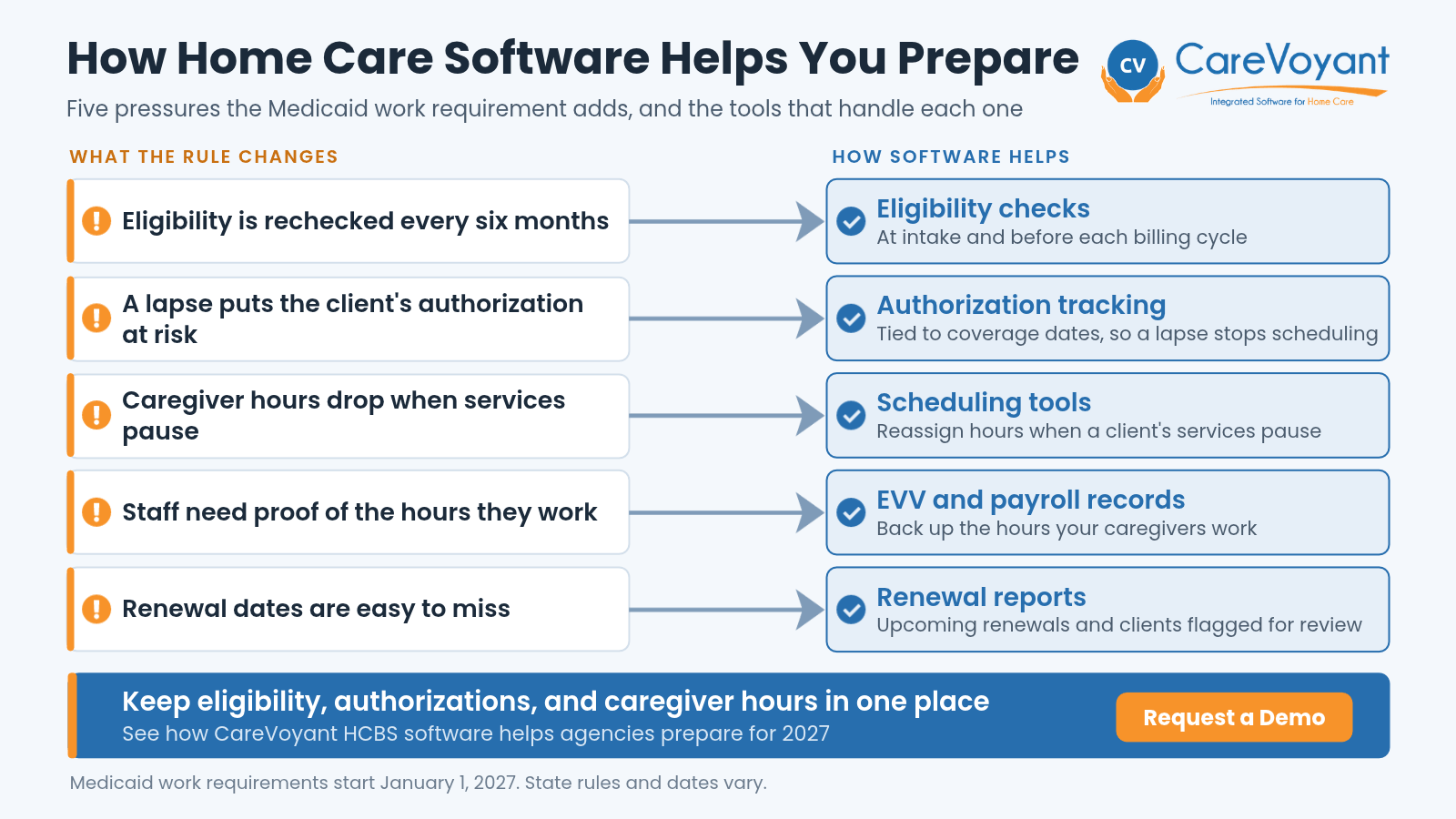
The work requirement adds more dates, more checks, and more reasons for coverage to change mid-service. Spreadsheets struggle with that. Integrated home care software keeps the pieces connected:
Eligibility checks at intake and before each billing cycle
Authorization tracking tied to coverage dates, so a lapse stops scheduling before it creates unbillable visits
Scheduling tools that move caregiver hours quickly when a client's services pause
EVV and payroll records that back up the hours your caregivers work
Reports on upcoming renewals and clients flagged as possibly subject to the rule
Agencies already working through HCBS strategies to survive Medicaid cuts will find the same tools apply here. For more, see how integrated software improves data visibility and how CareVoyant supports Medicaid billing for home care.
Conclusion
Medicaid work requirements start January 1, 2027, and they apply to people, not agencies. For HCBS and personal care agencies, most clients fall outside the rule. The real exposure sits with caregivers on Medicaid and with the paperwork that comes with six-month renewals.
Three steps will cover most of the risk before January:
Flag clients ages 19 to 64 without Medicare at intake, and confirm their exemption basis.
Make employment proof fast and easy for every caregiver.
Track renewal dates so a lapse never reaches a visit or a claim.
To see how CareVoyant HCBS software can help your agency prepare, request a demo today.
Frequently Asked Questions
-
States must start by January 1, 2027. Some states moved earlier: Nebraska began May 1, 2026, Montana July 1, 2026, and Iowa December 1, 2026. Montana gave enrollees a grace period until October 1 before enforcing it. States that opt into CMS's hold-harmless period can pause coverage losses until June 30, 2027. Check your state's Medicaid agency for its exact date and verification rules.
-
Usually not. The rule covers adults ages 19 to 64 in the Medicaid expansion group who are not on Medicare. Most HCBS and personal care clients qualify through age, Medicare, or disability. Working-age clients whose disability significantly impairs activities of daily living are generally exempt as medically frail.
-
Yes, if they are working-age adults in the expansion group. About one-third of direct care workers rely on Medicaid. Most work enough hours to meet the 80-hour or $580 test, but variable schedules, sudden gaps, and missing paperwork can trigger a noncompliance notice and put their coverage at risk.
-
Family caregivers of a child 13 or younger or of a disabled individual are exempt. A caregiver who is neither related to nor living with the person must provide at least 80 hours of care a month. States verify caregiver status differently, so caregivers should confirm the rules where they live.
-
Starting with renewals scheduled on or after January 1, 2027, most expansion adults move from yearly to six-month renewals. States must also verify compliance at application. Some states, including Indiana and New Hampshire, plan to check compliance between renewals as well, which means more frequent requests for information and more chances for coverage to lapse.
-
The state sends a notice of noncompliance and gives the person 30 calendar days to show they met the requirement or are exempt. If the issue is not resolved, the application is denied or coverage ends. There is no lock-out period, so the person can reapply at any time.
About CareVoyant
CareVoyant is a leading provider of cloud-based integrated enterprise-scale home health care software that can support all home-based services under ONE Software, ONE Patient, and ONE Employee, making it a Single System of Record. We support all home based services, including Home Care, Private Duty Nursing, Private Duty Non-Medical, Home and Community Based Services (HCBS), Home Health, Pediatric Home Care, and Outpatient Therapy at Home.
CareVoyant functions – Intake, Authorization Management, Scheduling, Clinical with Mobile options, eMAR/eTAR, Electronic Visit Verification (EVV), Billing/AR, Secure Messaging, Notification, Reporting, and Dashboards – streamline workflow, meet regulatory requirements, improve quality of care, optimize reimbursement, improve operational efficiency and agency bottom line.
For more information, please visit CareVoyant.com or call us at 1-888-463-6797.
Request for Information
To learn more about CareVoyant Software and how we improve the operational efficiency of Home Healthcare Agencies, contact us:
