

Holiday Staffing in Home Care Starts Before the Holidays
A ventilator-dependent child does not get a day off on December 25. The authorization for round-the-clock nursing stays in force, the trach still needs suctioning at 3:00 a.m., and the family still expects a nurse at the door for the 7:00 p.m. shift. What changes is the nurse pool. Nurses want time with their own families, flu season pushes call-offs up, and every agency in the market is chasing the same per diem staff.
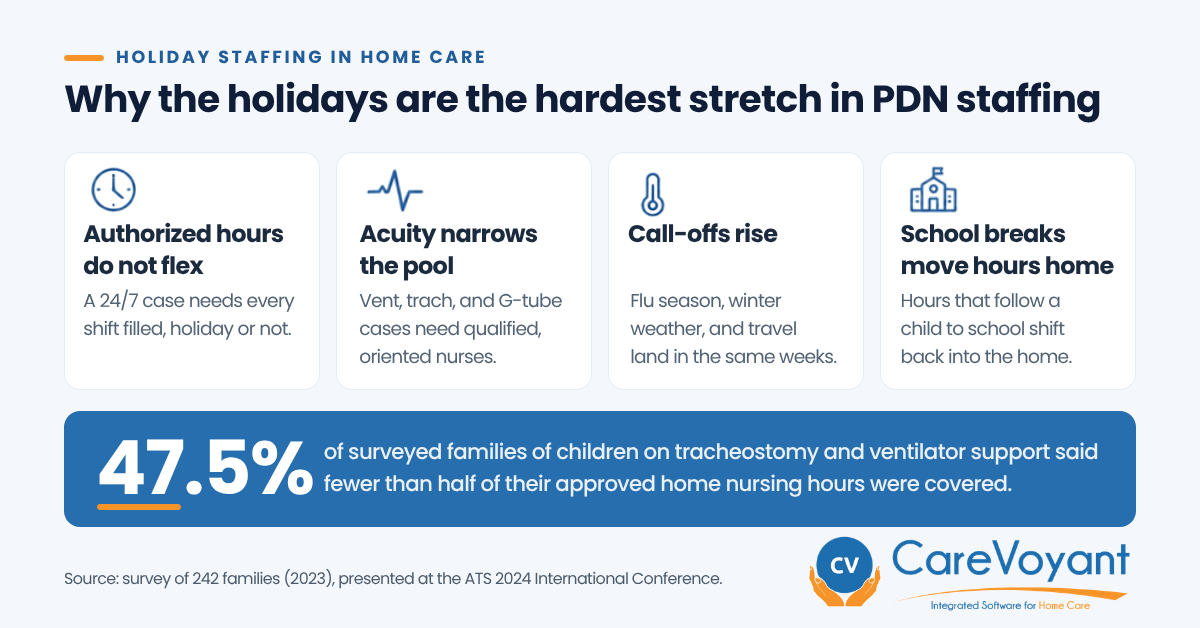
That makes holiday staffing in home care a planning problem before it is a scheduling problem. Private duty nursing (PDN) cases already run short in an ordinary month. In a 2023 survey of 242 families of children on tracheostomy and ventilator support, presented at the ATS 2024 International Conference, 47.5% said fewer than half of their approved home nursing hours were covered. The five weeks from Thanksgiving to New Year's Day widen that gap.
Agencies that hold coverage through the season pull the same four levers, and they pull them early: a clear holiday pay differential, a rotation nurses accept as fair, a sign-up window that closes weeks ahead, and plain communication with families. Here is how to set up each one, and how private duty nursing software keeps the plan out of spreadsheets and off the whiteboard.
Why Thanksgiving to New Year Is the Hardest Stretch in PDN Staffing
The season packs five high-demand dates into about five weeks. Holiday calendar for 2026 to 2027, when Christmas and New Year's Day both fall on a Friday:
| Date | Day | Holiday |
|---|---|---|
| November 26, 2026 | Thursday | Thanksgiving |
| December 24, 2026 | Thursday | Christmas Eve |
| December 25, 2026 | Friday | Christmas Day |
| December 31, 2026 | Thursday | New Year's Eve |
| January 1, 2027 | Friday | New Year's Day |
When Christmas and New Year's Day fall next to a weekend, the calendar creates back-to-back long weekends. Expect time-off requests to cluster around them, and expect nurses who work the night before each holiday to ask for both the eve and the day.
A few pressures make this window harder for PDN than for almost any other home care service:
Authorized hours do not flex. A case approved for 24/7 coverage needs every shift filled, holiday or not.
Acuity narrows the pool. Ventilator, trach, and G-tube cases can only go to nurses who are qualified and oriented to that patient.
Call-offs rise. Flu season, winter weather, and family travel all land in the same weeks.
School breaks move hours home. For children whose nursing follows them to school, winter break can shift those hours back into the home schedule.
The baseline is already thin. In Delaware's PDN workforce study, over three-quarters of family caregivers of children with medical complexity reported having no nursing coverage multiple times a month. Treating the holidays as a normal month with more requests tends to leave the last week of December for filling shifts by phone. Agencies that already have a plan for managing the home care labor shortage are in a better position, but holiday staffing in home care still needs its own playbook.
Holiday Pay Differentials: What the Law Requires and What Fills Shifts
Pay is the first question every nurse asks about a holiday shift, and the answer should be in writing before anyone signs up.
The federal baseline
The U.S. Department of Labor is clear that the Fair Labor Standards Act (FLSA) does not require payment for time not worked, including holidays. Paid holidays are a matter of agreement between the employer and the employee. The FLSA also does not require a premium for hours worked on a holiday. Under federal law, an hourly nurse who works Christmas Day is owed their regular rate, plus any overtime the week's total hours trigger under the FLSA overtime rules for home care workers.
That is the legal floor, and every agency weighs what it can offer above it against reimbursement that rarely changes for the holidays. Even a modest premium, stated clearly and early, tells nurses the agency values the holiday they are giving up.
Before you set rates: State law, employment agreements, and any collective bargaining agreement can require holiday pay or premiums that federal law does not. Confirm all three before you publish your holiday policy. This section is general information, not legal or payroll advice.
The 1.5x line that changes your overtime math
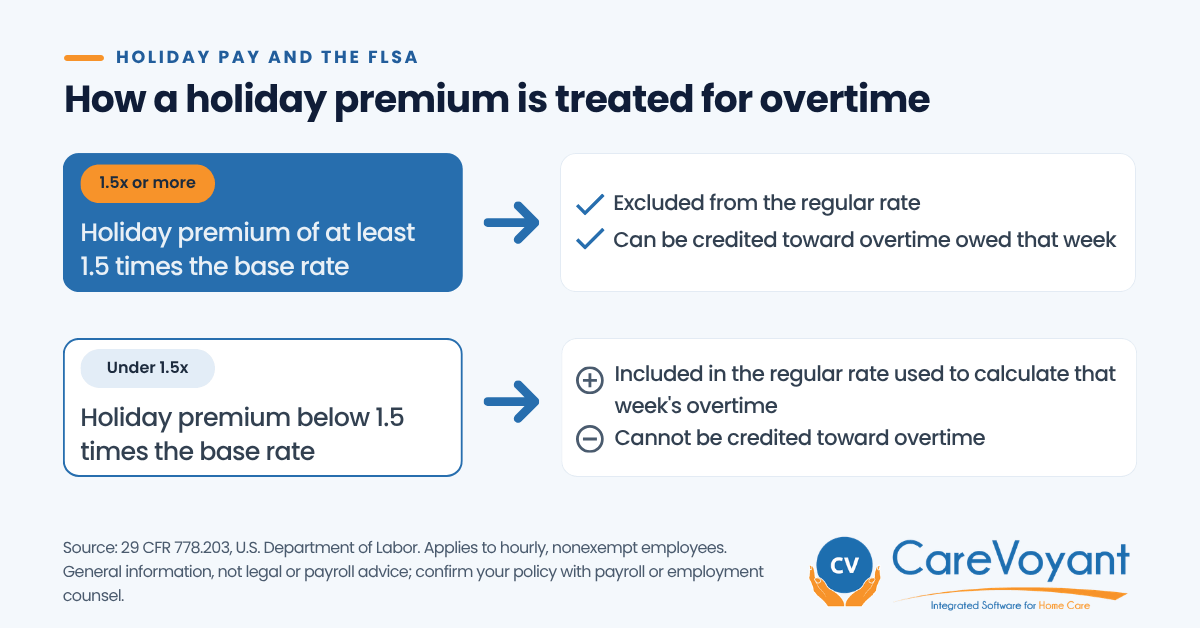
This detail is easy to miss. Under the Department of Labor's rules on payments excluded from the regular rate (29 CFR 778.203), a holiday premium of at least one and a half times the base rate is treated as an overtime premium. It stays out of the regular rate and can be credited toward overtime owed that week. A premium below 1.5x is treated differently: it must be included in the regular rate used to calculate that week's overtime, and it cannot be credited toward overtime.
Here is how that works for one hourly, nonexempt nurse paid $40 an hour on a standard 40-hour workweek. The nurse works 48 hours in Christmas week, including a 12-hour shift on December 25.
| Christmas week (48 hours) | Flat $5/hr holiday add-on | Time-and-a-half on holiday hours |
|---|---|---|
| Straight-time pay | $1,980 | $2,160 |
| Regular rate for overtime | $41.25 | $40.00 |
| Additional overtime owed | $165 | $0 (holiday premium is credited toward overtime) |
| Total pay for the week | $2,145 | $2,160 |
| Pay above the base rate for 48 hours | $225 | $240 |
In this example, the two options land within $15 of each other, for the agency and for the nurse. The real difference is clarity. With time-and-a-half, the holiday premium and the overtime calculation stay separate, which makes pay stubs easier to explain and payroll easier to check. Run your own numbers with payroll, because the result depends on when the overtime hours fall and how your workweek is defined. For how differentials and blended overtime are calculated across multiple cases, see our guide to blended overtime and rate stacking in private duty nursing.
Choosing a differential model
| Model | How it works | Best for | Keep in mind |
|---|---|---|---|
| Flat per-hour add-on | A fixed dollar amount added to every holiday hour | Agencies that want a simple, predictable cost | Under 1.5x, it is included in the regular rate for overtime |
| Time-and-a-half | 1.5x base rate on named holidays | Most PDN agencies; easy to explain | Define exactly which hours count |
| Double time on the hardest shifts | 2x on Christmas Eve night, Christmas Day, and New Year's Eve night | Shifts that go unfilled every year | Budget it shift by shift, not across the season |
| Season commitment bonus | A set bonus for working a minimum number of holiday shifts | Building a reliable holiday core | A promised bonus is nondiscretionary and counts in the regular rate for overtime |
A practical combination: time-and-a-half on every named holiday, plus double time on the two or three shifts they struggle to fill every year.
Define the holiday window precisely
Vague policies cause payroll disputes in January. Write down:
Which dates qualify, and whether Christmas Eve and New Year's Eve count as full holidays or only their night shifts
The exact start and end clock times, such as 12:00 a.m. to 11:59 p.m.
How a 7:00 p.m. to 7:00 a.m. shift that crosses midnight is split between premium and regular hours
Those rules only hold up if your system applies them the same way every time. Scheduling rules that apply holiday differentials by date and time, connected to payroll integration, keep the split consistent across every nurse and every case.
Budget the premium against reimbursement
PDN is billed by the hour, so a holiday premium is a cost the agency carries unless a payer modifier covers it. Check whether your state Medicaid program or managed care plans pay any holiday or off-shift modifier. Rhode Island, for example, has paid an off-shift modifier that includes state holidays on certain personal care codes, with the increase passed through to workers. That modifier applies to personal care, not PDN, so treat it as an example of what to ask your payers about rather than a PDN rate. Where no modifier exists, the premium comes out of margin, so estimate it up front: projected holiday hours multiplied by the premium per hour. Agencies that already track overtime in home care payroll can pull last year's holiday hours as the starting point.
Rotation Fairness: A Holiday Schedule Nurses Trust
A generous premium will not keep a nurse who has worked Christmas three years running while a colleague never has. Uneven shift distribution is one of the quieter reasons caregivers quit home care jobs, and the holidays are where it shows most. The fix is a rotation rule that every nurse can predict before sign-up opens.
Four rotation models that work
The big-three rule. Every nurse works one of Thanksgiving, Christmas Day, or New Year's Day, and has at least one of the three fully off. Simple to explain and easy to audit.
Alternate-year rotation. The nurse who works Christmas this year gets it off next year. This only works if you keep a holiday history log that survives staff changes and scheduler turnover.
Points or bidding. Each holiday shift carries points, with the hardest shifts worth the most. Nurses with the lowest point balance from prior years choose first.
Volunteers first. Some nurses want the premium shifts for the extra pay or because the dates fit their own plans. Offer every holiday shift to volunteers before assigning anyone, then apply your rotation rule to what is left.
A practical default is volunteers first, then one of the other three for the remaining shifts. Pick one and use it every year. Switching methods every season makes nurses feel the rules bend for someone. Whatever model you choose, leave room for time-off requests for other religious or cultural holidays nurses observe during the season, and handle them the way you would at any other time of year.
Balance fairness with continuity of care
Rotation has a limit in PDN. Families of medically fragile children build real trust with their primary nurse, and a stranger on Christmas morning is a risk to both care quality and that trust. Protect continuity of care in pediatric home care on your highest-acuity cases first, then rotate around them.
Two practices make that easier:
Every backup nurse completes at least one orientation shift on the case before the holiday, not on it.
Backups are chosen by skill and case fit, not just availability. Matching nurses to patients by skill and acuity matters more, not less, when the regular nurse is off.
Put the rules in writing
Publish the holiday policy as one page, before sign-up opens, covering:
Sign-up dates and how unclaimed shifts are assigned
Tiebreakers when two nurses want the same day off
Swap rules: swaps need scheduler approval, and the incoming nurse must be credentialed and oriented to the case
How holiday call-offs are handled, stated in advance rather than decided case by case
When the rules are written down, a disappointed nurse can see why the decision went the way it did. That is what makes a rotation feel fair.
Fairness test: If a nurse asks why they are working Christmas this year, your written policy should answer in one sentence.
Early Sign-Up: Lock the Holiday Calendar Weeks Ahead
One of the clearest differences between a calm holiday season and a chaotic one is when the schedule closes. Every week of lead time gives you a chance to fill a shift at the planned rate instead of an emergency one. Count back from Thanksgiving:
8 weeks out: publish the holiday policy, qualifying dates, and premium rates.
6 weeks out: open sign-up and the volunteer window.
4 weeks out: close sign-up, assign open shifts by rotation history, and publish the schedule.
2 weeks out: run backup orientation shifts and check every license and CPR expiration date.
48 hours out: confirm each nurse and each family.
Day of: monitor clock-ins and work the escalation ladder.
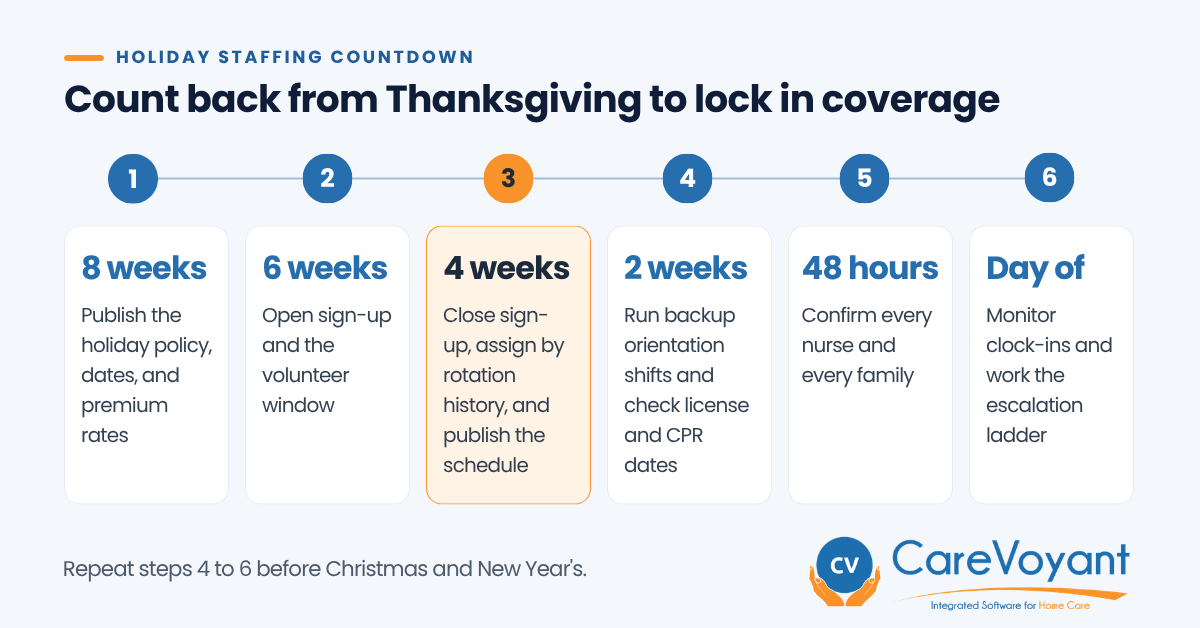
Repeat steps 4 through 6 before Christmas and again before New Year's. For a single sign-up that covers all three holidays, the 4-week deadline before Thanksgiving works for the whole season, and it gives nurses one set of plans to make with their families.
Build a holiday backup bench
A published schedule is only as strong as the bench behind it. For each high-acuity case, identify at least one backup nurse who is credentialed, oriented to the patient, and available on each holiday. For lower-acuity cases, a PRN pool can absorb call-offs. Agencies already running a core team plus flex pool staffing model have most of this in place; the holiday task is confirming who in the pool is actually available on each date.
Check credentials and authorizations before the calendar turns
Two year-end problems catch agencies every January:
Expiring credentials. A license, CPR card, or competency that expires in December takes a nurse off the schedule at the worst possible time. Pull the expiration list in November.
Expiring authorizations. Authorizations that end December 31, and plan changes that take effect January 1, can leave the first week of the year scheduled against approvals that no longer exist. Renew early, and make sure your system blocks overscheduling on expired authorizations instead of letting the shifts run and the claims fail later.
Tying every holiday shift to an active approval through authorization and plan of care management keeps the schedule and the billing from drifting apart over the break.
If you are reading this in November: You can still recover. Post your premium rates today. Open a five-day volunteer window. Assign the remaining shifts by rotation history the following day, then use the next week for backup orientations. A compressed plan beats no plan, and nurses will remember that the schedule came out before Thanksgiving week.
Family Communication: Set Expectations Before the Holidays Do
Families of PDN patients plan their holidays around nursing coverage. A shift that goes unfilled with no warning can mean a parent missing work, a cancelled trip, or an exhausted caregiver doing overnight care alone. Early, honest communication protects the family and your relationship with them.
Ask about their holiday plans first
Start the conversation before you build the schedule, not after. Ask each family:
Are relatives visiting who can help, or will the home be busier than usual?
Is the family traveling, and if so, where and for how long?
Do they plan to use fewer hours on any specific day?
Using fewer hours is always the family's decision, never something the agency asks for. When a family chooses to skip a shift, for example because relatives are visiting and want to help, confirm the change in writing. That nurse can then be offered to a case that has no backup.
The family decides: Using fewer hours is always the family's decision, never something the agency asks for. When a family chooses to skip a shift, for example because relatives are visiting and want to help, confirm the change in writing. That nurse can then be offered to a case that has no backup.
Share the coverage plan in writing
Once the schedule is set, send each family a written holiday plan that shows who is covering every shift, which shifts are still open, and what happens if a nurse calls off. If a shift may go uncovered, say so now. A family told in mid-November that December 24 overnight is not yet filled can make arrangements. A family told at 6:00 p.m. on Christmas Eve cannot. That honesty is how agencies keep building trust with family caregivers through the hardest weeks of the year.
Plan for travel and closures
Two details deserve a direct conversation:
Travel. If the patient will travel out of state, licensure, payer coverage, and EVV requirements may not follow them. Confirm with the payer before you agree to staff the trip.
Supplies and pharmacy. Pharmacies and medical supply companies often run reduced holiday hours. Confirm that medications, trach supplies, and feeding supplies are stocked before each holiday.
Keep one channel and a steady cadence
Pick one channel for holiday updates and use it consistently:
The written plan by mid-November
A reminder 48 hours before each holiday, naming the nurse on each shift
Same-day messages for any change, sent through care coordination and secure messaging rather than a scheduler's personal phone
A short message is enough. For example: "Hi Maria, here is Jayden's coverage for Thanksgiving week. Sarah has the day shifts on Wednesday and Thursday, and Tom covers both nights. Friday night is still open; we will confirm by November 20. Reply here with any changes to your plans." For more on keeping families informed, see our guide to communication tools for pediatric home care.
Day-Of Coverage: Monitor Early and Recover Fast
Even a well-built holiday schedule will have a call-off. What matters is how fast you know and how fast you respond. On a holiday, a late clock-in that nobody notices for 45 minutes can leave a parent alone with a ventilator and no backup on the way.
Set up three things before each holiday:
Alerts for late clock-ins. Real-time monitoring in private duty care, backed by EVV and CV Mobile visit data, flags a missed start while there is still time to act.
An escalation ladder. The on-call scheduler calls the oriented backup first, then the PRN pool, then the supervising RN. The family hears from the agency at the first step, not the last.
A named on-call roster. Every holiday shift has a scheduler and a supervising RN on call, with phone numbers in the family's written plan.
The same habits that work year-round apply here. Scheduling software that reduces caregiver no-shows does its most important work on the days when no-shows are hardest to cover.
After January 1: Review the Season
The best time to plan next year's holidays is the first week of January, while the details are fresh. Pull the numbers:
Holiday shift fill rate, by date and by shift
Authorized versus delivered hours across the five-week window
Call-off rate on premium days compared with regular days
Premium cost per filled hour, by differential model
Overtime hours generated by holiday shifts
Family complaints or escalations tied to coverage
These sit naturally alongside your top 10 private duty nursing KPIs. With reports and dashboards tracking these measures, the review starts from current data instead of a stack of exports. Update the rotation history log at the same time, so next year's sign-up starts with an accurate record of who worked what.
How CareVoyant Supports Holiday Staffing in Home Care
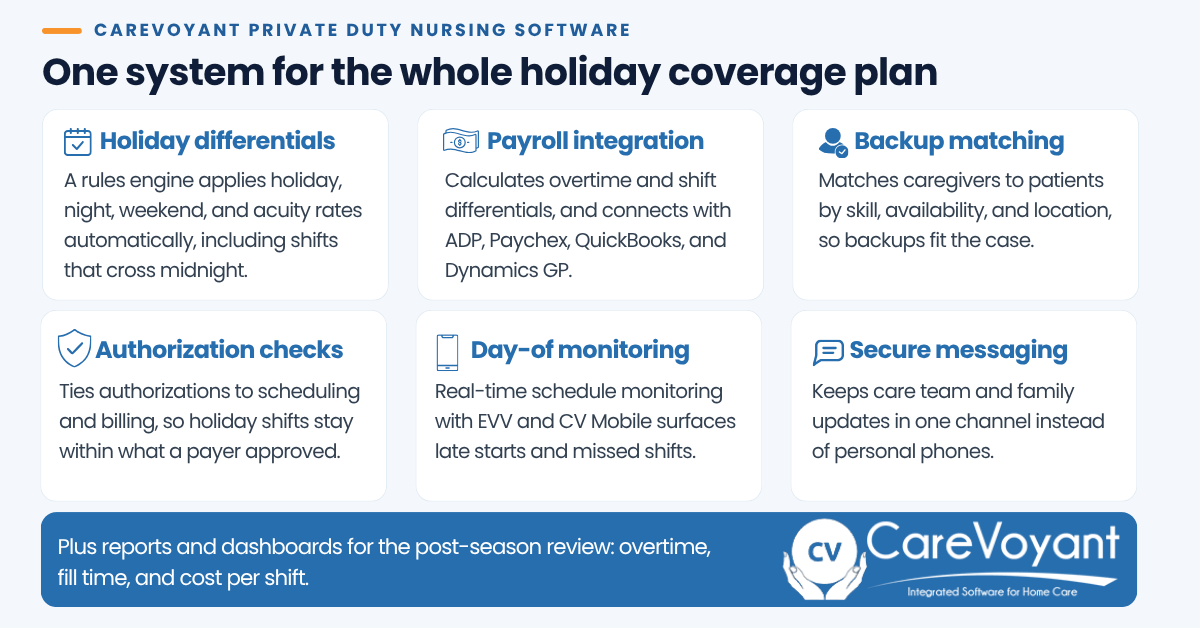
A holiday plan that lives in a spreadsheet, a group text, and a payroll export breaks the first time a nurse calls off on Christmas Eve. CareVoyant Private Duty Nursing Software keeps every piece of the plan in one system:
Shift-based scheduling built for 24/7 PDN coverage, with caregiver-to-patient matching by skill, availability, and location, so backups are chosen by case fit
A configurable rules engine that applies holiday, night, weekend, and acuity differentials automatically, including shifts that cross midnight
Authorization tied to scheduling and billing, so holiday shifts cannot be scheduled outside what a payer approved
Real-time schedule monitoring with EVV and CV Mobile, surfacing late starts and missed shifts while there is still time to recover
Payroll integration that calculates overtime and shift differentials and connects with ADP, Paychex, QuickBooks, and Dynamics GP
Secure messaging for care team and family updates
Reports and dashboards that track overtime, fill time, and cost per shift for the post-season review
For agencies serving children with medical complexity, CareVoyant Pediatric Home Care Software brings the same tools to pediatric PDN, with one patient record across every line of service.
The Bottom Line
Pay: Set a holiday premium in writing before sign-up, and have payroll confirm how it interacts with overtime.
Rotation: Choose one rotation rule, keep a multi-year history, and protect continuity on your highest-acuity cases.
Sign-up: Close the holiday schedule four weeks before Thanksgiving, with an oriented backup for every high-acuity case.
Families: Ask about their plans first, put the coverage plan in writing, and tell them early about any open shift.
Holiday staffing in home care goes best when the plan is set early and shared openly, whether you start in October or November. The nurses, the families, and the patients all feel the difference. Talk to CareVoyant about building a holiday coverage plan your team can run from one system.
Frequently Asked Questions
-
Not under federal law. The Fair Labor Standards Act does not require pay for holidays not worked or a premium for hours worked on a holiday. Holiday pay is a matter of agreement between employer and employee. State laws, employment contracts, and union agreements can add requirements, so check all three before setting your policy.
-
There is no national standard. Common structures include time-and-a-half on named holidays, a flat per-hour add-on, and double time on the hardest shifts such as Christmas Eve night or New Year's Eve night. Some agencies combine a base holiday premium with a higher rate on the shifts that go unfilled most often.
-
It depends on the size of the premium. Under 29 CFR 778.203, a holiday premium of at least 1.5 times the base rate can be excluded from the regular rate and credited toward overtime owed. A smaller premium must be included in the regular rate used to calculate that week's overtime. This is general information, so confirm your policy with payroll or employment counsel.
-
Publish the holiday policy and premium rates about eight weeks before Thanksgiving, open sign-up at six weeks, and publish the schedule four weeks out. Use the final two weeks for backup orientation shifts and credential checks, and confirm every nurse and family 48 hours before each holiday.
-
Offer holiday shifts to volunteers first, then assign the rest with one consistent rule, such as the big-three rule, alternate-year rotation, or a points system. Keep a multi-year holiday history log and publish the rules before sign-up opens so every nurse can see how decisions are made.
-
Give each family a written plan by mid-November showing who covers every shift, which shifts are still open, the backup plan if a nurse calls off, and one contact for changes. Ask early about visitors, travel, and any hours the family chooses not to use, and send a reminder 48 hours before each holiday.
About CareVoyant
CareVoyant is a leading provider of cloud-based integrated enterprise-scale home health care software that can support all home-based services under ONE Software, ONE Patient, and ONE Employee, making it a Single System of Record. We support all home based services, including Home Care, Private Duty Nursing, Private Duty Non-Medical, Home and Community Based Services (HCBS), Home Health, Pediatric Home Care, and Outpatient Therapy at Home.
CareVoyant functions – Intake, Authorization Management, Scheduling, Clinical with Mobile options, eMAR/eTAR, Electronic Visit Verification (EVV), Billing/AR, Secure Messaging, Notification, Reporting, and Dashboards – streamline workflow, meet regulatory requirements, improve quality of care, optimize reimbursement, improve operational efficiency and agency bottom line.
For more information, please visit CareVoyant.com or call us at 1-888-463-6797.
Request for Information
To learn more about CareVoyant Software and how we improve the operational efficiency of Home Healthcare Agencies, contact us:
